Blue skies, sunshine on a 20° morning. Yesterday we had a record high of 82°. How do we make sense of this? Although spring won’t arrive for three more weeks we’ve had persistent, unseasonably warm temperatures and then a cold spell. The lilacs have dangerously leafed out, other shrubs and trees have swollen buds. Friends call and ask if they can put out their lemon grass or plant cabbage. We lose ourselves to any sighting of spring. In fact, spring seems like a more potent drug than coffee or alcohol or sugar or you name it. I’ve listened to the motorcycles racing up and down the state road close by, knowing the mostly young riders feel the lure of spring. I do too. I notice my mood lifting, my gait increasing, and my energy level seemingly boundless. (That may be an exaggeration.) Will we crash and burn? Should we wait on ‘traditional’ spring or well, spring forward? Who knows. It’s a gamble. I’m cautious.
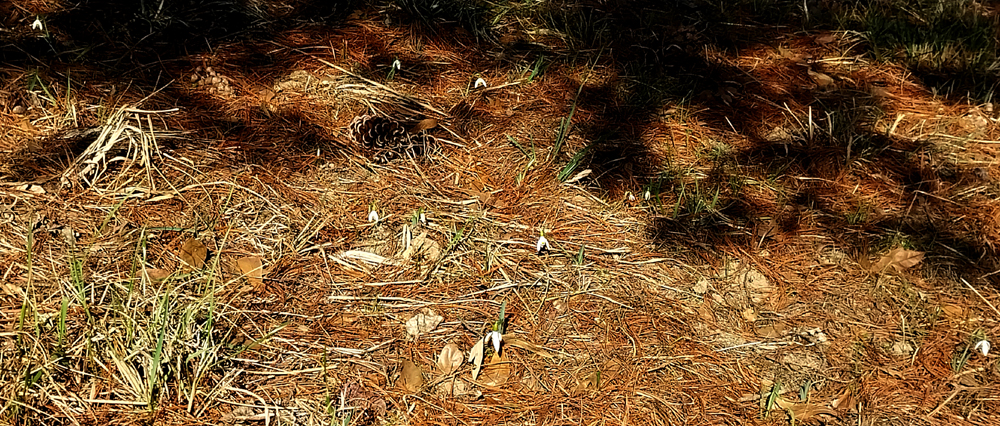
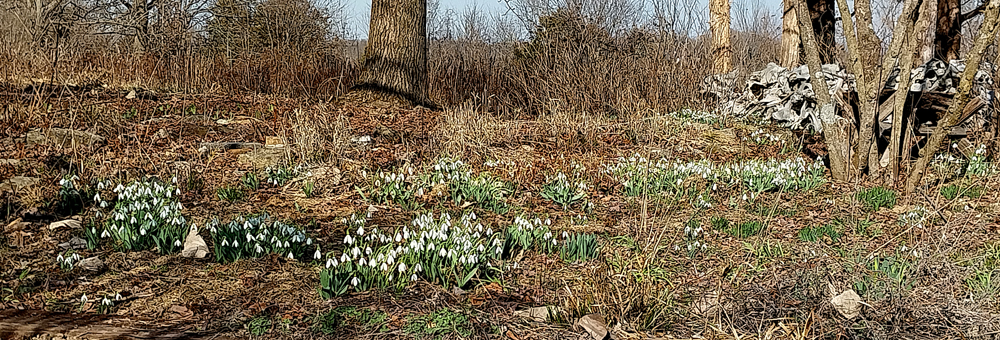
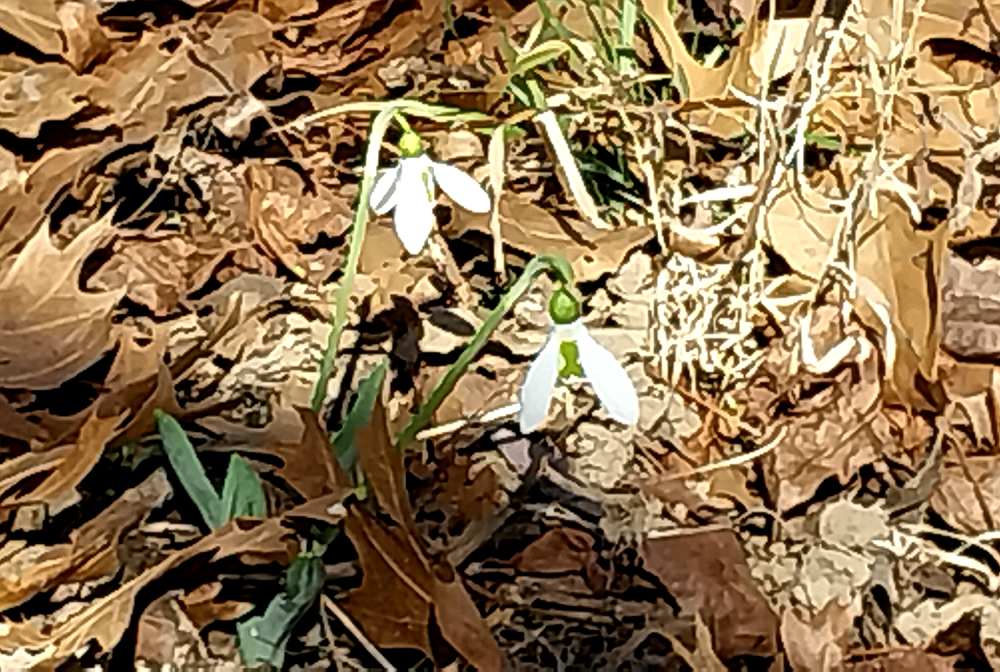
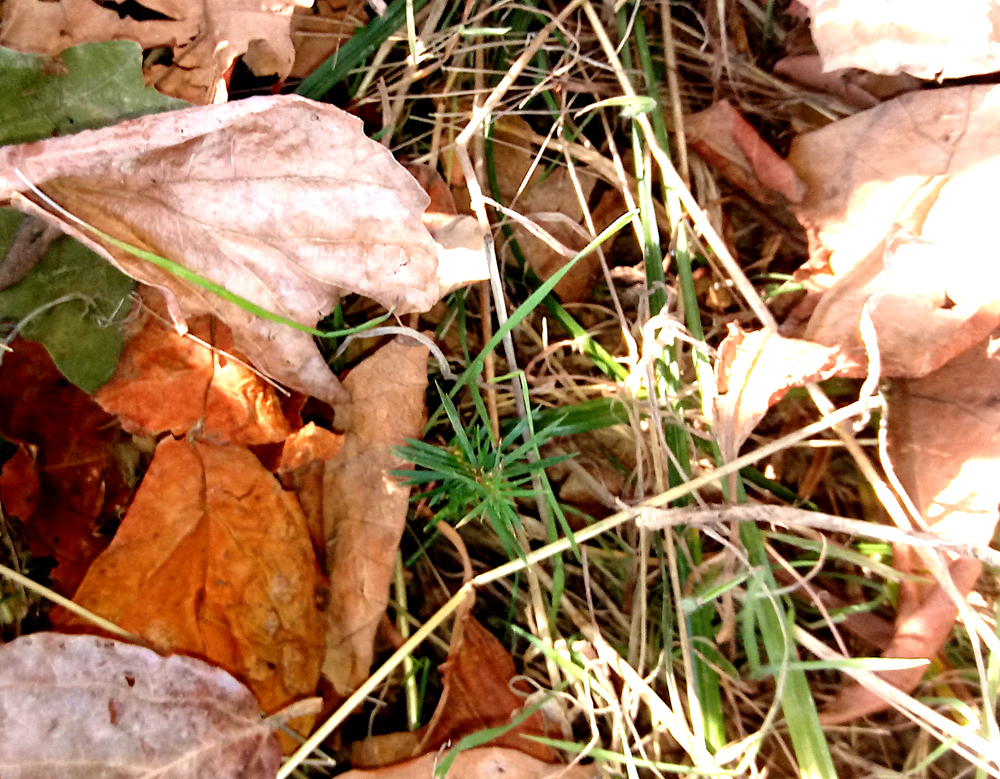
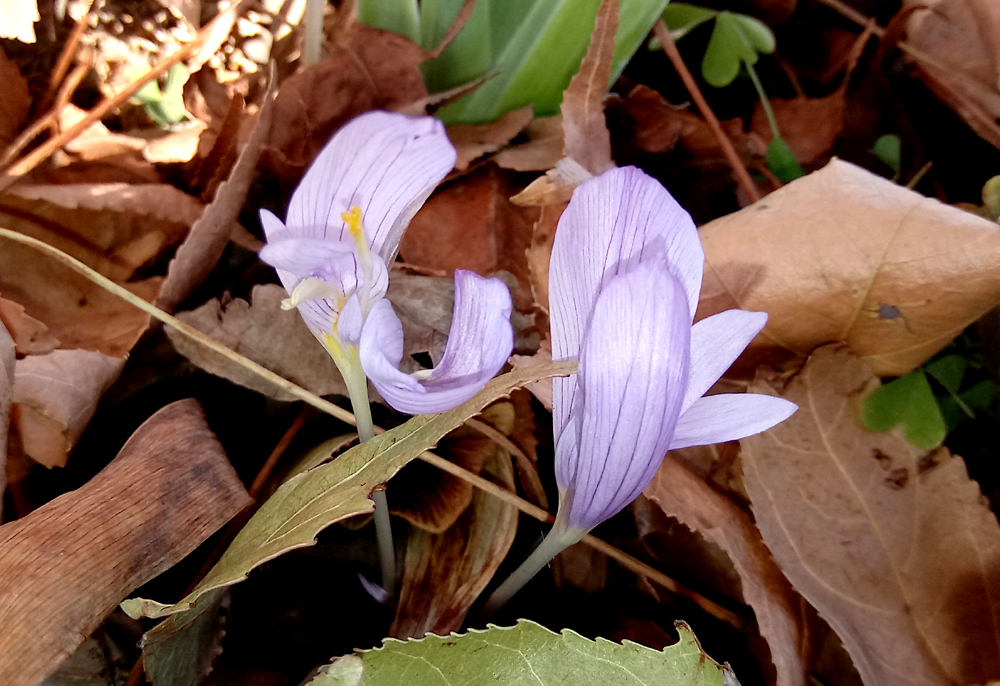
While I wait, I watch the earth erupt. I’ve noticed these snowdrops I planted last fall. Remember the tiny bulbs I planted under the short leaf pine? This is what they did this year. I never expected any of them to bloom. That tells me they like the space under this pine and in 40 years they might spread like these have.
Snowdrops after 40 years.
Here you’ll see the snowdrops I planted 2 years ago. This avenue in between the witch hazel and beauty berry shrubs has become one of those magical spots I used to find in childhood. Cozy, quiet, away from everything and everyone, a secret hideaway to play with sticks and look at all the wonders high and low. Humming, singing, pretending.
The soil inside this little woodland will make any plant want to luxuriate. As I dig holes for the Little Beauty miniature daffodil, (I had to move them out of a newly made path), the bulb almost leaps out of my hand into its new home. Snug inside, soil pressed, I scoot on to plant another bulb, feeling like that child I once was.
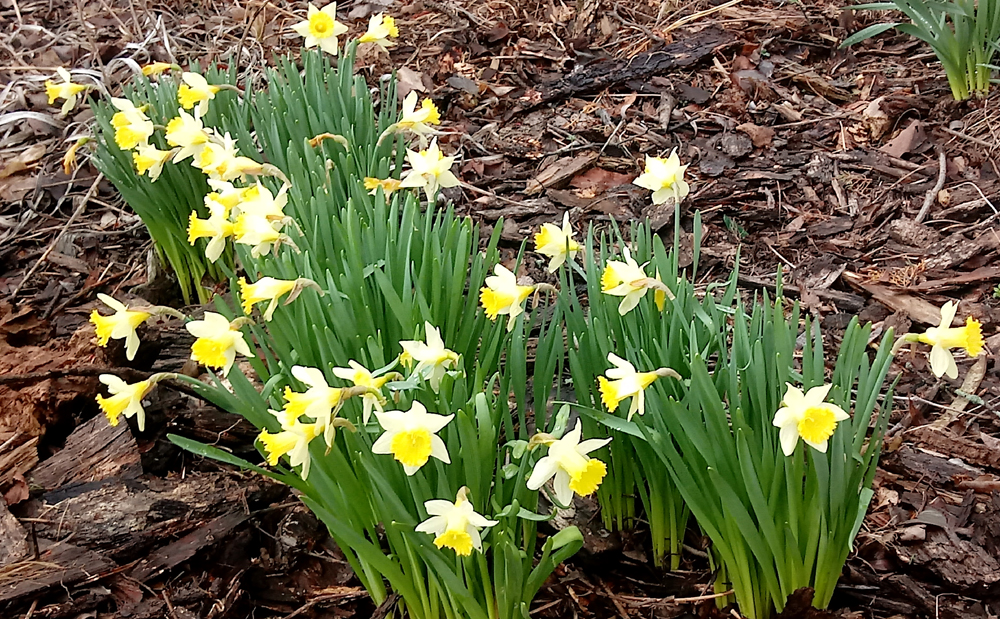
Down at the bald cypress I saw that some native bamboo canes crowded out the blooming daffodils. With pruners in pocket I sat again in a cozy spot and cut canes. Stretching, reaching underneath other canes, to find the offenders who smother the daffodils I saw these spring beauty leaves.
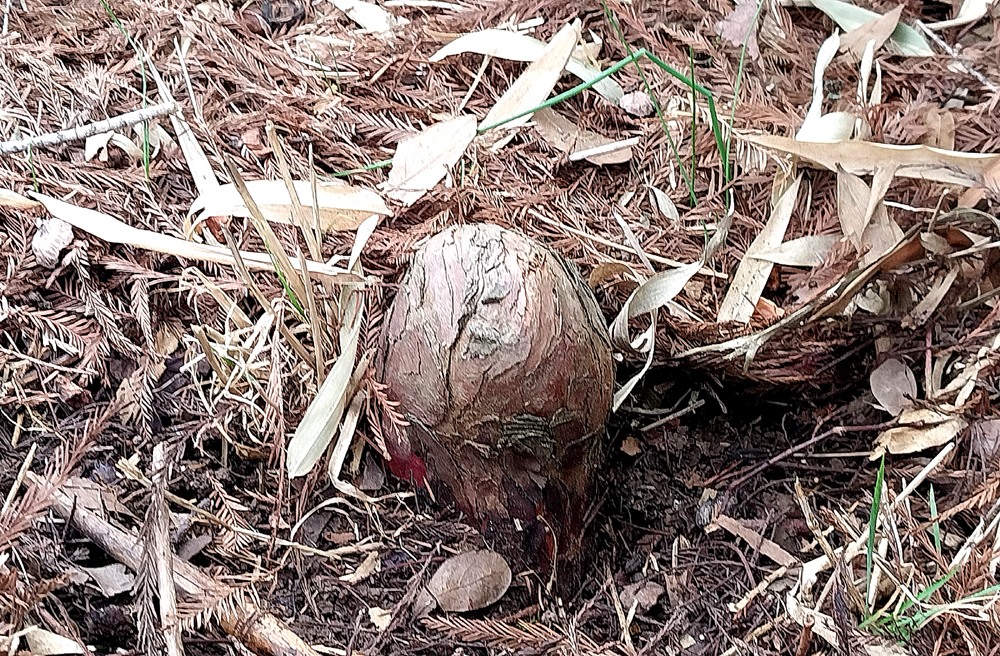
I’d rescued the bulbs from the grass last spring as this spot, under the cypress, should make a much safer spot where the mower can’t reach them. And they look happy. This cypress knee isn’t anything like in the swamps of the southeast but still, it’s a knee!
Bald cypress knee
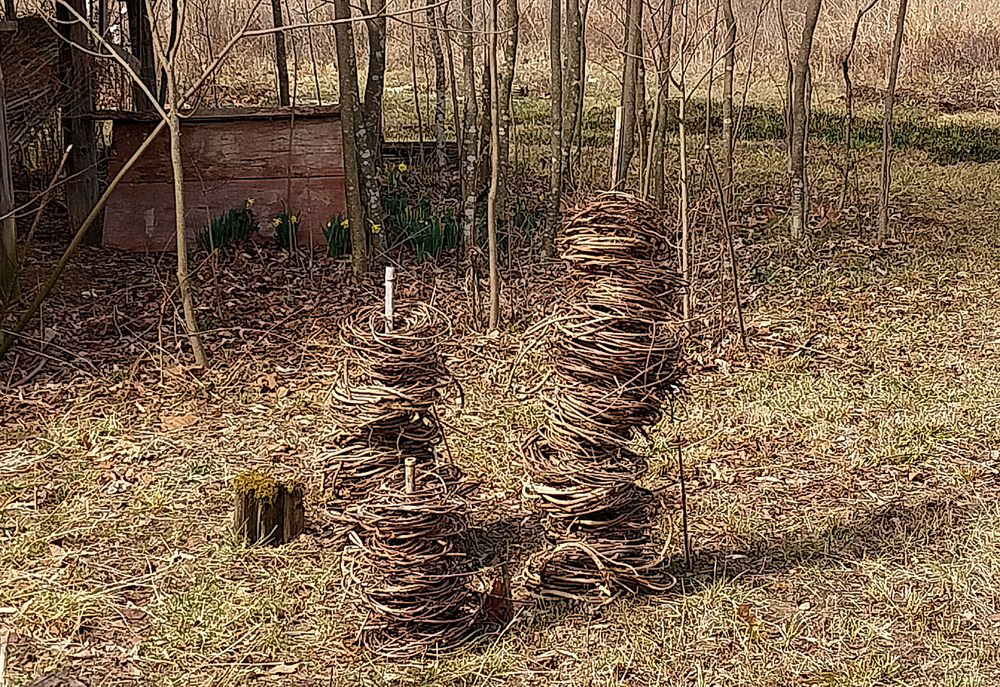
I walk by the latest sculpture and smile at my tribute to a story about Sambo and the pancakes the family ate after the tigers were turned to butter, or ghee, as they ran around the tree. Our family had the record with a picture book and I listened to the story over and over. Sambo ate 169 pancakes. In this case, the pancakes come from wisteria vines I eradicated and always thought I’d use for something. And once again, time and moisture made them mostly useless. They called out for a use and found one. It doesn’t take much imagination to see them as pancakes.
On another day I hurried to the pond as I heard a commotion. Scores, no hundreds of robins had showed up. They chattered loud and constantly except when they flew to the edge of the pond, almost circling it, and dipped their beaks down into the water, and then up, as if the action was orchestrated. I stood, not moving a hair, and watched them at their party. Oh how they carried on.
I never resist going out to the Park as something always catches my eye. The winter aconite puts on a sunny display and like dandelions they cover the ground. I like to move the tubers as the flowers just appear. They don’t resent the move and the seed that literally explodes from the pods can spread in a fresh location. Maybe these could turn into butter too.
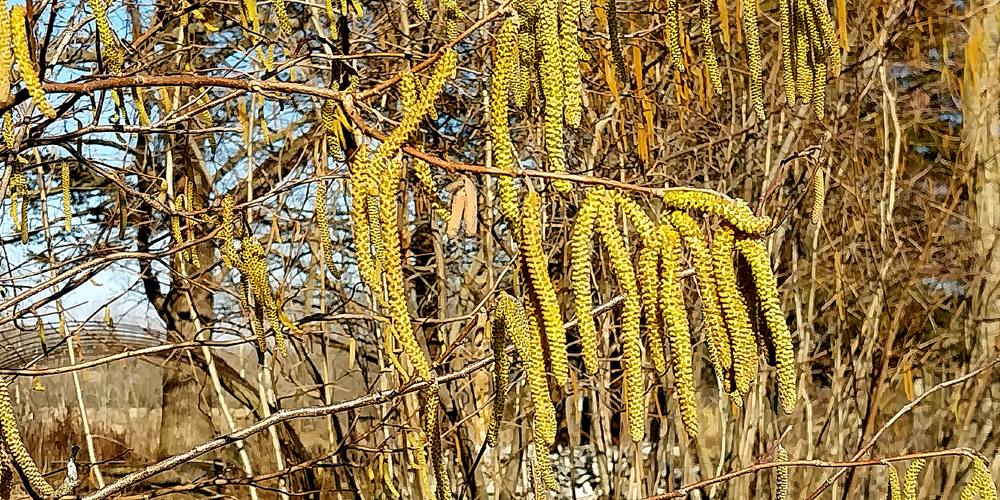
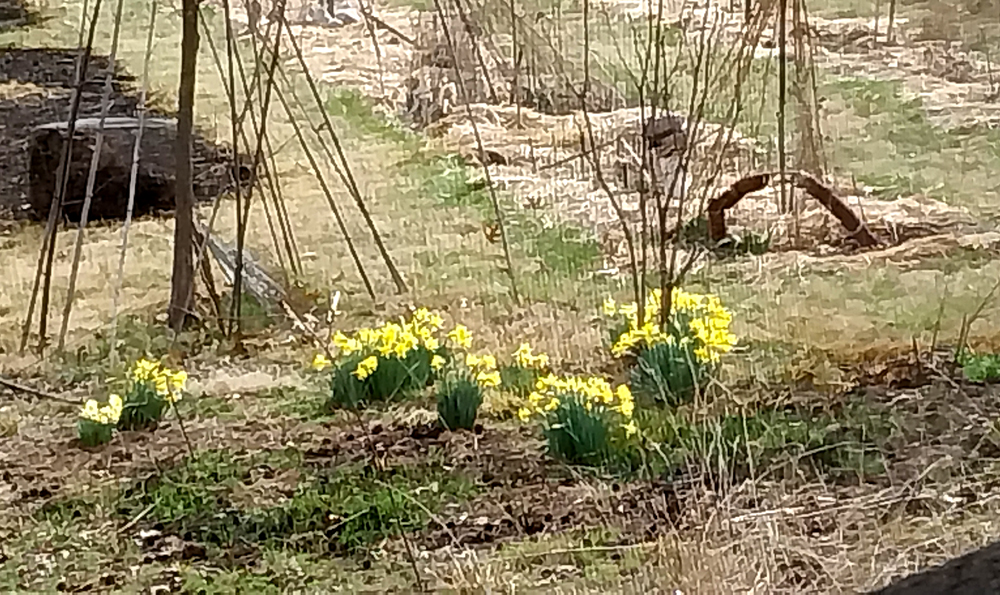
These in between days, when neither the solitude of winter nor the ecstatic energy of spring reign, give me a chance to relax and do whatever the spirit of the day suggests. I look out through the screened in porch and see the daffodils dancing in the breeze, (Wordsworth close by), the hazelnut catkins looking golden from afar. The signs and signals arrive daily. It’s a slow dance, not to be rushed until it all cascades down on us and we can’t keep up and go into our frenzied dance.
Through a screen, brightly.
Inside I admire the leaves that have opened on the witch hazel branches as the flowers fade. The veins look delicate, intricate and a little puffy, like seersucker. I have a front row seat to this unveiling and the other wonders of the in between days.
We have often spent my February birthday in a tropical spot but the last years have found us celebrating in the cold. Bud and Zoë will not let me forget our trip to Pawnee Buttes on a frigid birthday and a picnic lunch in the car. I threaten to revisit the site each year just to tease them.
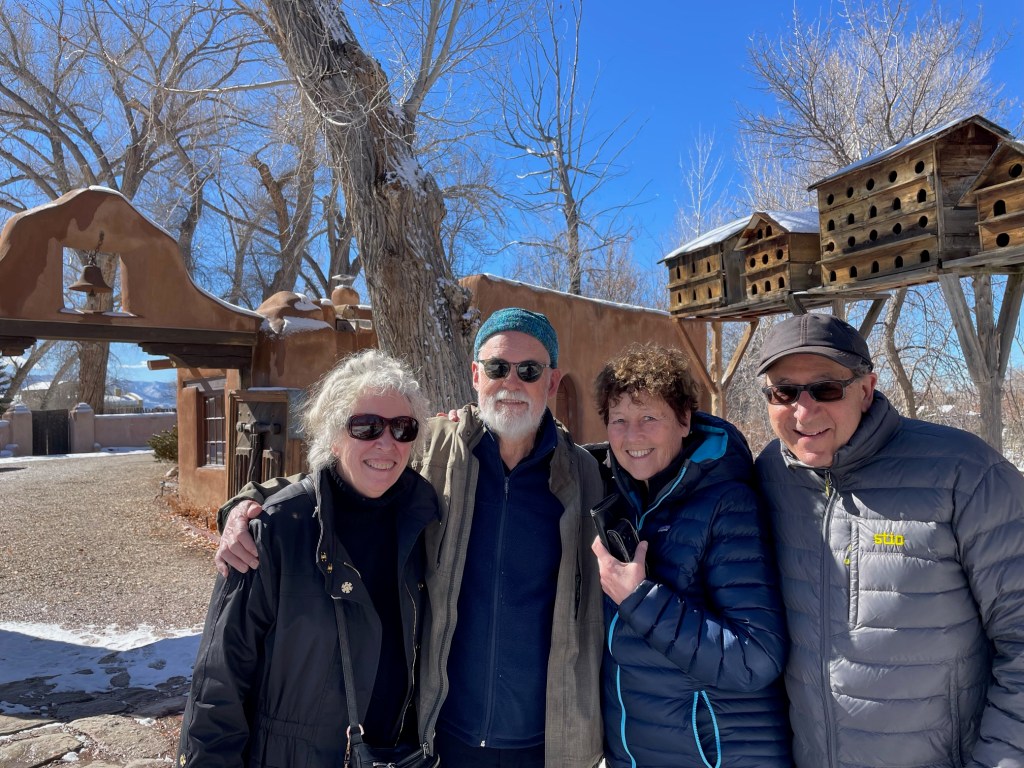
Renee, Rodney, me and Bud in the courtyard of the Mabel Dodge Luhan House.
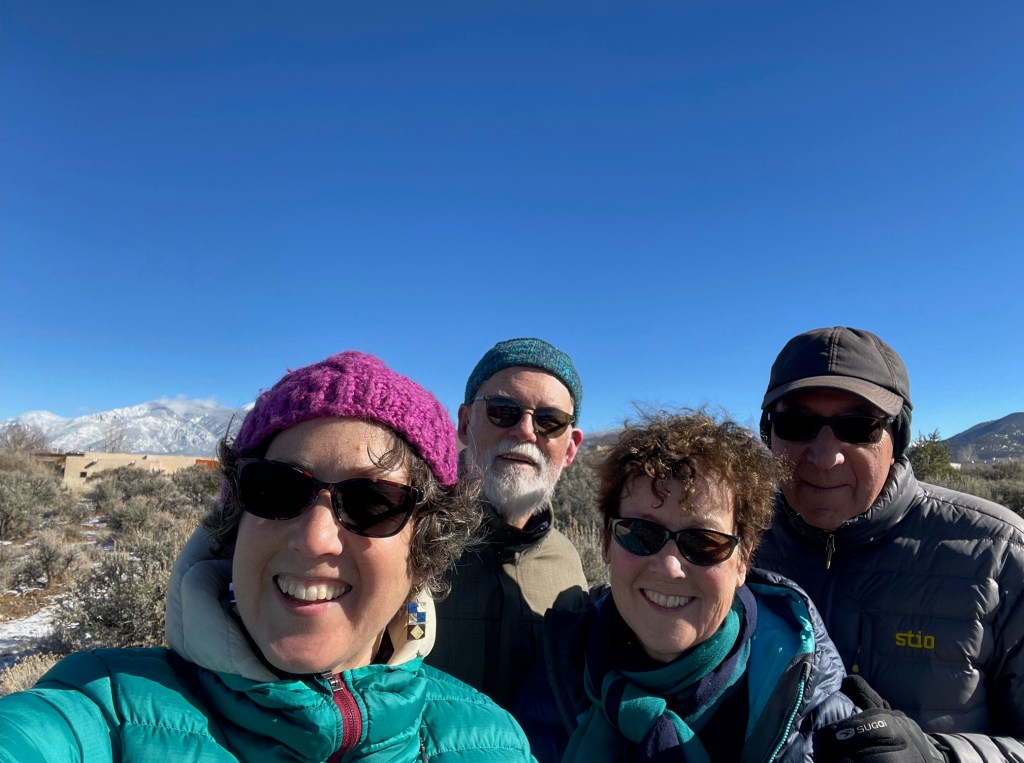
This February we traveled to Taos for a stay at the Mabel Dodge Luhan House, a place I have wanted to visit for years. We skirted snow and bad weather on our way south. The drive is a favorite part of the trip for me. Naming peaks along the Front Range, seeing the landscape open as we descend Raton Pass and winding through the canyon up and over the mountains to Taos.
Sited beneath looming Taos Mountain the charming historic inn is haunted by the many artists and writers who have stayed there. Our friends Rodney and Renee came from Santa Fe for a night and we talked and talked about our lives, aging, art, and food. I’m reminded of how important are our friends on life’s journey. Altogether a wonderful birthday weekend.
I can’t settle into any sense of winter as the weather swings from super cold near zero weeks to sunny over 50 degree days. I’ve been making salads one week, soups and stews another. Here are a couple of my cold weather concoctions.
Salmon Cakes
This dish is a trip into my childhood when we ate tuna patties for Friday meatless dinners. These are a vast improvement on those dry, rather boring patties and a nice pantry meal using canned salmon. Based on a recipe in the New York Times.
Combine 1 large egg, 2 tablespoons mayo, the zest and juice of 1/2 a lemon, 2 minced scallions, 1 1/2 teaspoons Dijon mustard, 2 tablespoons panko or other breadcrumbs. Stir in a handful of chopped dill or parsley. Add a large 15 ounce can of salmon, breaking it into smallish chunks, don’t mash it. I used salmon with skin and bones – a healthy choice – and picked out the bigger bones. Refrigerate for a hour. Form into four patties and sauté in olive oil until browned, about 2 minutes a side. Serve with Tartar Sauce:
Combine 1/2 cup mayo, 1/2 cup chopped dill pickles, 2 tablespoons finely minced red onion, 2 teaspoons capers, 1/2 teaspoon lemon juice, 1/2 teaspoon Dijon mustard, and some chopped dill. (I didn’t have capers but it was tasty without them.)
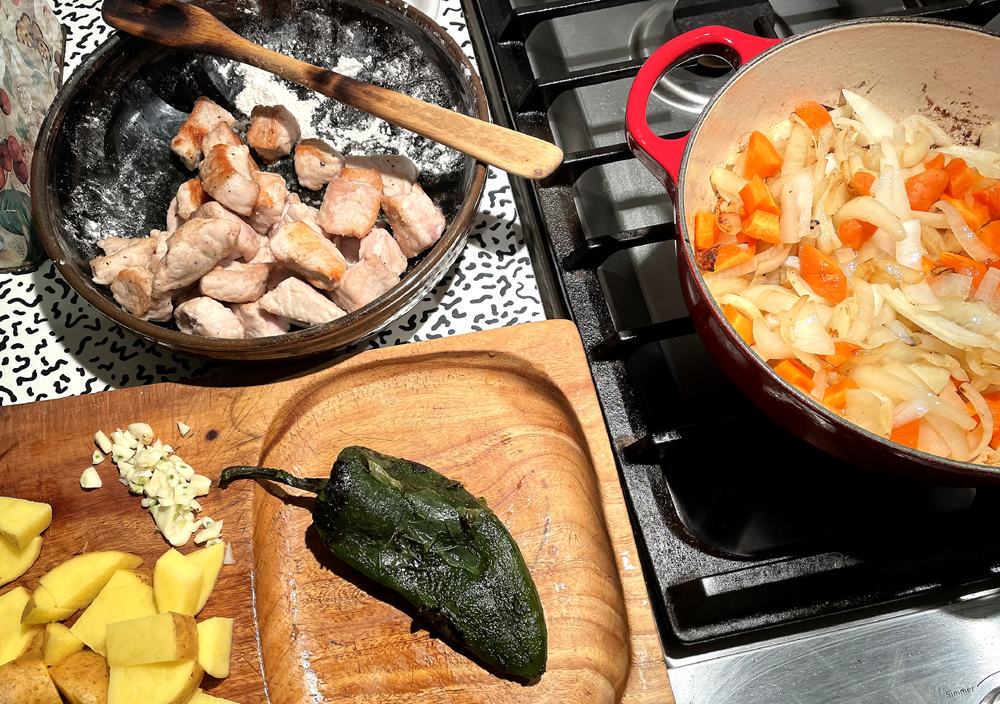
For dinner one cold night I made a pork and green chile stew. This is a free-form recipe so use what you have, in quantities you prefer, i.e. more chilé, meat, or other veggies – fennel would be nice here. I bought a pound of ‘pork stew’ at the butchers. You could use a pork shoulder cut into cubes, most of the fat removed.
Toss the meat with a few tablespoons of flour seasoned with salt and pepper. Brown in 2 tablespoons safflower oil and set aside. In the remaining fat cook a large sliced onion until translucent, ten minutes. Add a carrot and a large Yukon Gold potato cut into 1/2 inch chunks, and a few cloves of garlic, chopped. Deglaze the pan with a little water and scrap up the tasty bits. Return the browned pork to the pot. Add 2 roasted, peeled, seeded and chopped poblano peppers, a bit of salt and pepper. Add water to barely cover and bring to a simmer. Cover and let cook gently, do not boil, for an hour until tender. Add water as necessary for a brothy stew. Season to taste with salt and pepper. Serve with a handful of chopped cilantro, additional hot sauce, and corn muffins. Find the recipe at https://howilearnedtocookanartistslife.blog/2018/11/25/a-taste-for-corn/
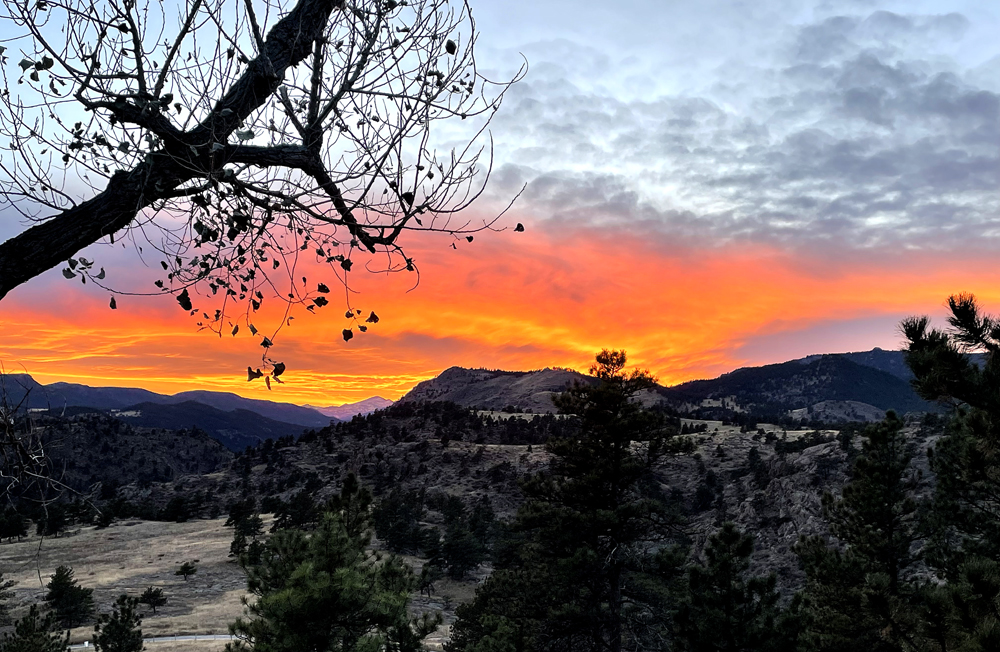
These winter days have an amorphous color and texture. Some people say they’re depressing and use terms like mid-west drab. This is the time of trees with bare branches, life buried under quiet earth, cedar trees offering the most color though if you look closely you see the expanding buds on the dogwoods, the parsley lush in emerald green. Or wait until sunset when the evening skies dissolve into vibrant colors unseen in spring. Granted the landscape does not seem overly generous. I like that. Looking at winter with different eyes helps me see the patterns of bird tracks, where the neighbor’s cat has prowled, how many persimmons the critters have eaten leaving the seeds behind; the structure of a winter landscape viewed with a quiet perspective.
The decreased light creates opportunities for both crawling inside my mind and listening to it spin and spin. Not always a pleasant experience. Recently a haunting kept me alert to the “stuff” I’ve accumulated. It was a monster under my bed, speaking, taunting me as it did when I was a child. Finally, after repeated confrontations and requests for that monster to leave me alone, I took action. I pulled out six suitcases, big suitcases, some super-sized, tucked under the beds, out of sight, out of mind for 41 years. These suitcases, filled with letters from as far back as the late 1960s, kept the mice at bay, the letters secure. But in all these years, I never once picked up a letter and re-read it. Thousands of letters. I saved them as a matter of fact. A ritual I’d go through at the end of each year. Bundle up the letters, store them, never giving thought to the day that I, or heaven forbid someone else, would have to deal with them.
I’ve had experience with overwhelming projects. They make me see stars. I want to dissolve into the ether, float away, where peace and calm reside. I wasn’t quite sure what I was doing, should I recycle everything and be done with it? My mother would do just that. In fact, she wouldn’t have saved anything. My dad would’ve saved it all and then protested when my mother said it had to go. So I approached my project in the only way I know how – organize.
I put each person’s letters in a pile. The queen-sized bed wasn’t big enough to hold the piles. Then I used boxes. I allowed myself an hour each day unless more pressing duties called. The first day I got lost in memories as I read one letter after another. Too many memories stuffed inside me all at once. My mind spun. Voices echoed through the years. I had to have a firm stopping point to avoid unraveling. “I’ll never finish this.”
Piles, piles everywhere! Some from family, my niece, my sisters, my daughter, my ‘other’ daughter whose letters made me burst into hysterical laughter. Letters from high school friends, college, the Ribeiros in Brazil, from grade school, gardeners I’ve met from around the world. From casual acquaintances who wrote thank you notes, old loves, my mother and father, friends I cherished who have either passed or simply passed from my life. Some memories made me sad, some made me laugh, others made me feel fortunate to have known those people. When my hour was up, I’d go outside, breathe in the cold air and refocus.
Outside I’d begun another project with accumulated stuff. The old rabbit shed where I’d stored 400 bamboo canes had a collapsed roof, right on top of the bamboo. In order to move the canes, the tin and then the lumber of the shed had to come down. It’s that old saying about how one thing leads to another. I felt like a juggler who had lost the art and had to re-figure how to keep many things in the air. Or like with pick-up-sticks; having to decide which stick you have to move before you could move the next one. I stood in the winter cold with a blank look.
It soon became clear that deconstructing the old rabbit shed came first. That was easy once I relaxed. I called Patrick, my friend and good neighbor, and asked him to help. He said, “I could do it in 10 minutes but I suppose you want to save the wood.” (He’s seen my ‘museum’ of curated lumber.) Of course I did. That voice spoke to me, “there you go, saving again.” Ahhh, I plead guilty. I can’t help it, I just can’t help it.
Patrick and I took our time, the nails did not give up easily. We carefully took out each one, hammered in thirty-eight years ago, stacking the barn wood that came from Goldie’s sixty-year-old shed down in Belle, a shed Ron and I took down at Goldie’s request, forty-one years ago. Hundred year old lumber holds a special place in my heart. Patrick saw the beauty too.
Liberated bamboo
Once the shed was down, the tin in a pile for Patrick to take home, the lumber sequestered in the museum, I could move the bundles of bamboo canes. No, wait a minute! Like in pick-up-sticks, I couldn’t move the bamboo until I’d moved the basket willows out of another shed because that’s where I planned on moving the bamboo. (If you’re confused, think of how the architect of this plan felt!)
This is the sad part. I’d grown, cut and bundled all those willow rods over many years. I had dreams of making many baskets. Cutting the rods in the stools took time. I’d be down on my hands and knees in late autumn or winter, with pruners in hand, cutting rod after rod in each stool. Then I’d sort them according to length, bundle, and let cure for a year before I could then re-soak the rods and use them for making willow baskets. Like the rabbit skins I’d tanned and lost to mice with visions of making a blanket, many of the rods had deteriorated over the years, snow blowing in on them, rain falling through the holes in the tin, critters chewing on the end. An inevitable progression when life interfered with plans.
This is what happens to things we love and save. It’s the destiny of all things. The good part for me, during this process of cleaning up, letting go, was the recognition that we and everything are the stuff of stars. Atoms and molecules simply get rearranged. It’s our minds that get in the way. We want to hold on to what went into making us who we are. And we can, but only for a while, until the time comes for those objects to rearrange themselves in a new configuration. That simple thought lightened my mood, made me release so much of what I was holding on to, inside my head and physically. I did a little jig. I appreciated my optimism when I cut those rods and dreamed of baskets I’d make, the memories the letters held, and the beauty of the weathered lumber from Goldie’s shed.
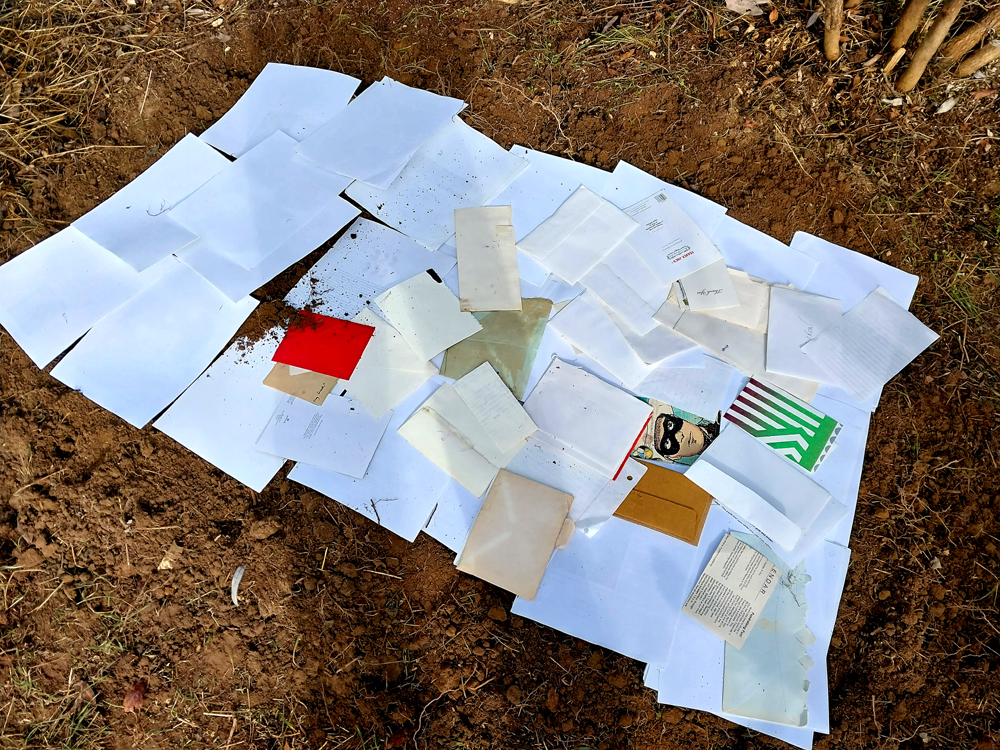
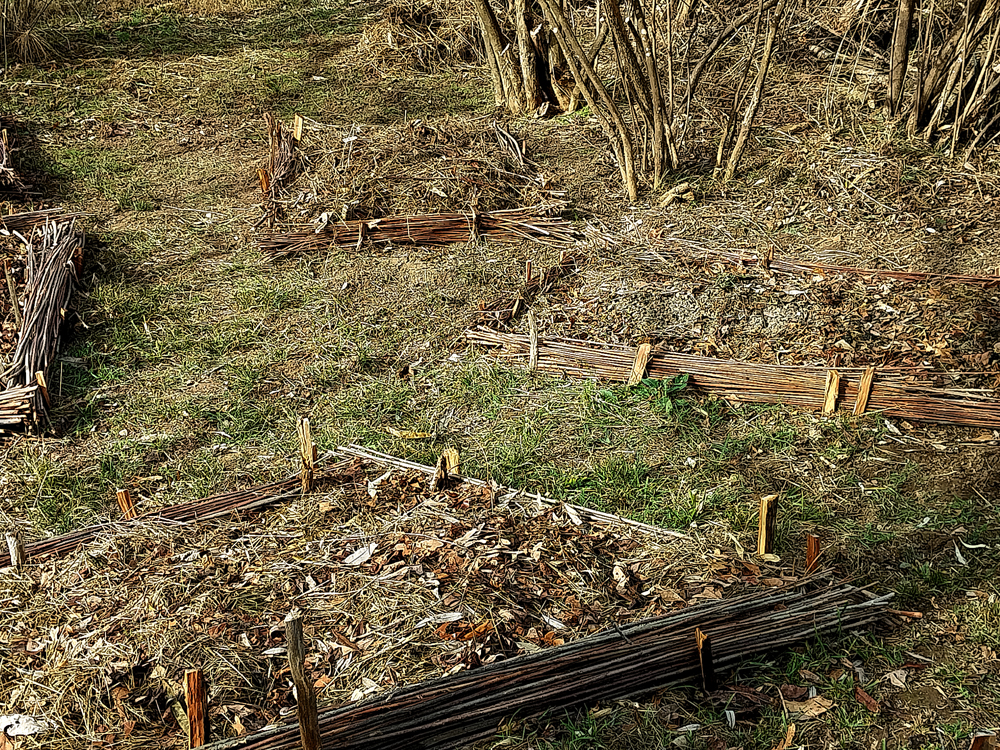
As I moved the willow rods out of the shed, I began to see how I’d use many of my saved objects. I saw a way to be the architect of the destiny of these things. I’ve promised Brother Cadfael I’d help him prepare the new garden area I’d given him. The garden’s edged by vitex shrubs on the north side and lilac shrubs on the south. In between these shrubs, brome and foxtails and other grasses grow. I’d make Brother Cadfael faux wattle-edged beds in that in between space, using the sad, old willow rods to frame the beds. Letters would cover the bare soil of each bed, cardboard over the letters, then leaves, grass clippings, compost and wood ashes as the cherry on top. I’d use the cedar pieces I’d saved for the stakes to contain the wattle fence … I was figuring it out, seeing the potential once I’d embraced the idea of reconfiguration and letting things go. And it felt wonderful!
I checked with Brother Cadfael to make sure he liked my idea. He was delighted. “You know the beds in the monastery garden had real wattle fences. Some of the young novitiates helped me weave them. The smell of willow has been dear to me. Flowers and herbs will grow in each bed. The buried richness will make them grow well. I have my memories. They’ll rest in this garden too. Thank you my friend.”
After consolidating the letters I’ll keep from those I’ll give to Cadfael’s garden, the keepers fit in two shoe boxes. The suitcases sit empty, waiting to go to thrift stores. I feel divested and free. The monster under the bed has long disappeared. I landed the final blow by opening the suitcases and releasing whatever lived inside them. People have called and written about the letters they asked me to send. One man, the son of a neighbor, was thrilled to read his mother’s letters to me. He said, “She told you things she never told me.” Another gardening friend called and made plans to come visit.
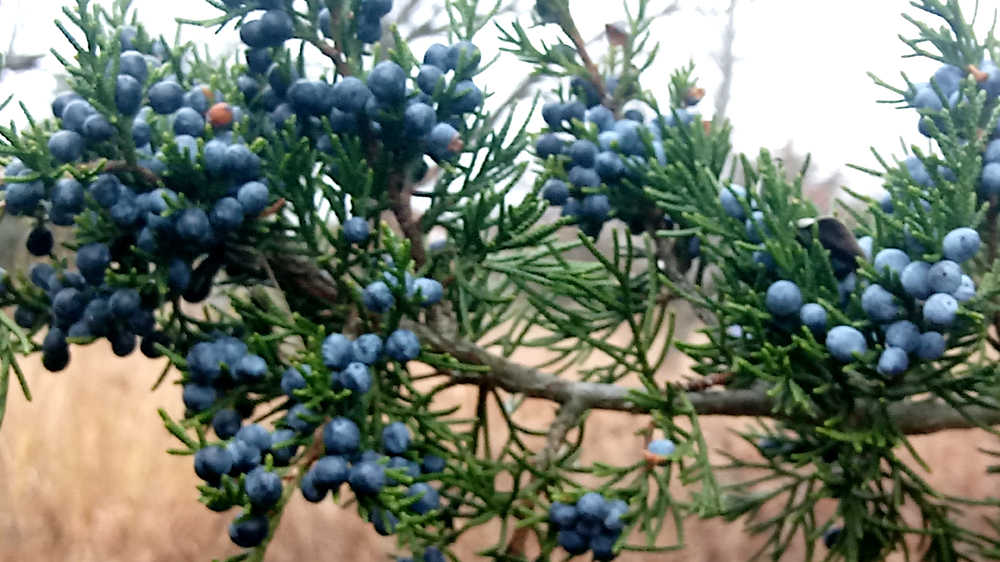
My eyes rest on more winter delights. Look at these cedar branches! Rich with beautiful berries. I watch a hairy woodpecker chase a black capped chickadee from the suet and laugh at his selfishness. There’s a blue jay by the bird bath, pecking at the ice, telling me to bring hot water.
Bare soilLetters over bare soilNow the cardboard
And you can see the process I used to create the beds in Cadfael’s garden. Still two beds to make and probably more work in the future when things don’t work out quite right. What a grand project of reconfiguration! And you dear reader, will be the only ones to know the origin of these gardens. I wish you well as you figure out how to let go of your stuff and move on. Happy New Year.
A crisp, cold day at Heil Ranch hiking with Moira.
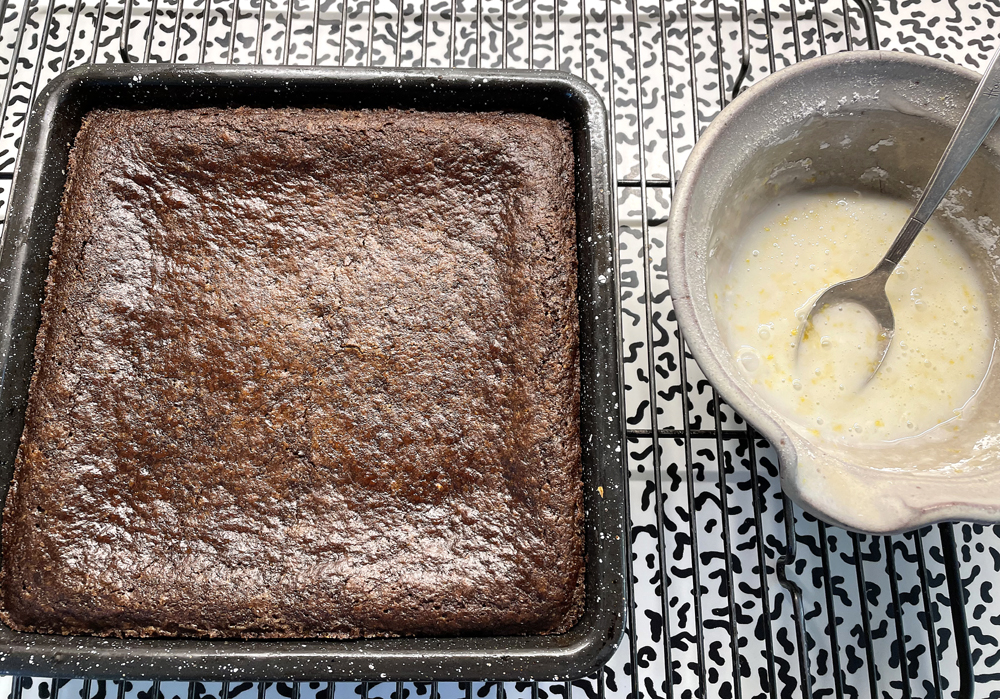
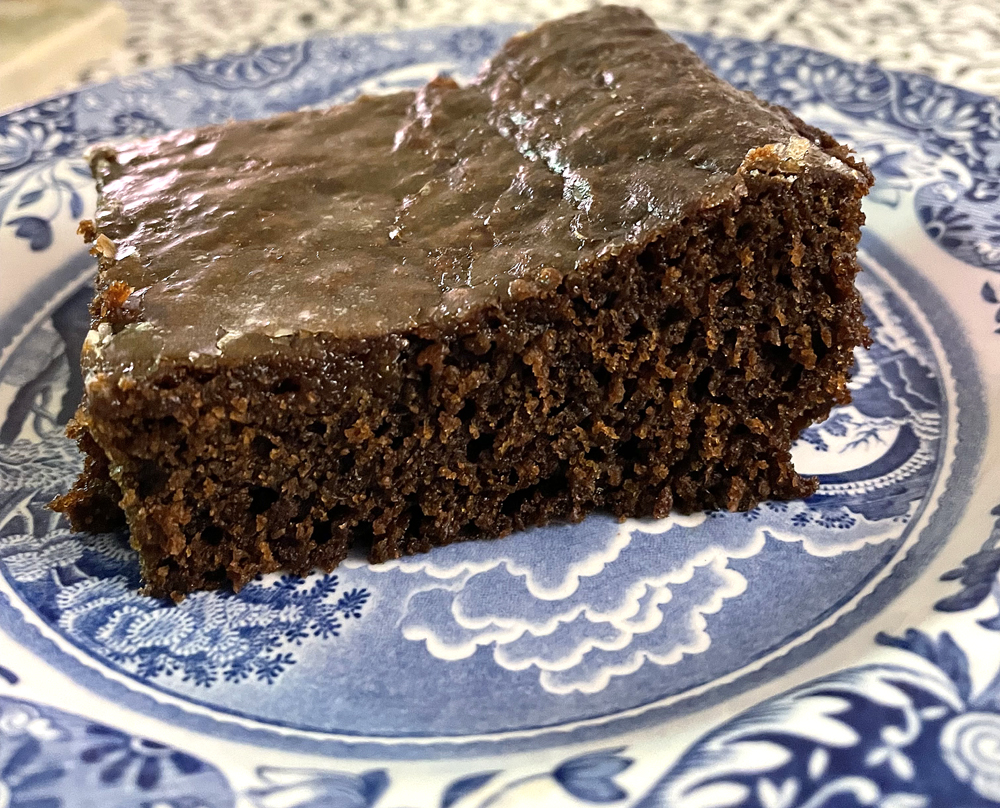
We had four inches of snow on the ground this morning – winter is on its way. As we approach the solstice, I start dinner preparations at 4:30, following the prompt of the fading daylight. When I realize it’s too early for dinner I may decide to make a dessert. I hunger for spicy, deep tastes. Gingerbread fits the bill and perfumes the house with irresistible aromas. This is an easy dessert to prepare at the last minute, requiring about 15 minutes of prep and 25 minutes of baking. (It’s also dairy-free.) My mom served gingerbread with a dollop of whipped cream. We sometimes add a scoop of vanilla ice cream. I like it plain with a cup of coffee or tea.
Gingerbread
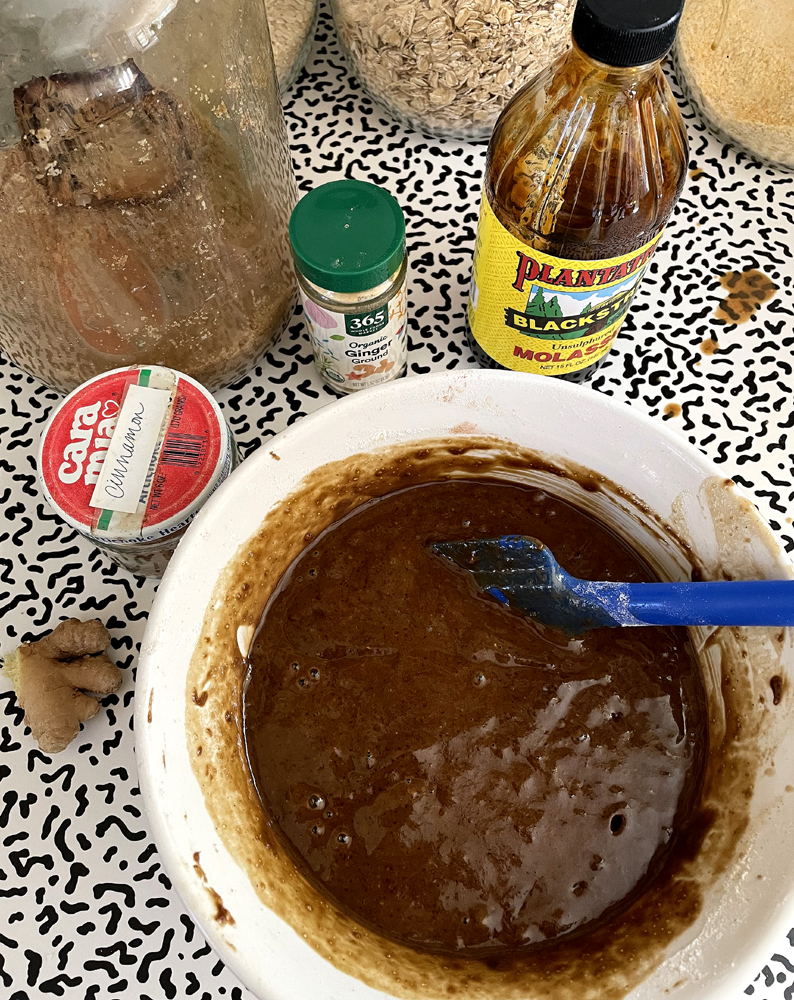
Combine 1 2/3 cups unbleached flour, ½ cup brown sugar, 1 ½ teaspoons baking soda, 2 teaspoons ground ginger, ½ teaspoon cinnamon and ½ teaspoon salt. I add fresh ginger for an extra punch, about a 1-inch piece, finely grated or chopped.
Stir in ½ cup blackstrap molasses, ½ cup safflower oil, and 1 large, beaten egg. Add ½ cup boiling water and mix well. Pour into an oiled and floured 8-inch square pan and bake at 350° for 25 minutesuntil firm and a toothpick tester comes out clean.
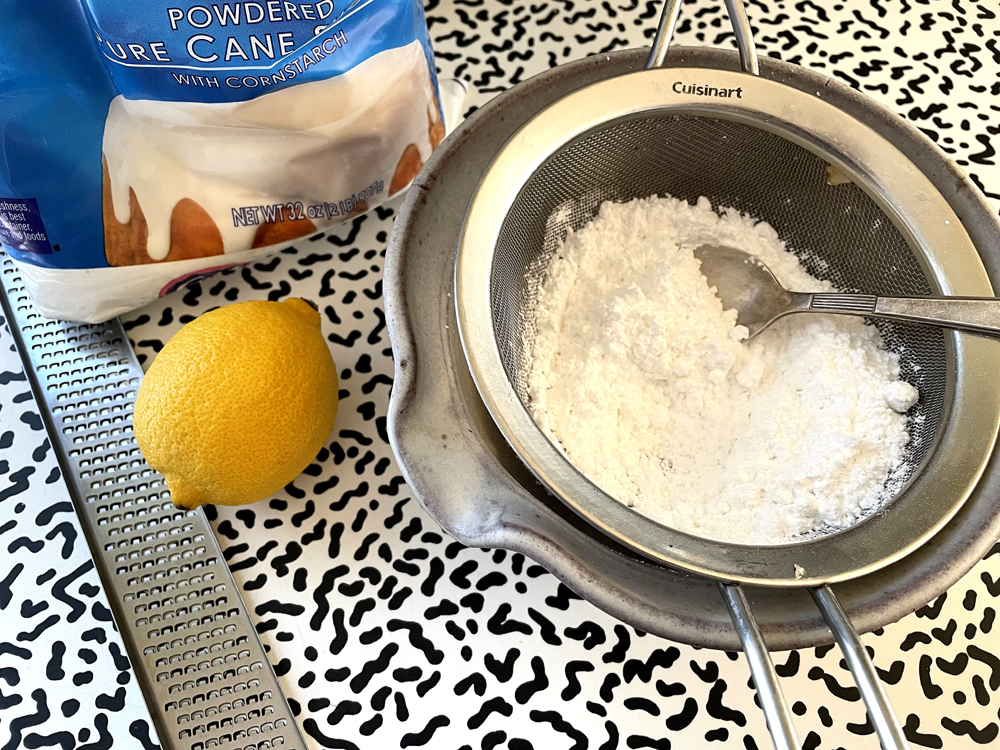
Make the glaze while the cake is baking. Combine ½ cup powdered sugar, shaken through a sieve to remove lumps, with a big pinch of zest and enough lemon juice to make a pourable glaze, about two teaspoons. Pour glaze over the hot cake and cool on a rack.
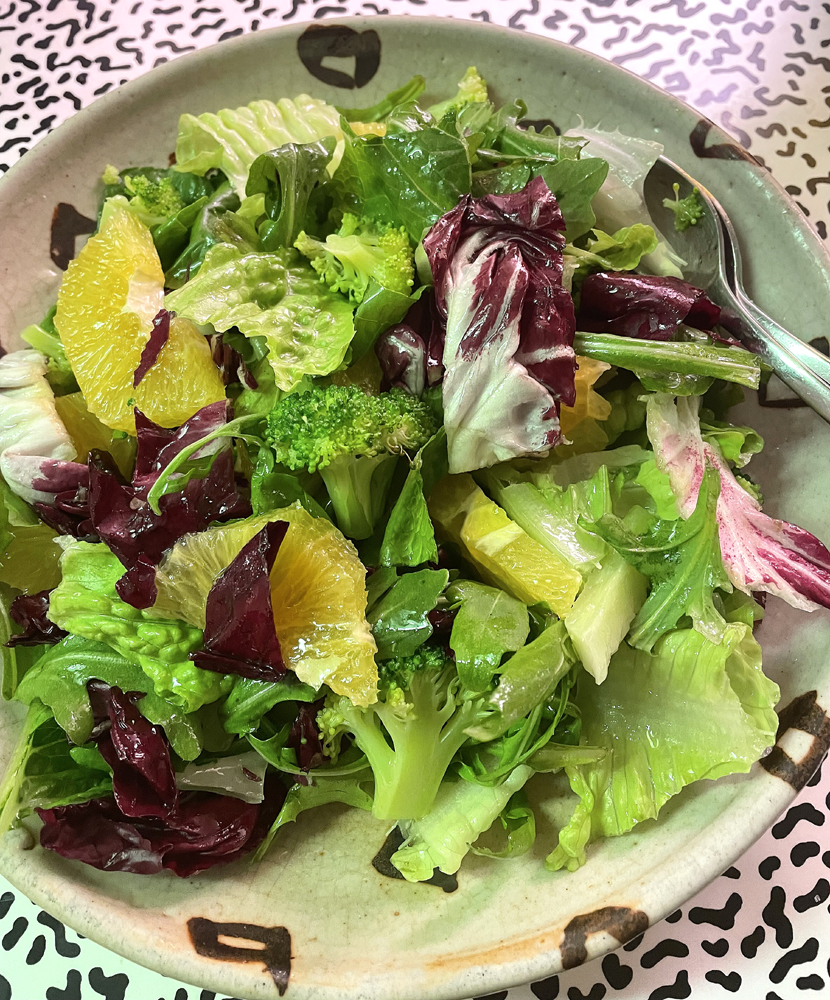
Our current choices for winter vegetables are limited so I’m always looking for new ways to use them. I like to mix up our dinner menu and include our veggies in a salad. This salad tasted great alongside an omelette filled with marinated goat cheese. (below) Or serve with a sautéed chicken breast, grilled salmon or a chop.
For two servings, steam a large stalk of broccoli until tender but with a little crunch. Cool and cut into bite-sized pieces, including the peeled stalk, the sweetest part of the vegetable. Combine with salad greens – lettuce, arugula, radicchio, endive.
Add an orange, peeled by slicing off both ends, then cutting down the sides to remove the skin. Cut into half-moons. Add two dates cut into ½ inch pieces. A handful of chopped fresh dill is nice here if you have it, or use a big pinch of dried. Toss with a good olive oil, salt and pepper.
I’ve been embellishing a log of Trader Joe’s goat cheese with lemon and olive oil. What a treat served with a crusty St. Vrain Market baguette, a loaf of Moxie sourdough, or in an omelette.
Crumble a log of plain goat cheese, 4-8 ounces, into a bowl. Keep some chunks. Add the zest of half a lemon and a big pinch of hot red pepper flakes. Pour over two tablespoons of olive oil and gently stir to combine. You may want to add more oil to taste as the cheese does absorb some.
Soon we will celebrate the return of the light. Happy holidays!
In autumn, more often than not, you’ll find me down on my hands and knees, crawling from one space to another, in search of seedlings, mostly cedar, but any tree seedling will do. I embrace seedlings I can wrest from the earth in this dry, dry autumn, part of my job description. On this particular morning, I’d gone up to our only native pine tree, the shortleaf pine, in the south 40, to plant snow drop bulbs. I saw a vision of them blooming on the slight slope in February’s to come, so that when I looked out the bathroom window, I would see a congregation of beauty and promise on a sunny winter’s day.
Down on my knees, marking where I’d plant the bulbs, I saw one cedar seedling after another, I couldn’t go a few inches without coming across another one. You can’t see these tiny sprigs of green from a standing position, they simply blend in with the grasses and forbs. As soon as you spy them a few feet from your eyes, like a child, squirrel or bird would, they come into stark view. Luckily all the pine needles made the soil under this lovely shortleaf pine loose so that the seedlings pull with ease as the root system has not developed a strategy, yet!, to make removing difficult without a trowel and moist soil.
Cedar, deciduous holly, mimosa, redbud
I keep saying I’ll collect the seedlings of one variety so I can authoritatively declare how many seedlings I’d pulled. A kind of bragging I guess. But I get tantalized by the pulling and finding so that I can’t control myself and like a child at Christmas, I go after them with crazy determination. As I pull and toss, I think of the birds that have perched in this pine tree, making the contribution of a cedar seed that had passed through their digestive system onto the soil below. I celebrate their honoring this beautiful tree with their presence, their song and don’t begrudge the seedlings they leave in their wake. Now the mimosa and redbud seedlings are another story! No bird sows those, the wind does, blowing the seed pods every which way, driving the head gardener to a frenzy of expletives. I laugh at her temper over something beyond our control but I must confess I sometimes feel the same way.
The snow drop bulbs rest in the earth, cedar seedlings lay on top of the soil, a pleasant hour’s work. I go about other autumn chores, like splitting cook wood. Not too much time passes before the Three Musketeers, father and two adult sons, who I’ve watch grow from babies into manhood, come with a trailer load of heating wood. We banter like old friends, they tease me about the scars on my ax handle and I blame the missed strikes on a “friend”. We all laugh and they go about their work while their two young sons, 6 and 8, appear, running around with boundless energy.
Luscious persimmons
Now I watch these boys grow up. Braxton, the younger, goes to the deciduous holly tree and asks me if those red things are apples. I look at the tiny berries and can see how through a child’s eye they may look like apples, so I say if you’re a tiny creature they might seem like something big, but then say, “Follow me” and I take them to the persimmon tree, loaded with fruit. They’d never tried one before. Drake bites into one from the ground as I’d instructed them and says, “Yum. That’s good!” I remind them again not to pick any off the tree until we’ve had many cold, cold nights. “Why?” Drake asks. I tell him if he bites into one he’ll never forget how it puckers up his mouth and how the awful taste stays with him.
The persimmon tree and the Shumard oak tree share the same space, touching each other, so it only took a moment for the boys to start finding the acorns under the tree. They loved the caps on the acorns and started picking them up. I went back to the house for a basket as they would find one cap after another that fascinated them. Then I told them how the native Americans made meal out of the meat inside an acorn. (To do this, “the acorns were dried for a year, shelled, winnowed to remove a thin inner shell, pounded into flour, sifted repeatedly through finely- woven baskets, leached by rinsing in water, then cooked into a mush like grits.”)
When they found a cap and acorn intact, they wanted to see what the meat looked like inside the acorn, so I went back for a board and hammer. Through the years we’ve hammered enough hazelnuts to demand a board with grooves chiseled into it so the nut would sit properly and not roll off. The boys watched me crack open one acorn, then of course they wanted to do it. They cracked open one after another, never once hitting their fingers, though they had warned me not to hit mine. They were fascinated by the grub inside each acorn. I pointed out the tiny hole in the shell. Of course they had to hold the acorn to see the hole up close. “That’s where an acorn weevil laid an egg inside the acorn in the summer and that egg turned into this grub.” Braxton asked me to move the grub off the board so he could crack open another acorn. He didn’t want to touch it whereas Drake would’ve squished the grub without a thought. How curious and wonderful the differences among us.
The three of us were down on our hands and knees, collecting caps and acorns and cracking them one after another. They accepted me as one of them. “Look at this one!” Drake would shout, and show me a cool, perfect cap, not damaged by a squirrel releasing the nut from the cap. Then I’d find a cute little acorn with beautiful cap and show them. I told them I’d string the acorn caps and they started to collect in earnest and we had a nice basketful by the time the Three Musketeers came over and saw us crouched together in a tight circle.
What a sight that must’ve made to their eyes, to see the three of us playing together. As they peered down on us, they looked like giants to my eyes now accustomed to being a child. Talk about walking through the looking glass, if only for a short while. I’d entered into the world of the boys. And I liked it.
When I stood up I became an adult again. The spell was broken. Drake had pulled a persimmon off the tree and started to eat it. His face puckered up something terrible and he exclaimed, “Oh Mimi, why did you let me do that! It’s awful.” The men started laughing and so did Drake. The boys left running with a whoop and a holler. Quietly, I did the same.
A wonderful event in Fort Collins – the opening of Kestrel Fields, a new Natural Area.
The autumn in Lyons has been glorious and long with cottonwoods, maples, grasses and brush putting on a colorful show before their leaves fall. As the season slowly turns toward winter I remember with sadness and gratitude the wonderful summer produce from Zweck’s and the Farmer’s Market.
Here’s a conglomeration of dishes, mainly salads, that I prepared for artists over the last few months.
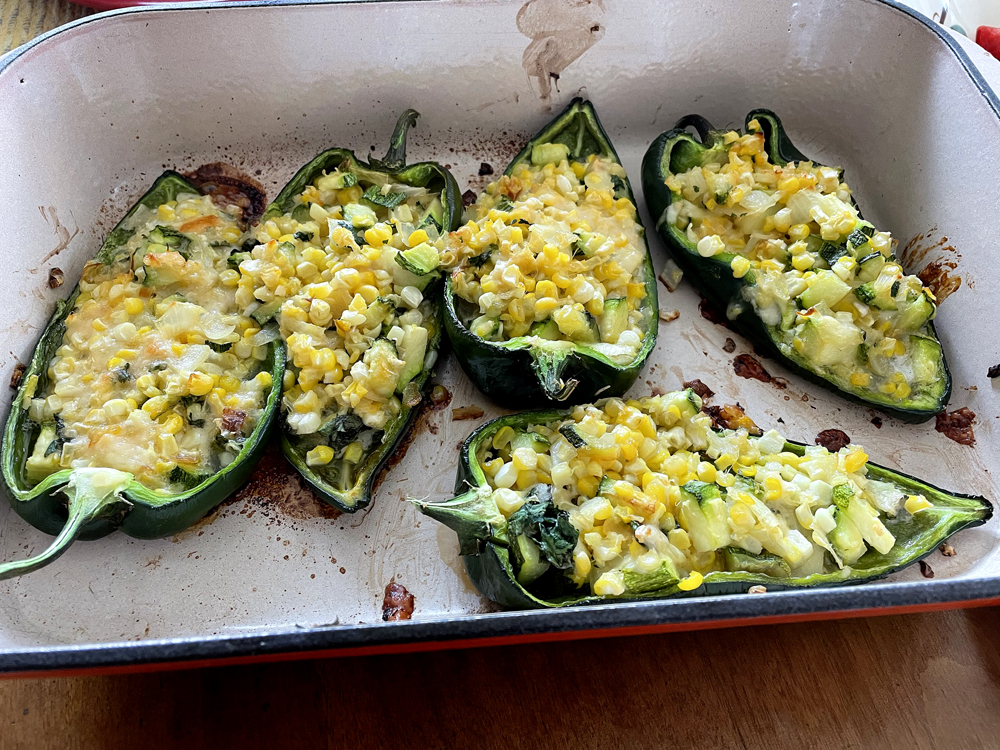
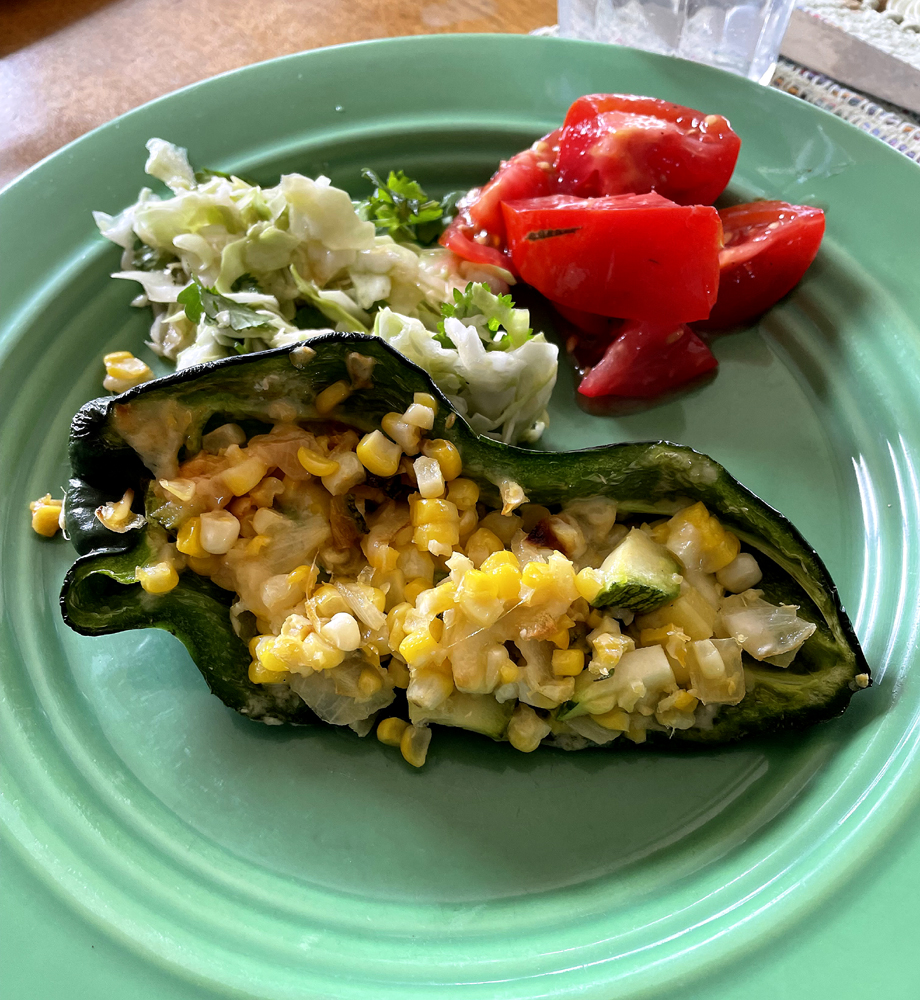
Connie and Tom Zweck grew these gorgeous poblanos. I bought some to roast and freeze and kept some to make these stuffed peppers. Filled with only-in-summer fresh corn. What a treat. The filling is simply sauteed onions, some zucchini bits, cheddar and corn. Baked at 350° until tender and bubbly. Served with those yummy garden tomatoes and a cabbage slaw.
Rancho Gordo garbanzos marinated with lemon zest and juice, garlic and olive oil. Garden tomatoes, avocado, and cilantro. Garnished with grilled fresh figs, a rare treat.
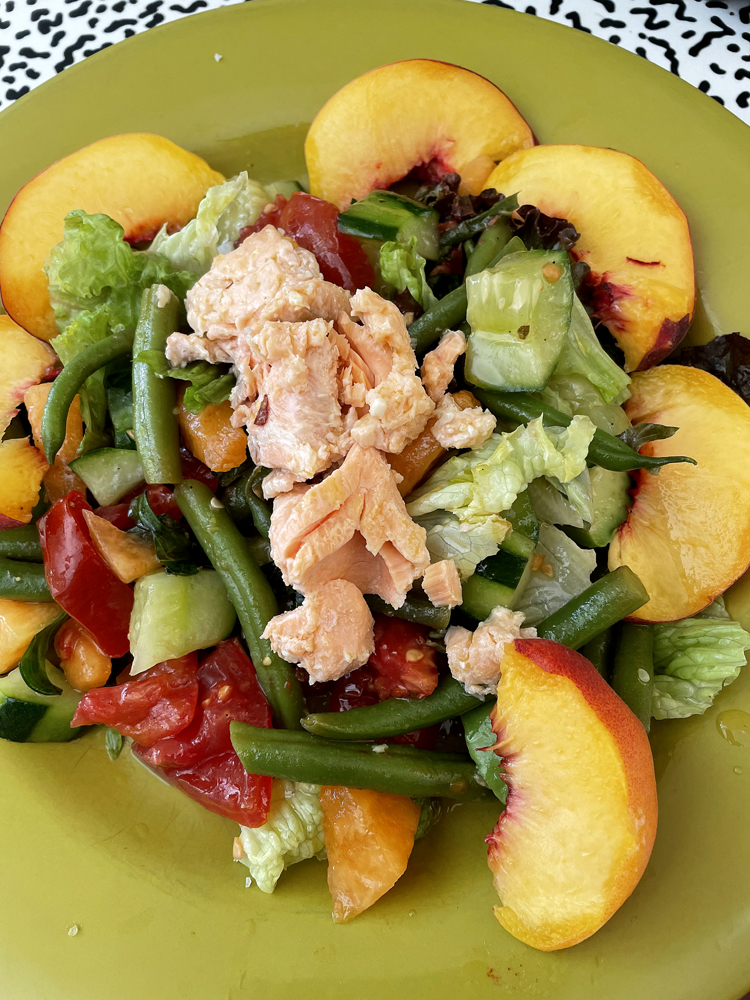
I have been buying lightly smoked salmon in a tin from Trader Joe’s. A nice addition to a salad made with lettuces, garden tomatoes, cukes, and green beans from Zweck’s and the irresistible Colorado peach. I figure we ate about 60 pounds of peaches this summer. (I did make peach salsa with some of them.)
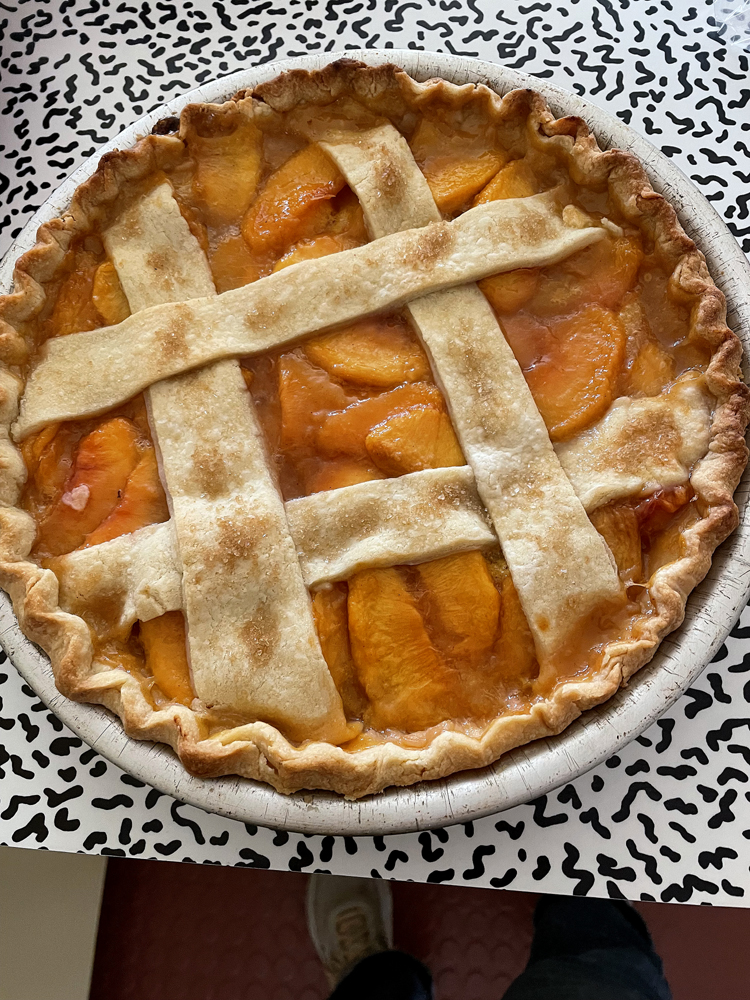
Pie, beautiful peach pie, a gift from James and Noriko. So good.
We are about to leave for The Print Fair in New York City. A week of greeting friends, clients and artists and selling prints at this annual exhibition. We will be showing new work from the last year as well as several favorite prints from past years. I look forward to eating in restaurants and choosing meals someone else prepares. I hope to be re-inspired in my kitchen after this culinary vacation and by the fall abundance of squash, apples, and root veggies.
A walk at Lily Lake looking for autumn color. The aspen leaves had flown in the strong winds.
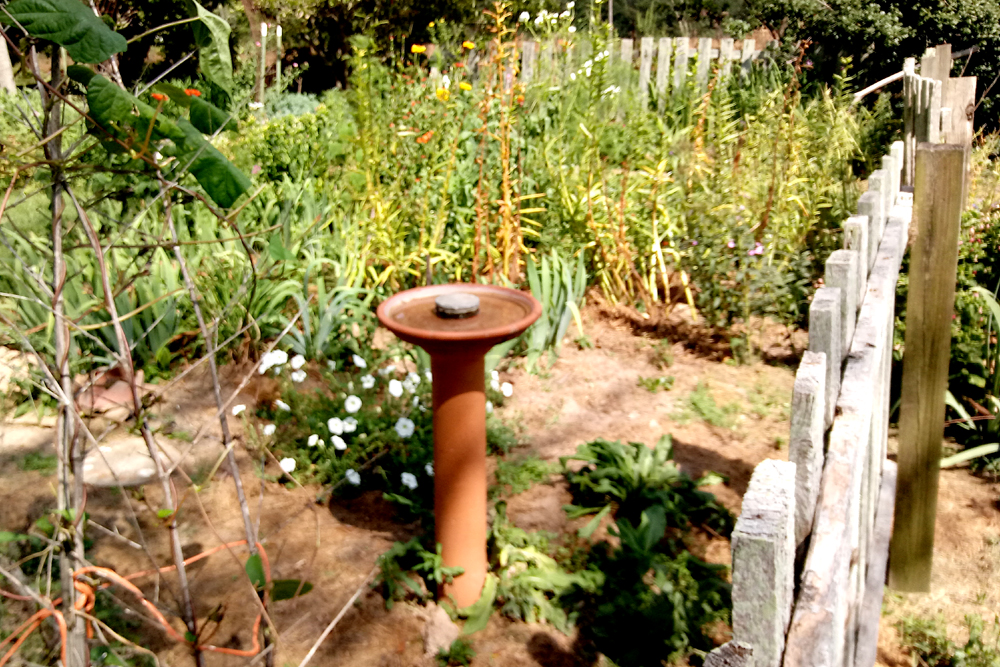
When I’m out in the Cottage Garden, near the bird bath, I think of a neighbor and friend who died from ovarian cancer in late July. Over the weeks since her old boyfriend stopped by to tell me she was gone, I would think of her every time I worked in this part of the gardens, or even if I simply filled that bird bath. Her angelic, kind face would smile at me and she’d say good morning, her eyes would twinkle. I’d find a lump in my throat and not be able to speak for a while. On this particular morning I hung my head in quiet meditation and gave my thoughts to Patty.
The Cottage Garden (undergoing renovation)
Brother Cadfael must’ve felt my distress as he walked over to the Cottage Garden and greeted me. He motioned to the bench in the shade by the sassafras tree and asked if I’d like to sit there with him. I closed my eyes and nodded. He remained respectful of silence. He let me be and eventually the beauty and coolness of the early morning comforted me, as did his presence.
Shadowy, mysterious, the illusion of Cadfael and the Gardener together under the sassafras tree.
Then I told him Patty had died 6 weeks after she came to visit after an absence of many years. Her cancer had aged her, taken all her hair, made it almost impossible for her to walk. She and I had sat on the bench under the sycamore tree while she told me her story. She’d driven out to see the horses, down the road where she used to live, and to see me. She couldn’t eat anything solid until they removed the blockage in her colon, so she was weak too. She was determined though, to make it to her granddaughter’s graduation.
I knew I was in the presence of someone in serious trouble. We were neighbors for many years, visiting now and then. Her children would come up to talk with Ron and me. Somehow, we loomed large in her life. The only comfort I could give her before her surgery was to listen and then to write her when she went to her daughter’s after surgery. We hugged when she left and she smiled that look of an angel. I keep that with me.
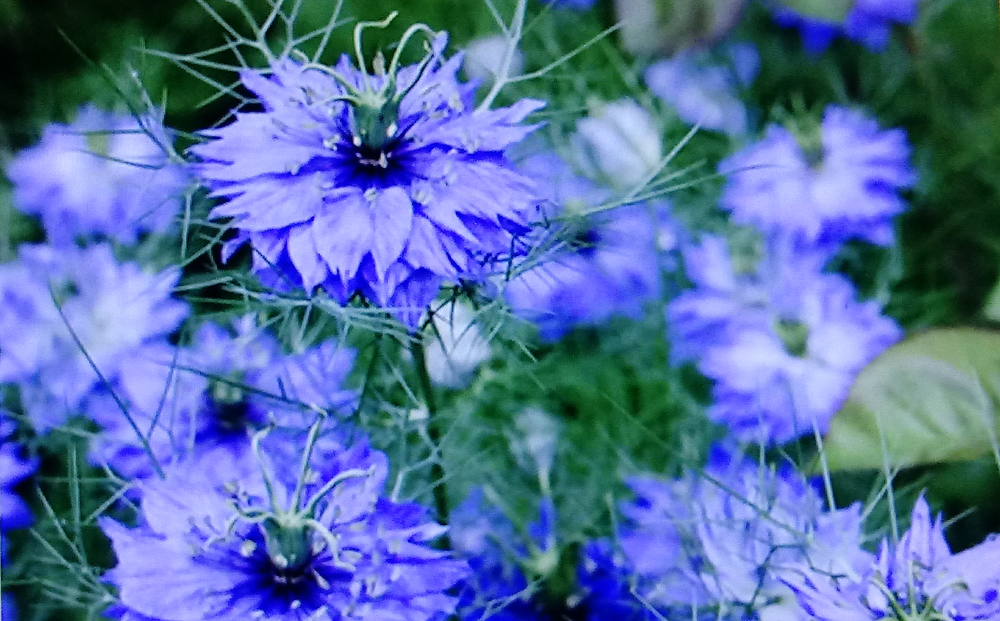
After my story, I told Brother Cadfael, “I want to celebrate Patty. She had a difficult life and still managed to find happiness.” After a long pause, he said, “It’s seems only fitting that you choose a flower so that every time it blooms, you’ll think of her.” I blushed. Of course, that’s what I do. I grow things. I think of so many friends, now long gone, who gave me seed or a start of a plant and indeed, they live in the gardens. I guess sadness can cloud the mind. “Yes, and I know just the flower I’ll choose. It’s called love-in-a-mist, nigella. There’s one species, nigella sativa, called black cumin. Maybe you know it Brother Cadfael. It’s been around since the time of Tutankhamen, even found in his tomb! I use it in Indian cooking and it has many medicinal qualities too. It’s a blue flower, perfect for Patty.”
Brother Cadfael laughed. “Yes, I know the lovely flower. I haven’t seen it since my roving youth when I traveled to Greece and Arabia. Though maybe I spied some in your culinary garden,” he said with a wink. “Perhaps you could share some seed with me? I’d like to have some in my garden too. Then I’ll remember this summer morning when we had this visit.” I felt touched beyond words. “Of course, I have fresh seed in the house.” He slowly rose and walked back to his garden, nodding his head at me and smiling, not an angelic smile, but the kind, rich smile of a man who has traveled the globe, seen much, done much, and still gracious enough to help out a sad gardener on a summer morn.
Revived from our talk, I realized the importance of sharing sadness. We carry it around; it can become a troublesome burden. Richard Fariña and Pauline Marden wrote this song, Pack up your Sorrows back in 1965. It says so well what Brother Cadfael understands:
“But if somehow you could pack up your sorrows, And give them all to me, You would lose them, I know how to use them, Give them all to me.”
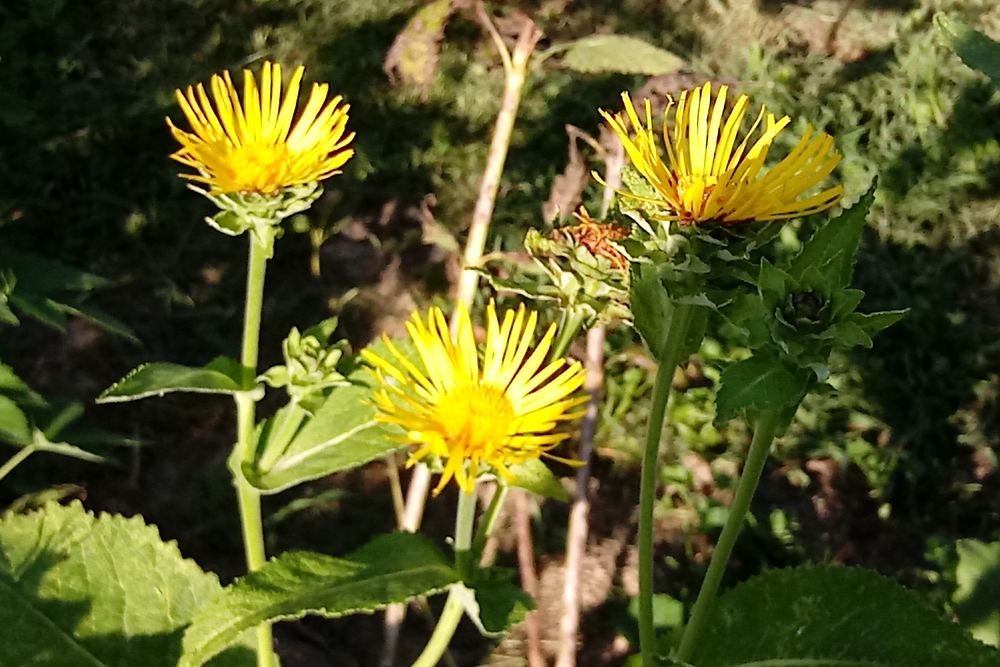
Elecampane
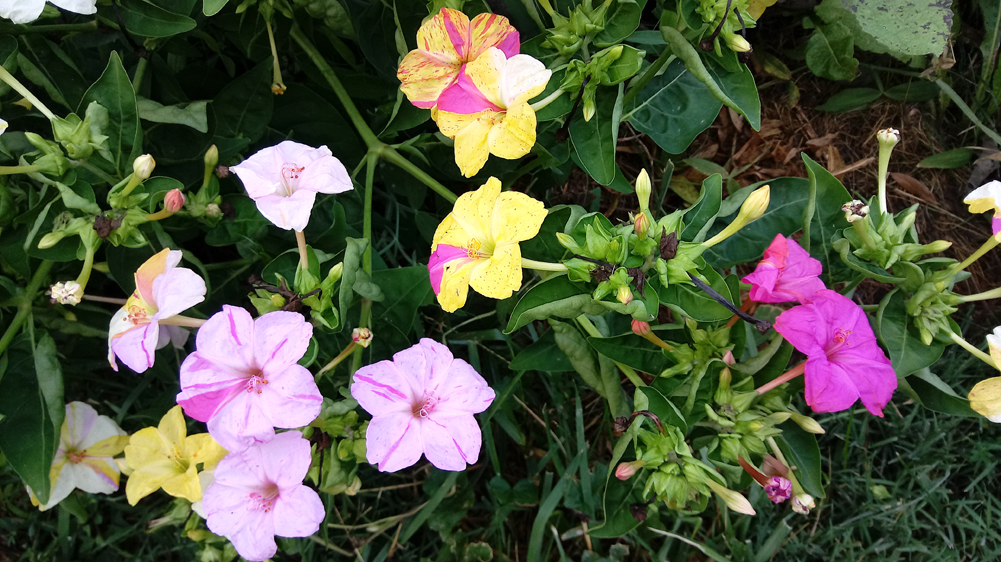
By now I felt light and joyous. The heat would soon come, so I moved about in the Park deadheading the elecampane, noticing the many colors on these Turkish Four O’clocks. How did the Cottage Garden come to have Turkish Four O’clocks? That’s a story for another time.
Turkish Four O’clocks
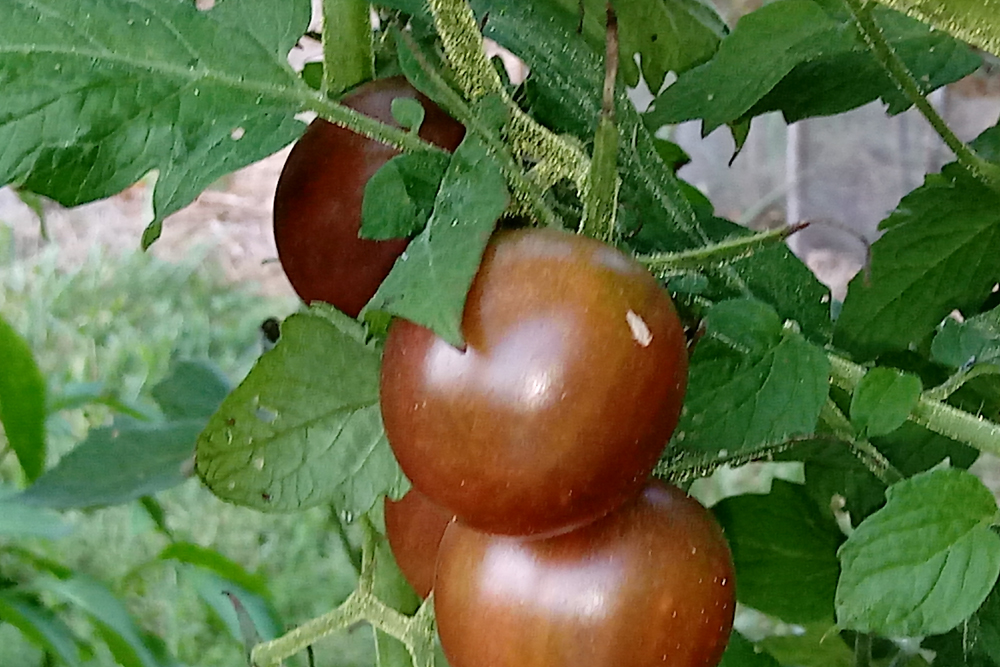
The cosmos, the zinnias, all so cheerful and welcoming. The vegetable gardens beckoned, to pick and admire, like the Mexican sunflowers, the plentiful black cherry tomatoes and dragon tongue beans. Oh so many things to do on a late summer morning, collecting happiness and leaving sorrows in a safe place.
As we launch into August, our last summer month, I’m excited about the abundance of late summer veggies. On the cool days and nights we experienced earlier in the summer I was reminded, how fleeting are these treasures. Better get busy and enjoy summer while we can.
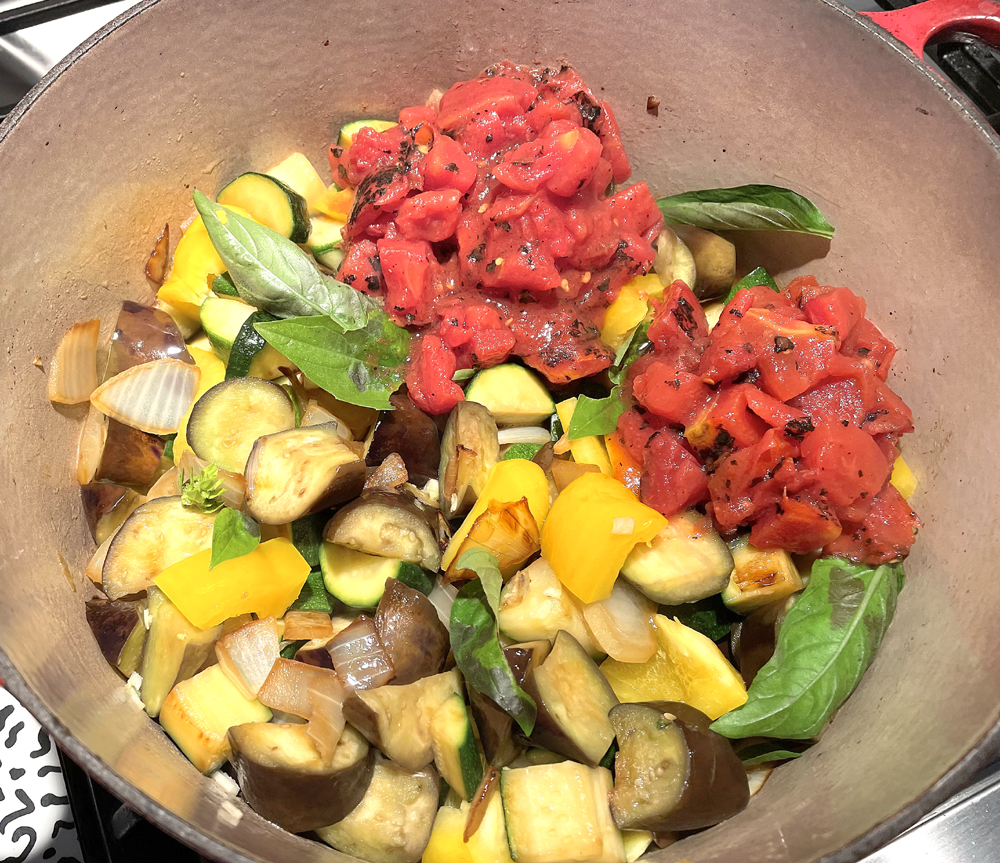
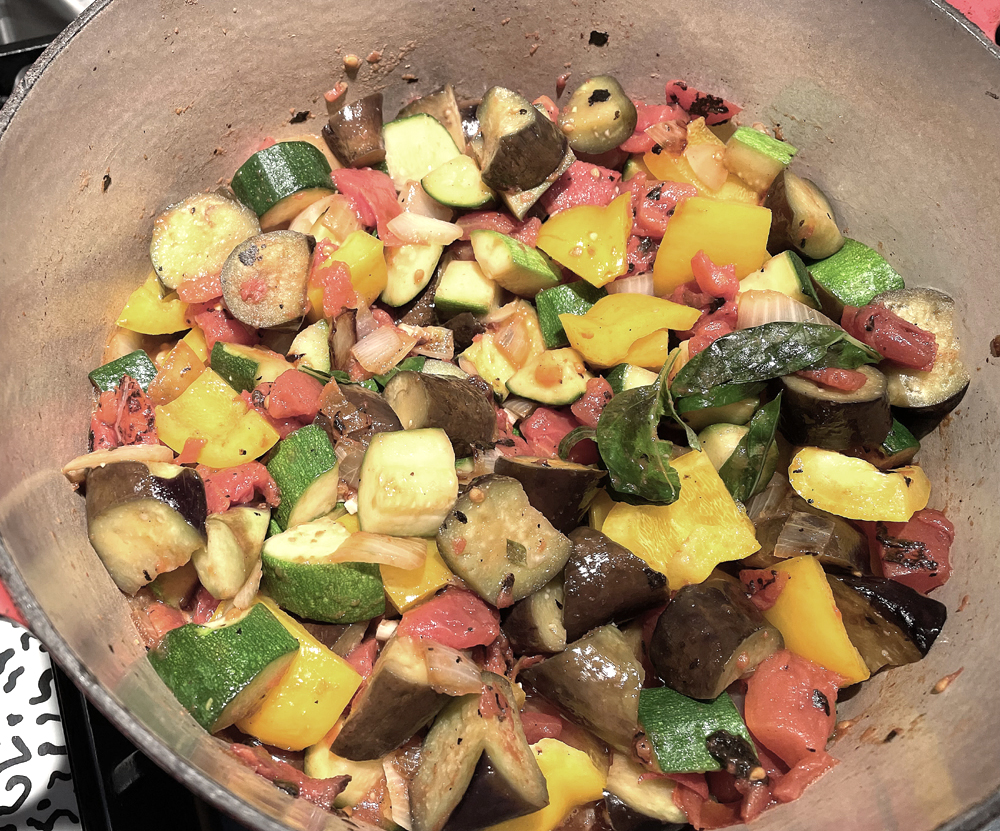
Generous friends from Apple Valley brought me cucumbers, green beans and zucchini from their bountiful garden. The zucchini inspired me, along with eggplant, peppers, and basil from the farmer’s market, to make ratatouille. The charming animated movie “Ratatouille” brought the pronunciation of this French word into common usage. Now it’s time to bring it onto the dinner table.
You’ll need two medium sized zucchini, an onion, two or three Japanese eggplant, a red or yellow pepper, garlic, a large tin of crushed or diced tomatoes or 8-10 fresh Romas, skinned and chopped, several sprigs of basil.
Chop onion into bite-sized 1-inch bits. Sauté it in 1 tablespoon of olive oil, in a pan large enough to hold all the vegetables, over medium heat until softened and barely brown about 3 minutes.
Add zucchini halved lengthwise and cut into 1-inch chunks and continue to cook, browning lightly, 3-4 minutes. Stir in the red or yellow pepper cut into 1-inch pieces. When these begin to sizzle, add the Japanese eggplant cut into, you guessed it, 1-inch pieces. No need to peel this delicate vegetable. Add a tablespoon or two of olive oil and cook until lightly browned and beginning to soften, 3-4 minutes more.
Add 2-3 cloves of garlic, minced. Pour in the large tin of tomatoes or the Romas and bring to a simmer. Add eight leaves of basil. Cover and let cook gently over low heat for 45 minutes into a thick and succulent mélange. Watch so the stew doesn’t catch and burn, adding a bit of water if necessary. Salt to taste – start with a scant teaspoon. When ready to serve scatter with torn basil leaves. This is delicious warm, at room temperature or cold. Even better the next day. We eat ratatouille with fried eggs, grilled fish, sausages, chicken, or on its own with crusty bread and a hunk of cheese. Any leftovers are great as a pasta topping.
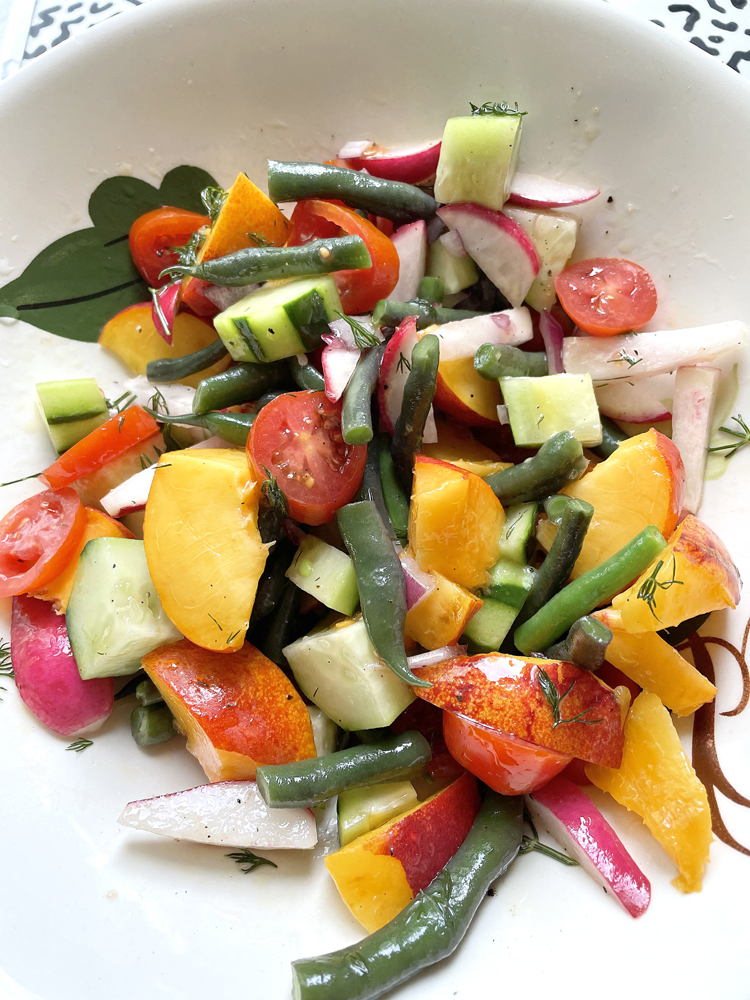
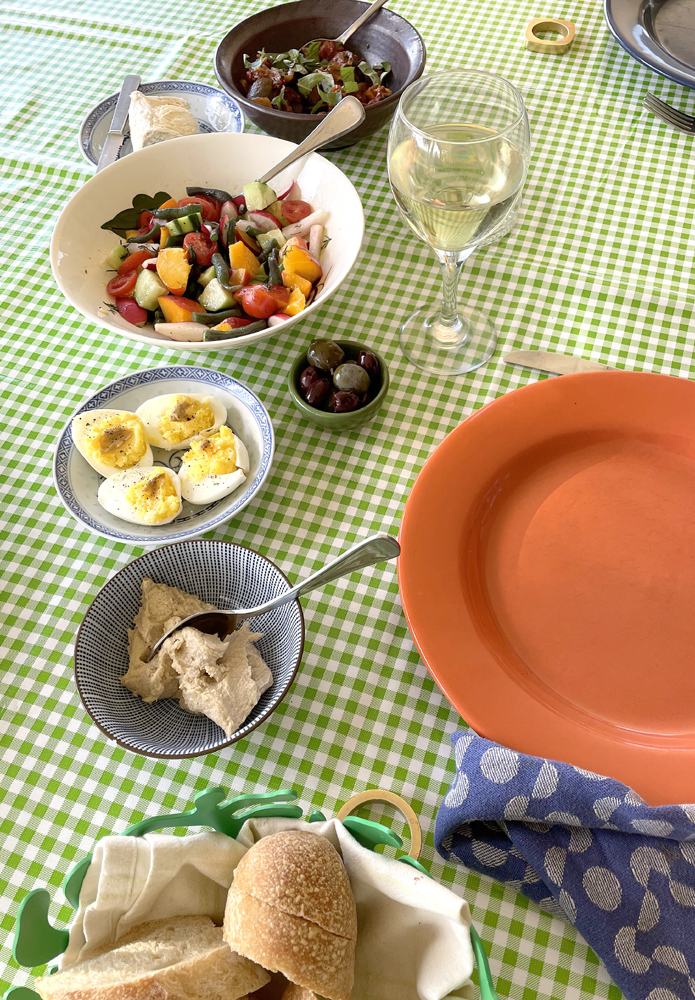
Two of my sisters have recently requested salad ideas. I love that they ask me and enjoy conjuring up a recipe. I look forward to hearing their comments. Again, the abundance of summer veggies prompted me to suggest these two salads.
A chopped salad
A cucumber, chopped into ½ inch chunks, peeled in stripes.
8-10 cherry tomatoes cut in half or a garden tomato cut into chunks.
A big handful of steamed green beans, cut diagonally into ½ inch piece
2-3 radishes, julienned
2 very thin slicesred onion, and cut into ½ inch pieces
a peach or two, cut into 1 inch chunks (optional)
Combine these with a vinaigrette:
2 tablespoons olive oil
2 teaspoons red wine or sherry vinegar
a crushed and minced clove of garlic
salt and pepper
Top with herbs – basil, dill, or chives.
I sometimes add a dollop of yogurt to smooth it all out.
Peach and Tomato Salad
Simply chunks of tomato and peaches in a spicy green salad including arugula, radicchio, a soft lettuce, or watercress.
Dress with the vinaigrette above. Top with toasted pine nuts or sliced almonds.
Every once in a while in the midst of summer, summer becomes spring if only for a brief morning. That recently happened after a long awaited rain. Before the rains came everything seemed desperate, even the birds. I spied two, TWO, brown thrashers at the bird bath, taking a bath together. They looked so big from the window, fifty feet away, at first I thought the mourning doves had come for the first bath I’d ever seen them take. Through the binoculars, I could see the long tail, the rufous back and striped belly that identified the thrashers as kin to the mockingbird. I couldn’t believe my eyes when I saw them splash, like my grandsons did at bath time as young ones. It positively took the heat out of the blistering day. I stood there laughing at the delight they took in their bath. (I took a photo through the window and hopefully my dear Editor will accept the less than perfect picture.) After they’d left I braved the heat to fill up the bath with another quart of water for the next bathers as birds get over heated and stressed too.
Bathing Brown Thrashers
Since I had decided not to irrigate the gardens, only water the plants in containers, I’ve had to be content to watch the drought take its toll on water-loving plants like cucumbers and melons. I’ve also been amazed at how tomatoes and peppers, beans and parsley, hang on quite nicely, thank you, with the thick mulch protecting their roots and that underground, mysterious river nurturing them. They may droop in the day to conserve moisture, but come evening, they perk up. Granted, they aren’t putting on tons of tomatoes but they’re doing the tortoise thing, hanging on, waiting for cooler weather, grateful for the underworld of riches.
The rest of the sweltering day and evening I did what people the world over do and have done, I endured. I did my suffering somewhat bravely, barely moving except to eat a meager dinner, drink lots of water and grudgingly do my tai chi. I tried to remain positive about the possibility of rain, but the predictions have not born fruit so I fell into the summertime blues trying out my fake smiles and pretending I was happy.
As I cleared the table on the summer kitchen after dinner I noticed dark clouds in the north and west. Opening the screen door and leaning outside to look further north I felt a breeze, a real breeze, and it felt delightful. Then I saw a bolt of lightning and over the next hour the drama unfolded with strong, bountiful rain pouring onto our parched, beloved piece of earth. Ecstasy.
Passionflowers as ground cover all over the gardens.
The next day after that glorious rain, I walked outside and felt the vibrancy of the landscape after a restorative rain. I thought, “this is what spring feels like”. After the darkness of winter our senses come alive with color and after a drought too.
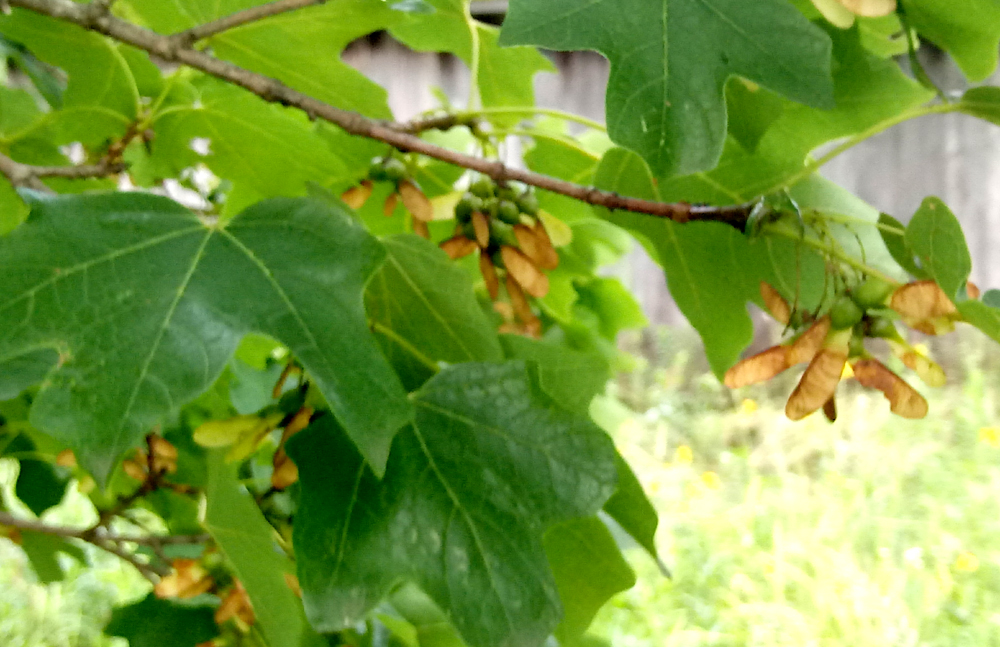
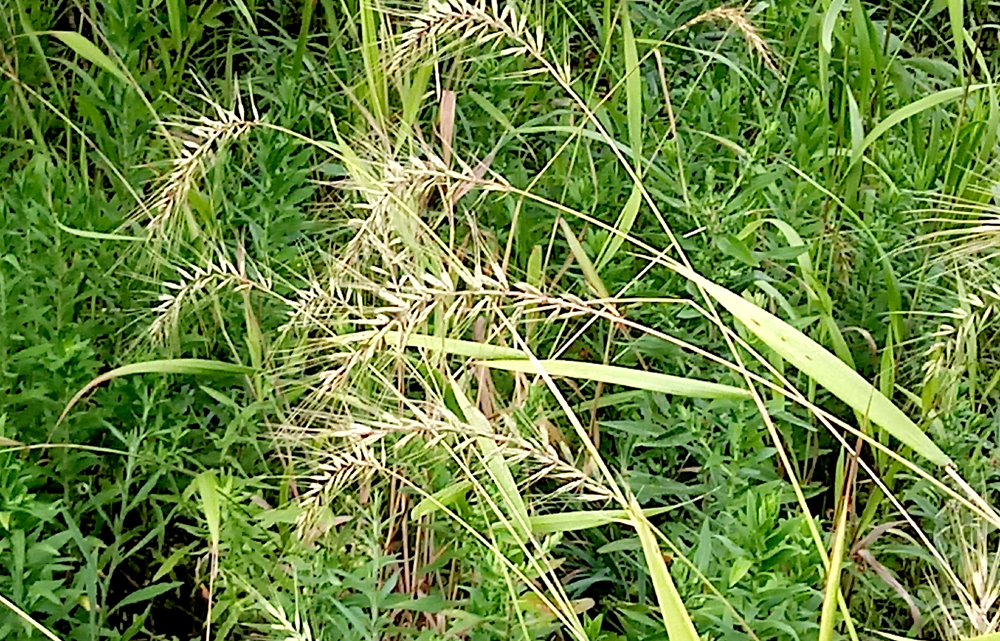
I put a lawn chair in the shade and spent some time sitting, enjoying spring in summer. I looked up at the maple tree and saw the tiny samaras forming, helicopter seeds because they spin through the air as they fall like a helicopter propeller. I’ve been too busy in past years to notice them when they’re young and colorful. Then I looked down and saw the bottle brush grass, a favorite, moving with the breeze, moving me.
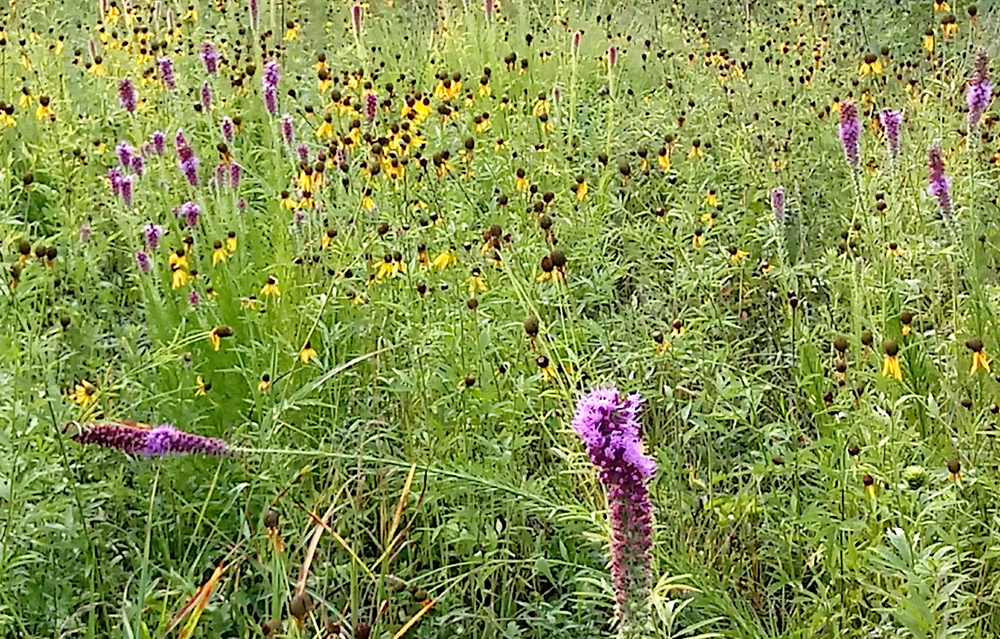
From this same vantage point gold finches, a group of eight or nine, dipped and dived like only they can do all the while chirping a youthful call. Do they ever grow old? They settled on the grey-headed coneflowers, bending them to the ground with their weight, eating the seed before it matured, chattering in between bites.
Grey-headed cone flowers and liatris
I couldn’t help but notice the greens that looked drab only a day ago had taken on a whole new depth of greenness. Blindingly beautiful, shimmering in the light. I breathed in deeply and tilted my head back. Up high I saw three buzzards patrolling the sky, soaring gracefully. Two indigo buntings flew into the shrubs close by as if they had a mission, then detected me even though I didn’t move and flew off. The price of this beauty – sitting still.
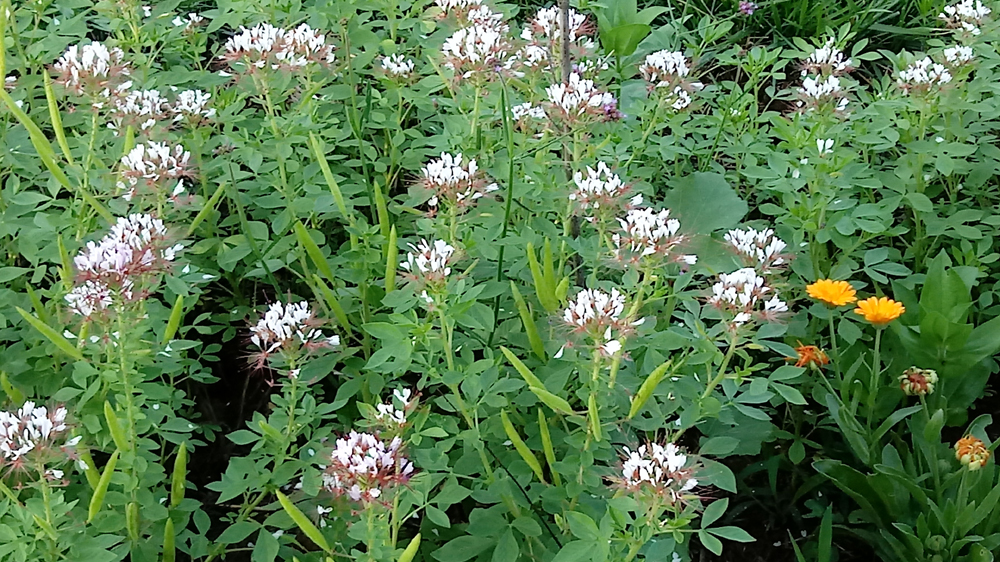
Rocky Mountain Cleome
That reminded me of an older man on my mail route in Boulder. One summer day he sat in the shade in front of his house with a big wash tub filled with collard greens. He greeted me and we talked like we usually did. I said something about what a big job that was to take the ribs out of all those greens. He looked at me and laughed and said, “I can’t think of a better way to spend a summer morning.” So there he sat, quietly in the shade, doing a simple task, enjoying a summer day. I often think of him when I feel harassed by life and forget how to live.
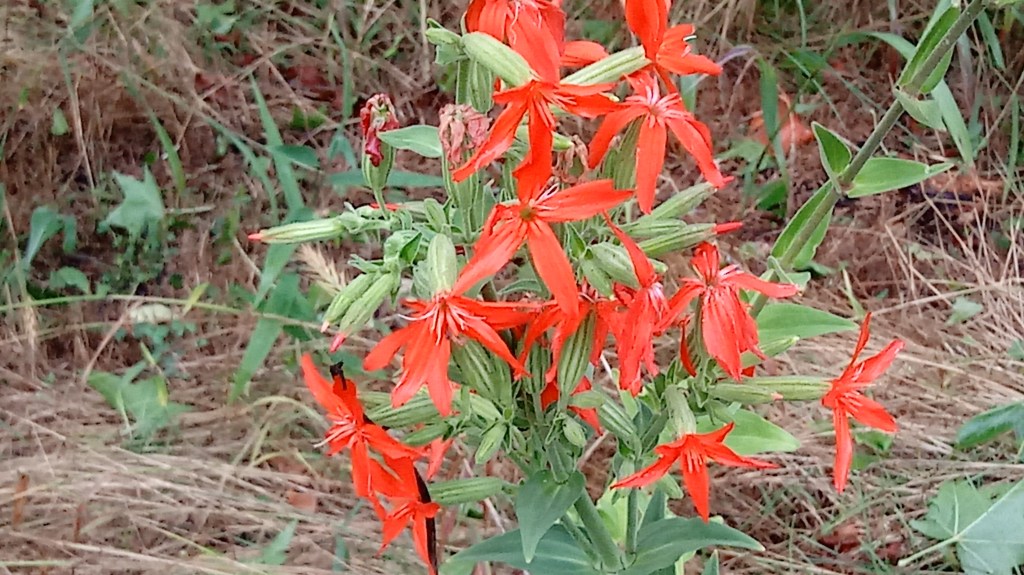
Royal Catchfly
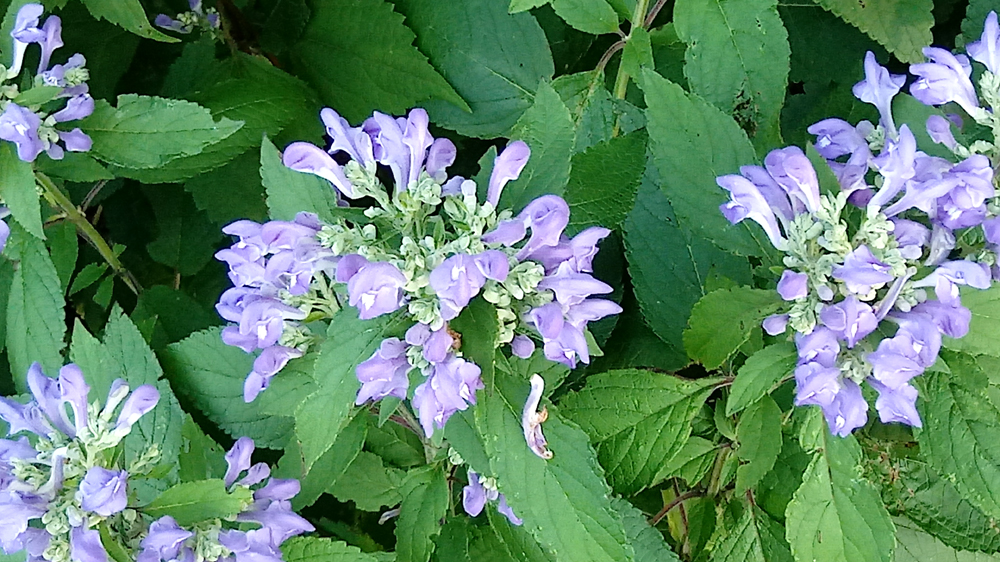
Ambling about, I took these photographs. They show a piece of what the rain brought out. Let them gladden your hearts as the ‘spring in summer’ did mine.
We spent a week on a family trip to a lake in Minnesota. We took walks in a nearby natural area, cooked meals, watched the birds, talked and talked. I enjoyed seeing the three generations and the changes in us all.
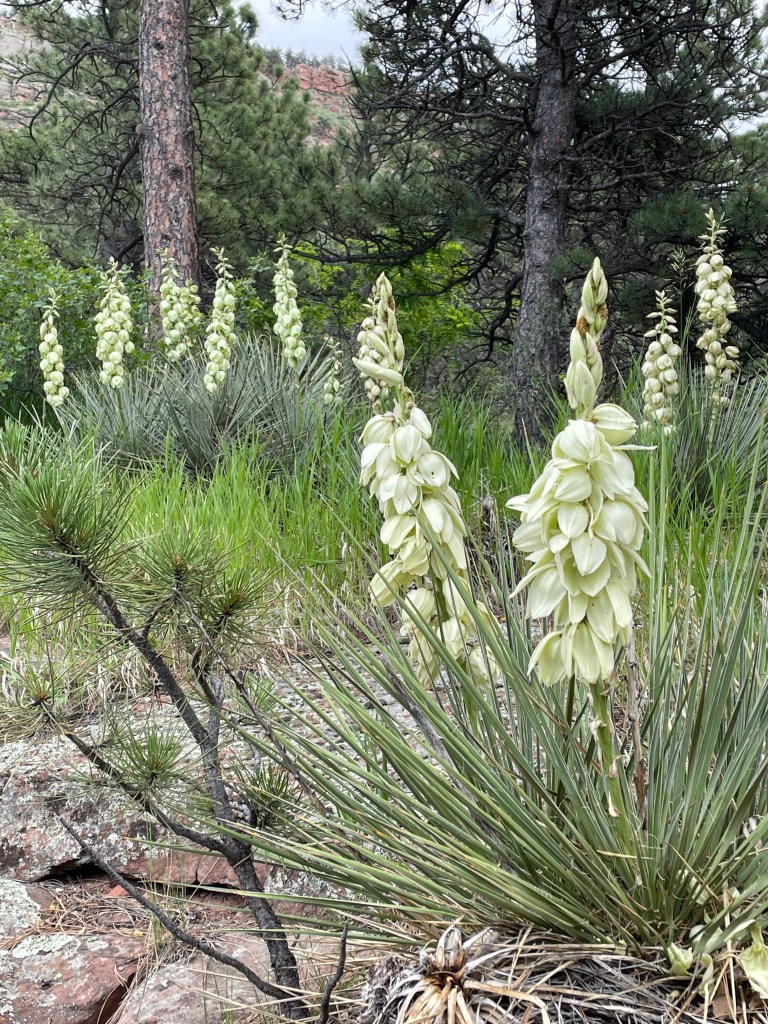
We came home to find the yucca busting out all over our hillsides. They’re blooming a bit late but oh, boy, have they put on a show. Must be all the rain we’ve had, a wet June for the Front Range with over six inches recorded. I’ll pick some of the flowers to add to salad – they are slightly crunchy, with a vegetal, somewhat bitter, taste akin to endive.
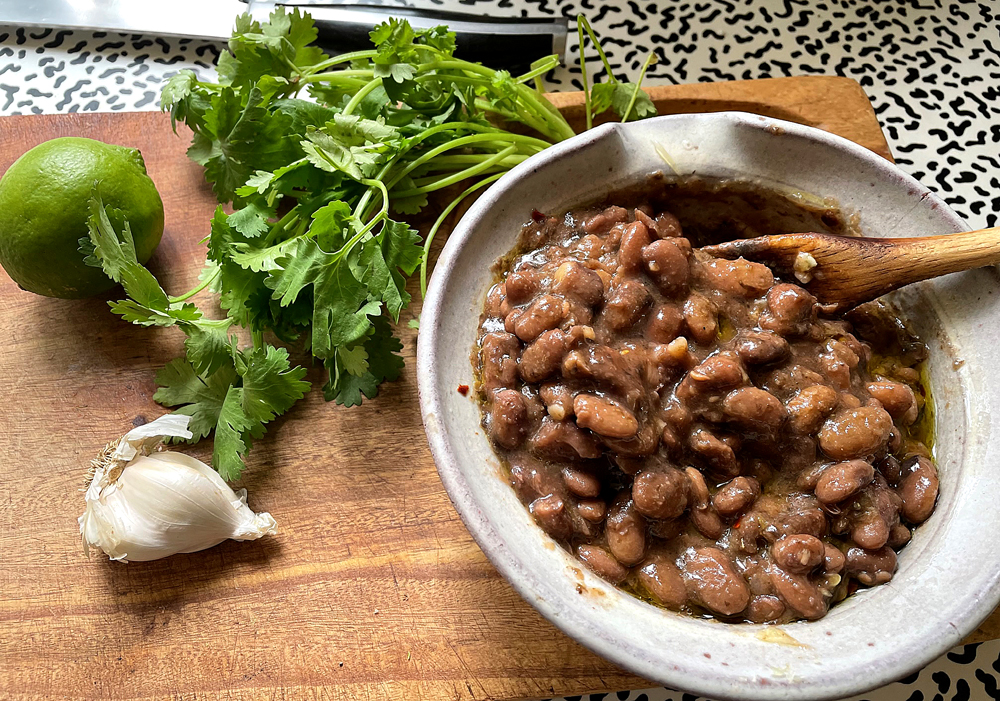
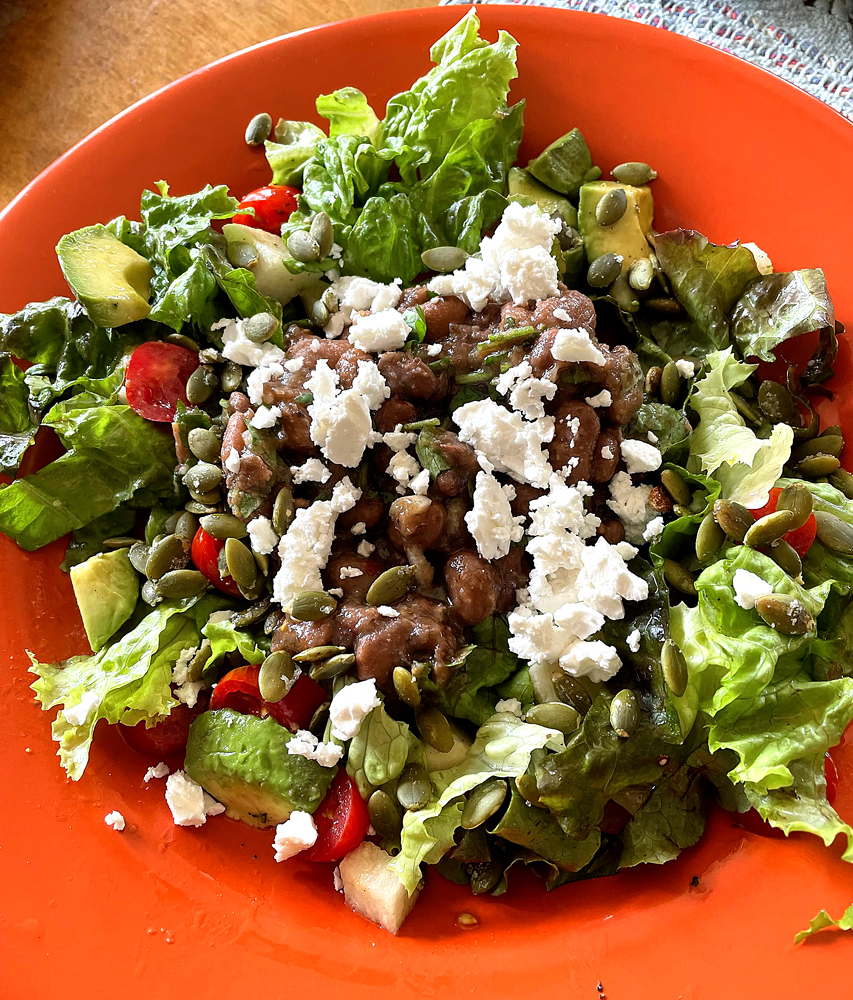
After our cool, rainy June, my cooking is taking on the flavor of summer with its long warm days seguing into cool evenings. The stands at the Longmont farmer’s market are laden with lettuces and other greens, radishes, asparagus, peas, and apricots. So of course, salad is on the menu for lunch and supper. As we eat less meat, I use beans, lentils, nuts and seeds, cheese and yogurt to provide protein. Here is a delicious bean salad. I used cooked Rancho Gordo beans but canned are okay. Just be sure to rinse them. Use any variety – pinto, black, cannellini, or your favorite.
Warm 1 1/2 – 2 cups cooked, drained beans in a saucepan. Dress them with 1-2 tablespoons olive oil, the juice of a small lime, big pinches of ground cumin and hot red pepper flakes. Stir in a minced clove or two of garlic (or a chopped shallot) and add salt to taste – I start with a big pinch.
At serving time, add a handful of cilantro, roughly chopped. Serve over salad greens, halved cherry tomatoes, and avocado chunks lightly dressed with olive oil. Top with crumbled feta and toasted pepitas.Enough for 2-3 servings.
The lavender is blooming amid a plethora of wild roses.