As we launch into August, our last summer month, I’m excited about the abundance of late summer veggies. On the cool days and nights we experienced earlier in the summer I was reminded, how fleeting are these treasures. Better get busy and enjoy summer while we can.
Generous friends from Apple Valley brought me cucumbers, green beans and zucchini from their bountiful garden. The zucchini inspired me, along with eggplant, peppers, and basil from the farmer’s market, to make ratatouille. The charming animated movie “Ratatouille” brought the pronunciation of this French word into common usage. Now it’s time to bring it onto the dinner table.
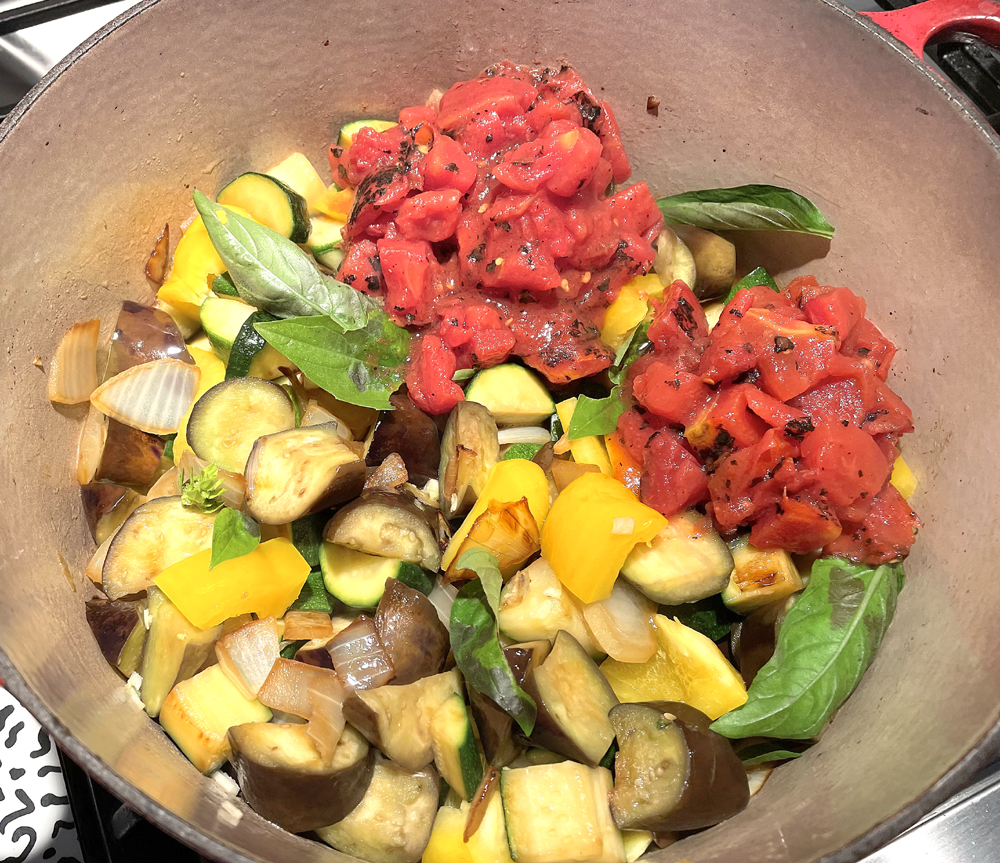
You’ll need two medium sized zucchini, an onion, two or three Japanese eggplant, a red or yellow pepper, garlic, a large tin of crushed or diced tomatoes or 8-10 fresh Romas, skinned and chopped, several sprigs of basil.
Chop onion into bite-sized 1-inch bits. Sauté it in 1 tablespoon of olive oil, in a pan large enough to hold all the vegetables, over medium heat until softened and barely brown about 3 minutes.
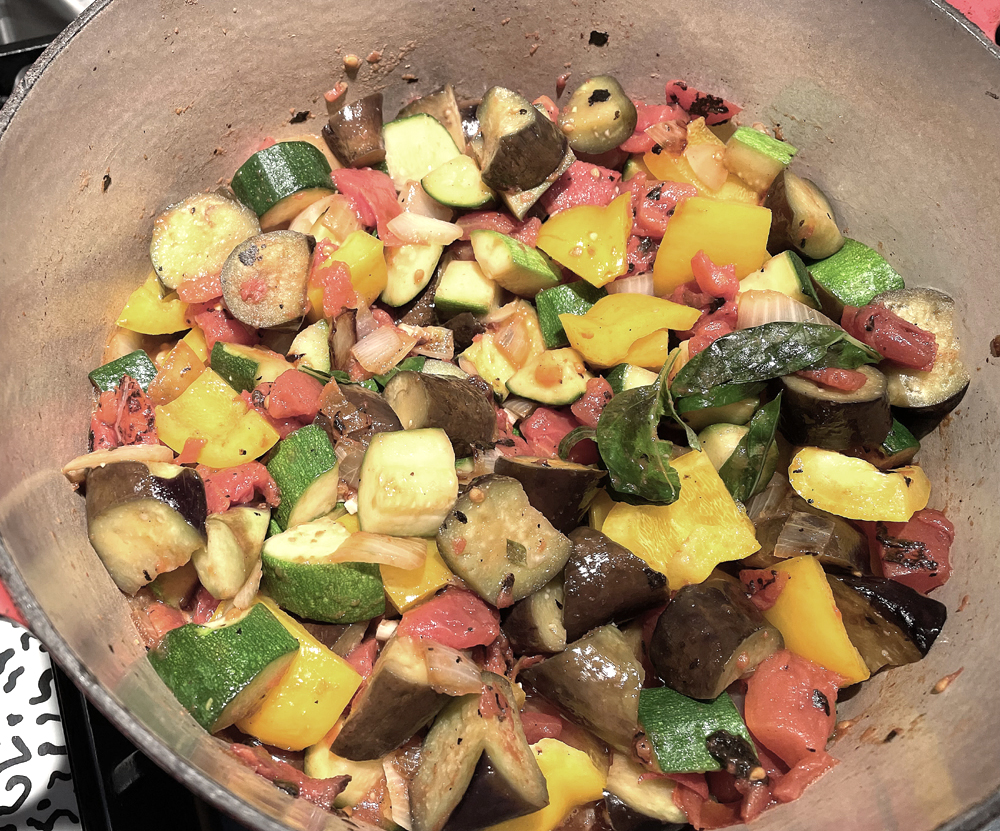
Add zucchini halved lengthwise and cut into 1-inch chunks and continue to cook, browning lightly, 3-4 minutes. Stir in the red or yellow pepper cut into 1-inch pieces. When these begin to sizzle, add the Japanese eggplant cut into, you guessed it, 1-inch pieces. No need to peel this delicate vegetable. Add a tablespoon or two of olive oil and cook until lightly browned and beginning to soften, 3-4 minutes more.
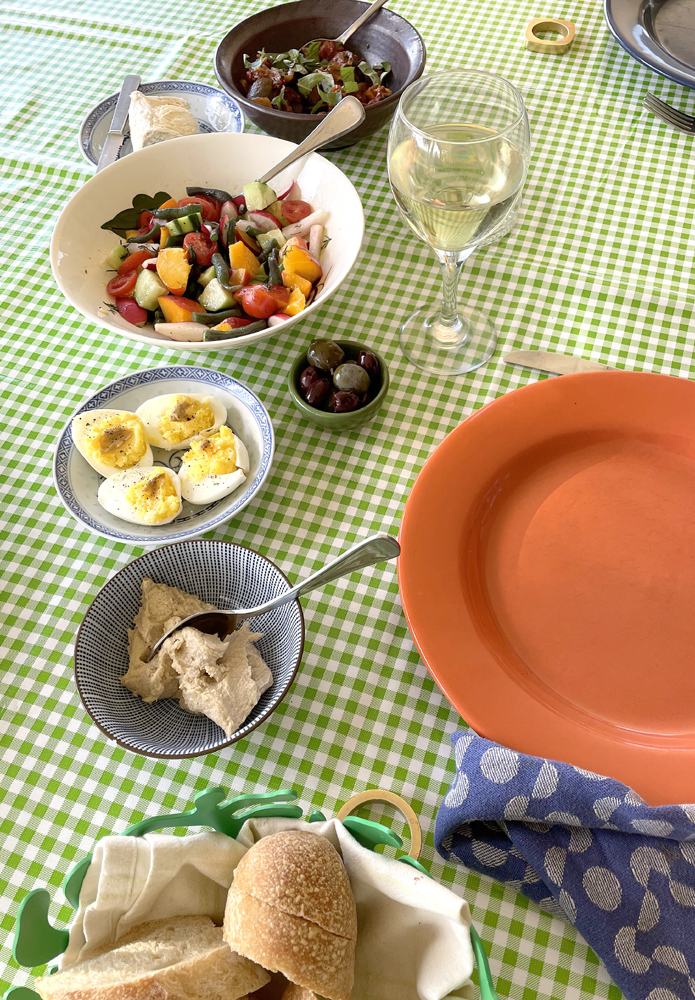
Add 2-3 cloves of garlic, minced. Pour in the large tin of tomatoes or the Romas and bring to a simmer. Add eight leaves of basil. Cover and let cook gently over low heat for 45 minutes into a thick and succulent mélange. Watch so the stew doesn’t catch and burn, adding a bit of water if necessary. Salt to taste – start with a scant teaspoon. When ready to serve scatter with torn basil leaves. This is delicious warm, at room temperature or cold. Even better the next day. We eat ratatouille with fried eggs, grilled fish, sausages, chicken, or on its own with crusty bread and a hunk of cheese. Any leftovers are great as a pasta topping.
Two of my sisters have recently requested salad ideas. I love that they ask me and enjoy conjuring up a recipe. I look forward to hearing their comments. Again, the abundance of summer veggies prompted me to suggest these two salads.
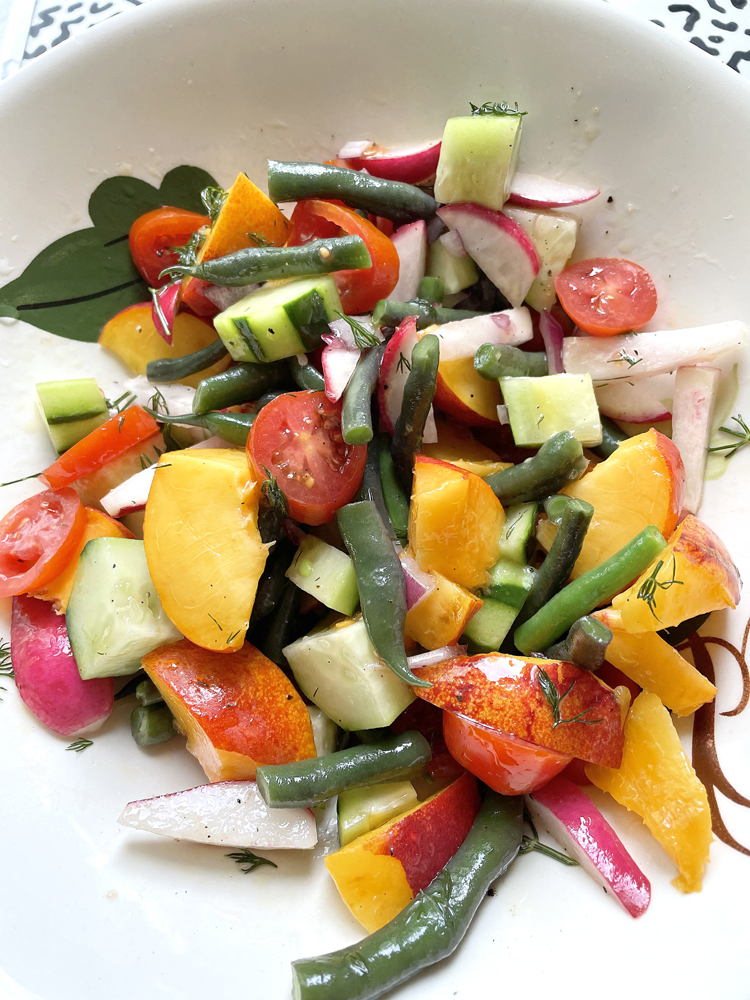
A chopped salad
A cucumber, chopped into ½ inch chunks, peeled in stripes.
8-10 cherry tomatoes cut in half or a garden tomato cut into chunks.
A big handful of steamed green beans, cut diagonally into ½ inch piece
2-3 radishes, julienned
2 very thin slicesred onion, and cut into ½ inch pieces
a peach or two, cut into 1 inch chunks (optional)
Combine these with a vinaigrette:
2 tablespoons olive oil
2 teaspoons red wine or sherry vinegar
a crushed and minced clove of garlic
salt and pepper
Top with herbs – basil, dill, or chives.
I sometimes add a dollop of yogurt to smooth it all out.
Peach and Tomato Salad
Simply chunks of tomato and peaches in a spicy green salad including arugula, radicchio, a soft lettuce, or watercress.
Dress with the vinaigrette above. Top with toasted pine nuts or sliced almonds.
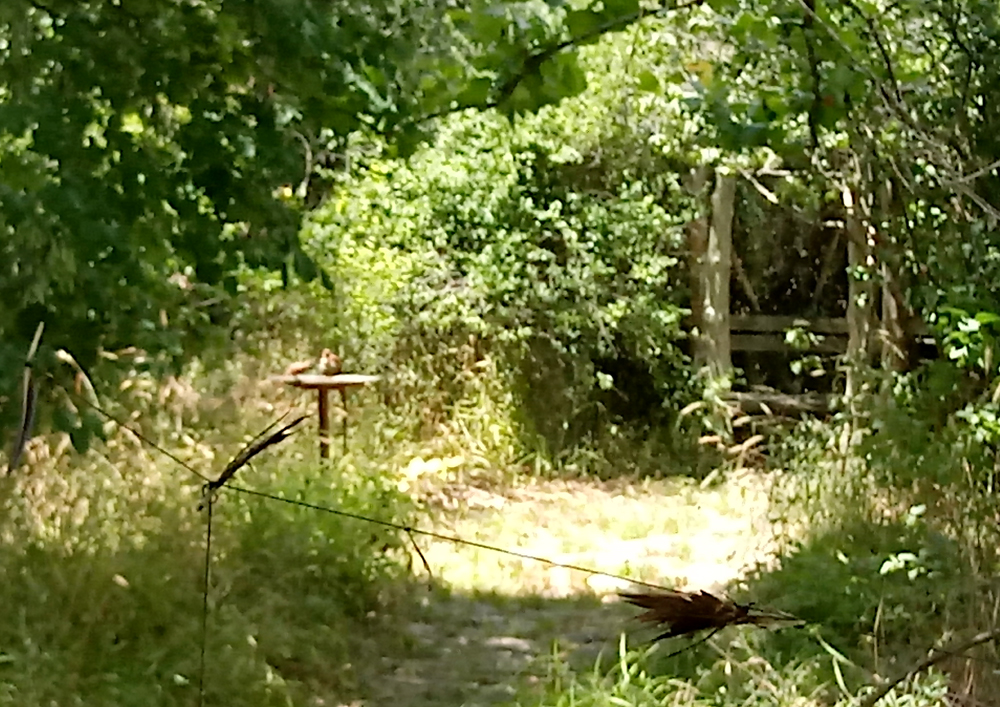
Every once in a while in the midst of summer, summer becomes spring if only for a brief morning. That recently happened after a long awaited rain. Before the rains came everything seemed desperate, even the birds. I spied two, TWO, brown thrashers at the bird bath, taking a bath together. They looked so big from the window, fifty feet away, at first I thought the mourning doves had come for the first bath I’d ever seen them take. Through the binoculars, I could see the long tail, the rufous back and striped belly that identified the thrashers as kin to the mockingbird. I couldn’t believe my eyes when I saw them splash, like my grandsons did at bath time as young ones. It positively took the heat out of the blistering day. I stood there laughing at the delight they took in their bath. (I took a photo through the window and hopefully my dear Editor will accept the less than perfect picture.) After they’d left I braved the heat to fill up the bath with another quart of water for the next bathers as birds get over heated and stressed too.
Bathing Brown Thrashers
Since I had decided not to irrigate the gardens, only water the plants in containers, I’ve had to be content to watch the drought take its toll on water-loving plants like cucumbers and melons. I’ve also been amazed at how tomatoes and peppers, beans and parsley, hang on quite nicely, thank you, with the thick mulch protecting their roots and that underground, mysterious river nurturing them. They may droop in the day to conserve moisture, but come evening, they perk up. Granted, they aren’t putting on tons of tomatoes but they’re doing the tortoise thing, hanging on, waiting for cooler weather, grateful for the underworld of riches.
The rest of the sweltering day and evening I did what people the world over do and have done, I endured. I did my suffering somewhat bravely, barely moving except to eat a meager dinner, drink lots of water and grudgingly do my tai chi. I tried to remain positive about the possibility of rain, but the predictions have not born fruit so I fell into the summertime blues trying out my fake smiles and pretending I was happy.
As I cleared the table on the summer kitchen after dinner I noticed dark clouds in the north and west. Opening the screen door and leaning outside to look further north I felt a breeze, a real breeze, and it felt delightful. Then I saw a bolt of lightning and over the next hour the drama unfolded with strong, bountiful rain pouring onto our parched, beloved piece of earth. Ecstasy.
Passionflowers as ground cover all over the gardens.
The next day after that glorious rain, I walked outside and felt the vibrancy of the landscape after a restorative rain. I thought, “this is what spring feels like”. After the darkness of winter our senses come alive with color and after a drought too.
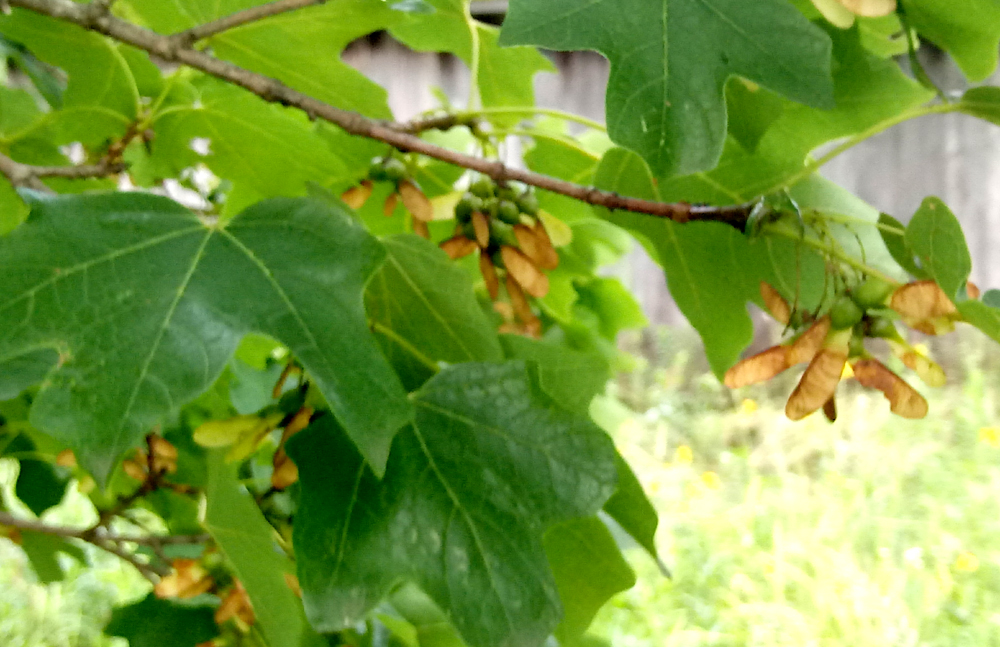
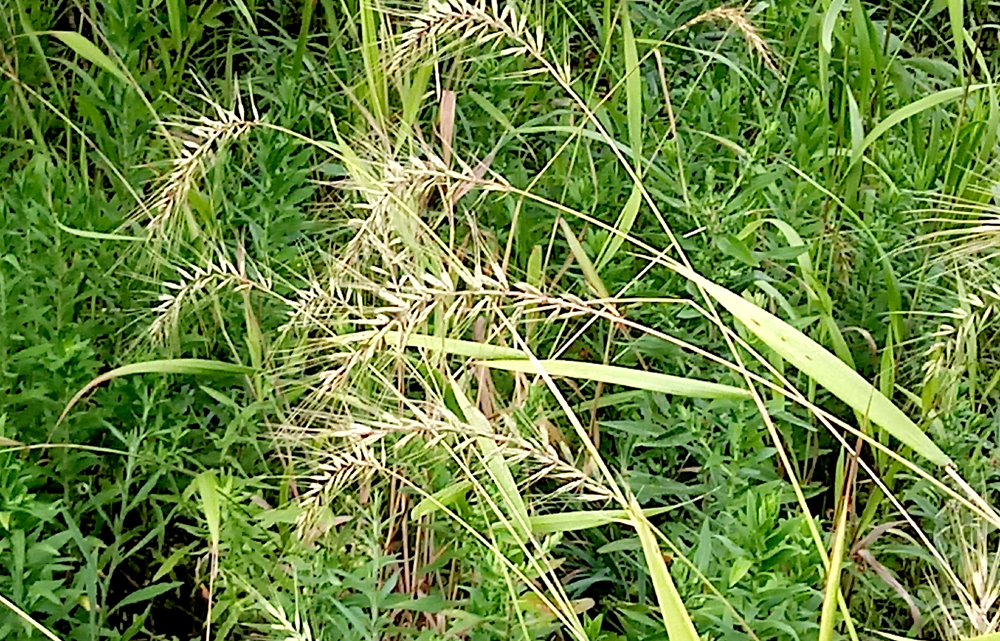
I put a lawn chair in the shade and spent some time sitting, enjoying spring in summer. I looked up at the maple tree and saw the tiny samaras forming, helicopter seeds because they spin through the air as they fall like a helicopter propeller. I’ve been too busy in past years to notice them when they’re young and colorful. Then I looked down and saw the bottle brush grass, a favorite, moving with the breeze, moving me.
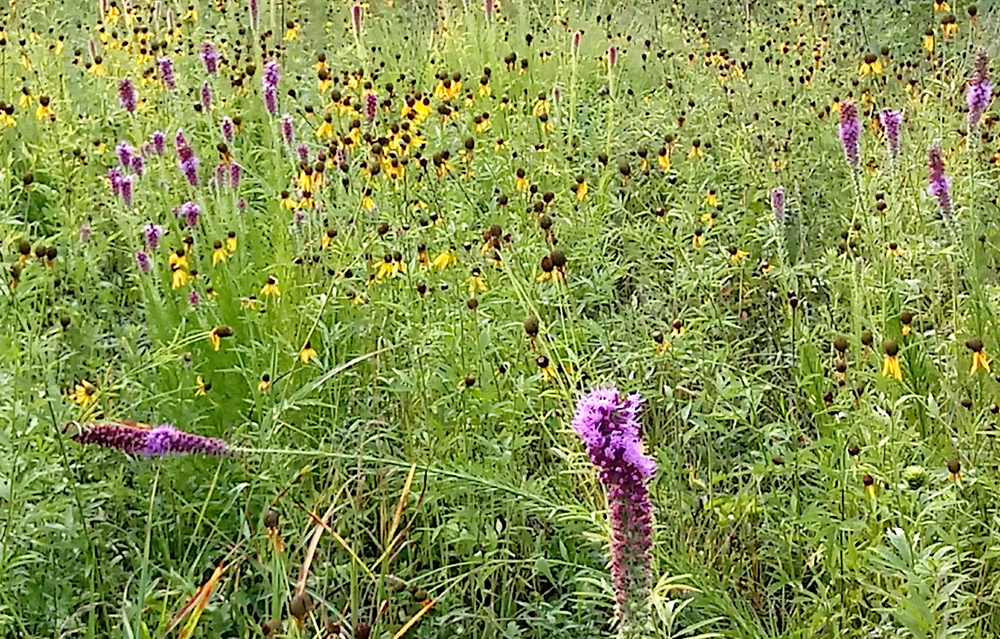
From this same vantage point gold finches, a group of eight or nine, dipped and dived like only they can do all the while chirping a youthful call. Do they ever grow old? They settled on the grey-headed coneflowers, bending them to the ground with their weight, eating the seed before it matured, chattering in between bites.
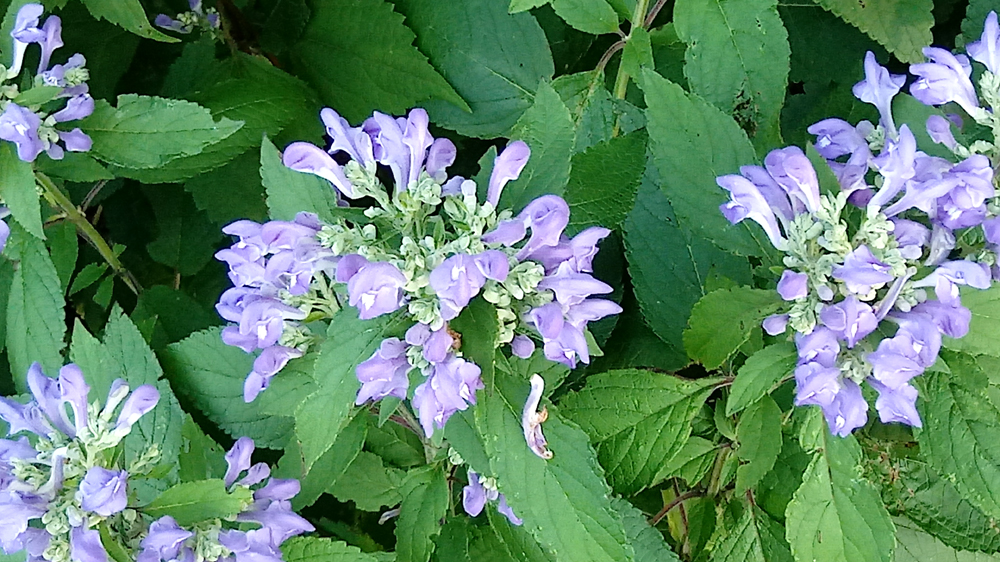
Grey-headed cone flowers and liatris
I couldn’t help but notice the greens that looked drab only a day ago had taken on a whole new depth of greenness. Blindingly beautiful, shimmering in the light. I breathed in deeply and tilted my head back. Up high I saw three buzzards patrolling the sky, soaring gracefully. Two indigo buntings flew into the shrubs close by as if they had a mission, then detected me even though I didn’t move and flew off. The price of this beauty – sitting still.
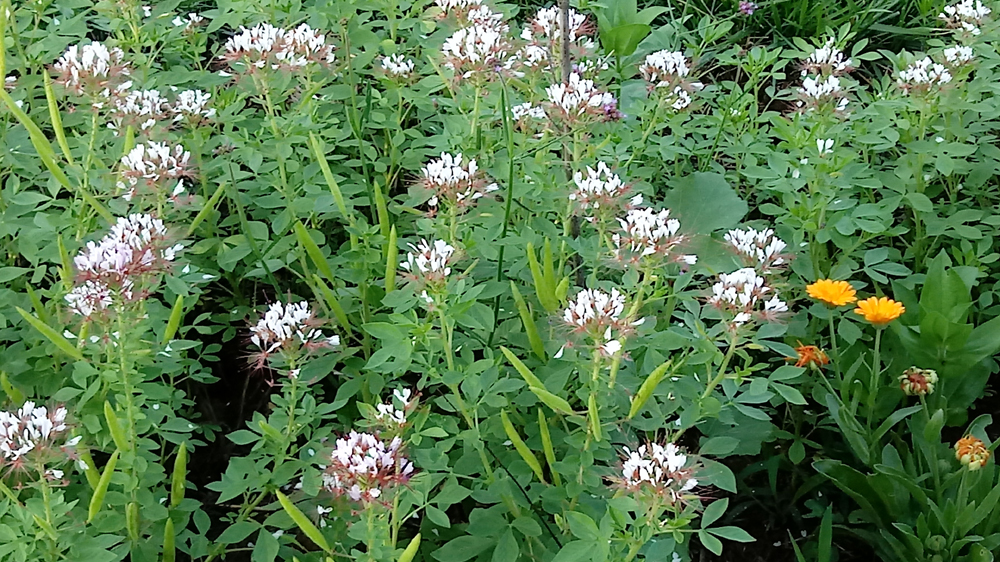
Rocky Mountain Cleome
That reminded me of an older man on my mail route in Boulder. One summer day he sat in the shade in front of his house with a big wash tub filled with collard greens. He greeted me and we talked like we usually did. I said something about what a big job that was to take the ribs out of all those greens. He looked at me and laughed and said, “I can’t think of a better way to spend a summer morning.” So there he sat, quietly in the shade, doing a simple task, enjoying a summer day. I often think of him when I feel harassed by life and forget how to live.
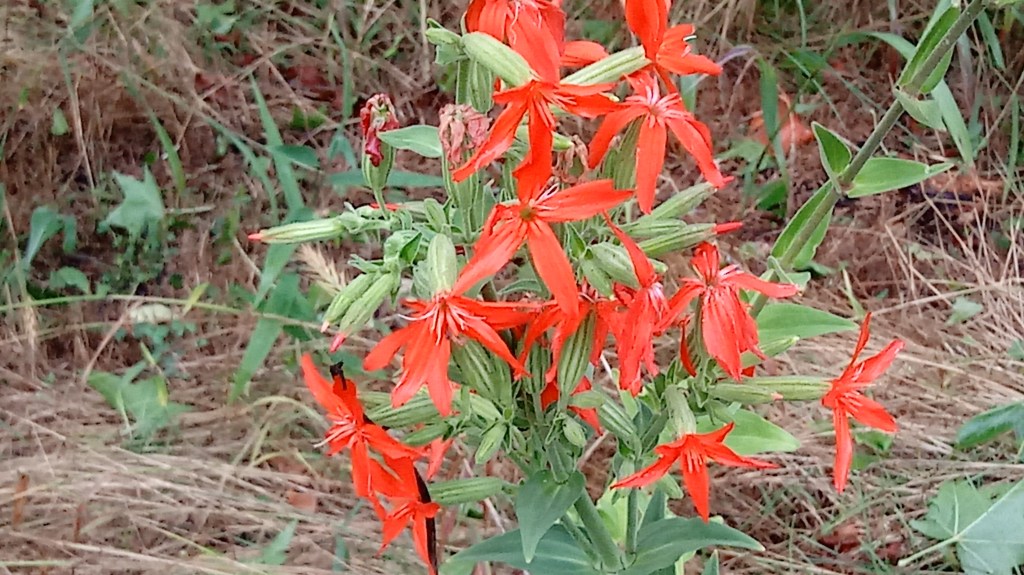
Royal Catchfly
Ambling about, I took these photographs. They show a piece of what the rain brought out. Let them gladden your hearts as the ‘spring in summer’ did mine.
We spent a week on a family trip to a lake in Minnesota. We took walks in a nearby natural area, cooked meals, watched the birds, talked and talked. I enjoyed seeing the three generations and the changes in us all.
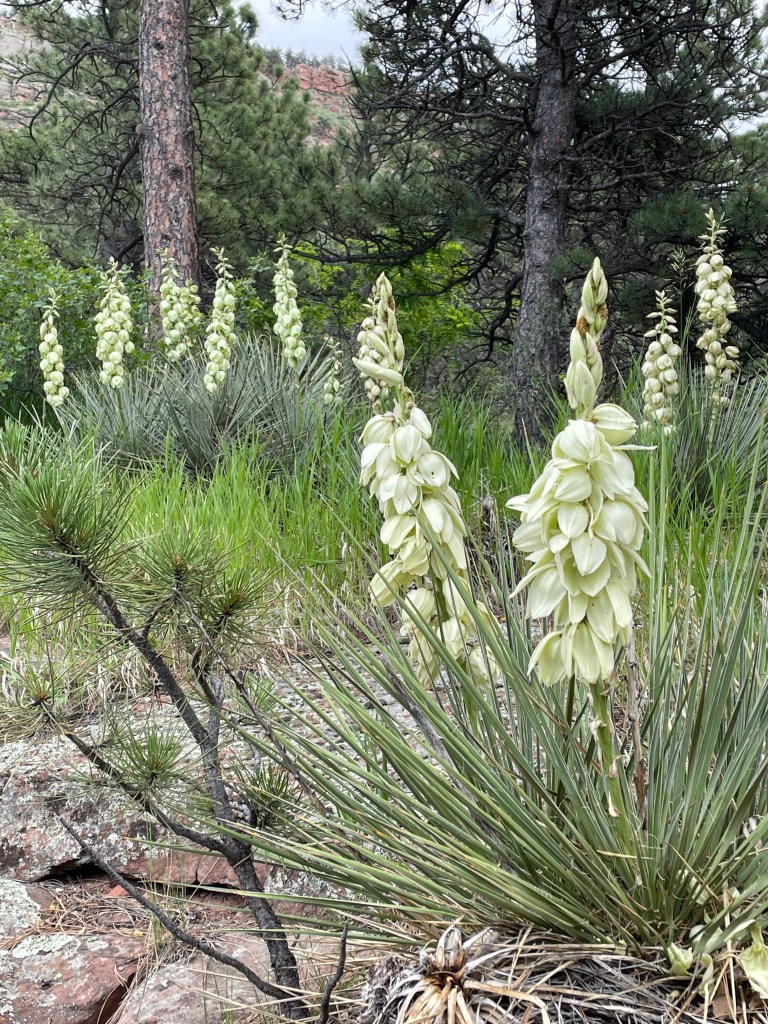
We came home to find the yucca busting out all over our hillsides. They’re blooming a bit late but oh, boy, have they put on a show. Must be all the rain we’ve had, a wet June for the Front Range with over six inches recorded. I’ll pick some of the flowers to add to salad – they are slightly crunchy, with a vegetal, somewhat bitter, taste akin to endive.
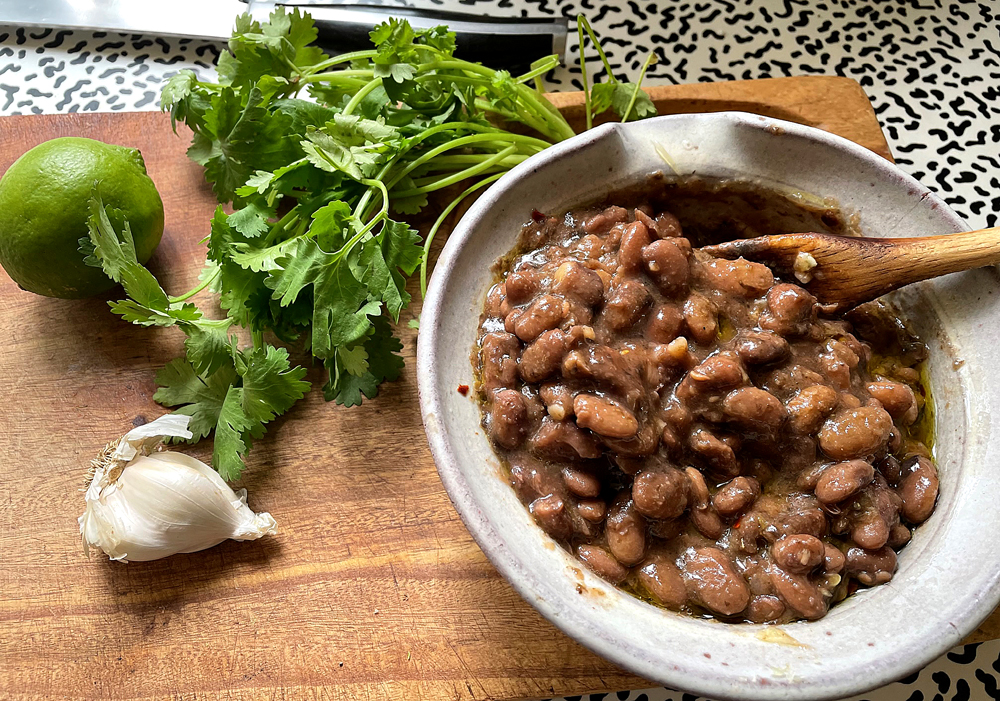
After our cool, rainy June, my cooking is taking on the flavor of summer with its long warm days seguing into cool evenings. The stands at the Longmont farmer’s market are laden with lettuces and other greens, radishes, asparagus, peas, and apricots. So of course, salad is on the menu for lunch and supper. As we eat less meat, I use beans, lentils, nuts and seeds, cheese and yogurt to provide protein. Here is a delicious bean salad. I used cooked Rancho Gordo beans but canned are okay. Just be sure to rinse them. Use any variety – pinto, black, cannellini, or your favorite.
Warm 1 1/2 – 2 cups cooked, drained beans in a saucepan. Dress them with 1-2 tablespoons olive oil, the juice of a small lime, big pinches of ground cumin and hot red pepper flakes. Stir in a minced clove or two of garlic (or a chopped shallot) and add salt to taste – I start with a big pinch.
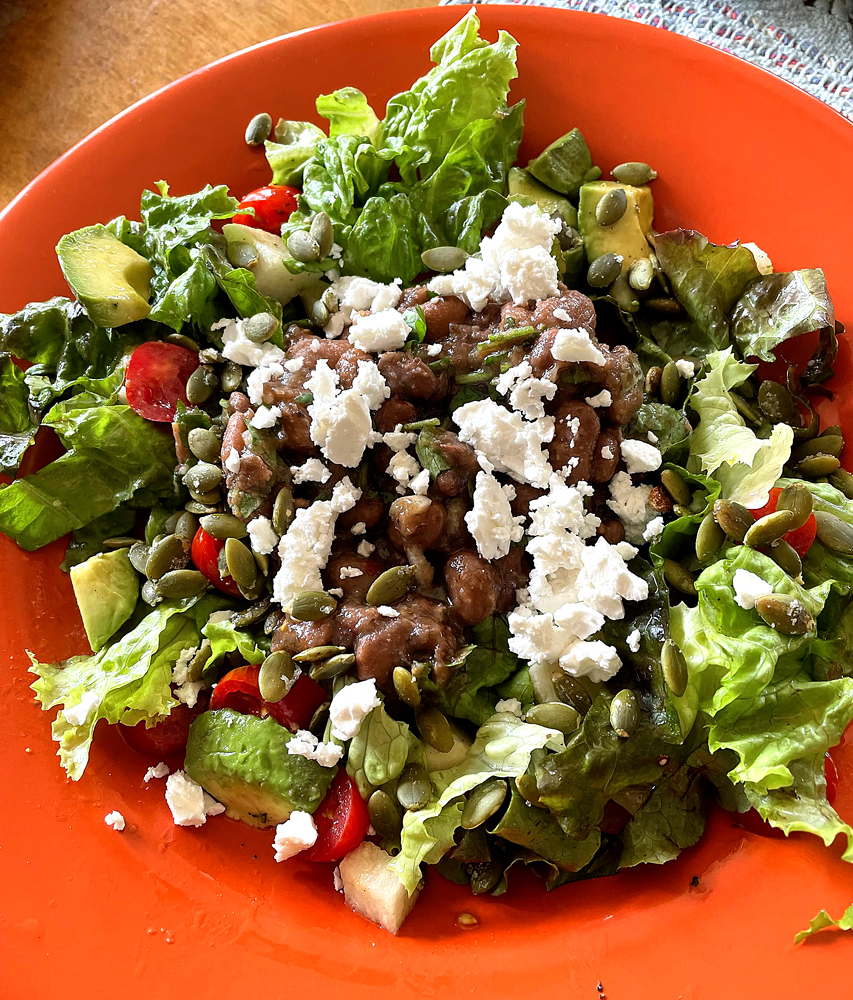
At serving time, add a handful of cilantro, roughly chopped. Serve over salad greens, halved cherry tomatoes, and avocado chunks lightly dressed with olive oil. Top with crumbled feta and toasted pepitas.Enough for 2-3 servings.
The lavender is blooming amid a plethora of wild roses.
Recently I had dinner with my friend Barbara. She’s an Islamic art scholar with a specialty in miniatures. She knows the art and its history inside out. She can recite dates, places and tell you what was going on in Persia or Pakistan or wherever at the time the art was made. She’s written many books and is as much of a misfit in this rural part of America as I am. Maybe that’s what brought us together 31 years ago when she bought my baguettes and bunches of basil at the Farmer’s Market in Linn.
But can she remember names of flowers or what they need and like or how to propagate them? Give me a break. Of course not. She’ll call me and say something like, “that little white flower you gave me, what’s it called?” And I rack my brain trying to come up with the name of the correct flower from that lengthy description. And if I ask her to describe it, she’ll mumble and fumble and fail to use any descriptive words like she does in great detail in her Islamic art books.
Yes, yes. We have our passions. We have our failings. I give blank stares about so many things. I don’t expect people to know what I know about botany. BUT!! I was horrified when Barbara told me she sprayed some nasty bugs (the carcasses of cicadas, all three of them) because she thought they were eating her Rose of Sharon shrub. GRAB POISON, SPRAY, then ask questions. As we sat on the back deck she pointed at the Rose of Sharon and the fact those bugs were still there. I went closer to investigate and did indeed find the shells the cicadas shed when they molted. I closed my eyes and tried to calm myself down, all the time thinking, “us ignorant Americans”. How often we react instead of try to understand what’s going on. Barbara has spent her life with a can of poison at the ready, never curious as to how Mother Nature works. She wants her beautiful garden to be perfect. Period.
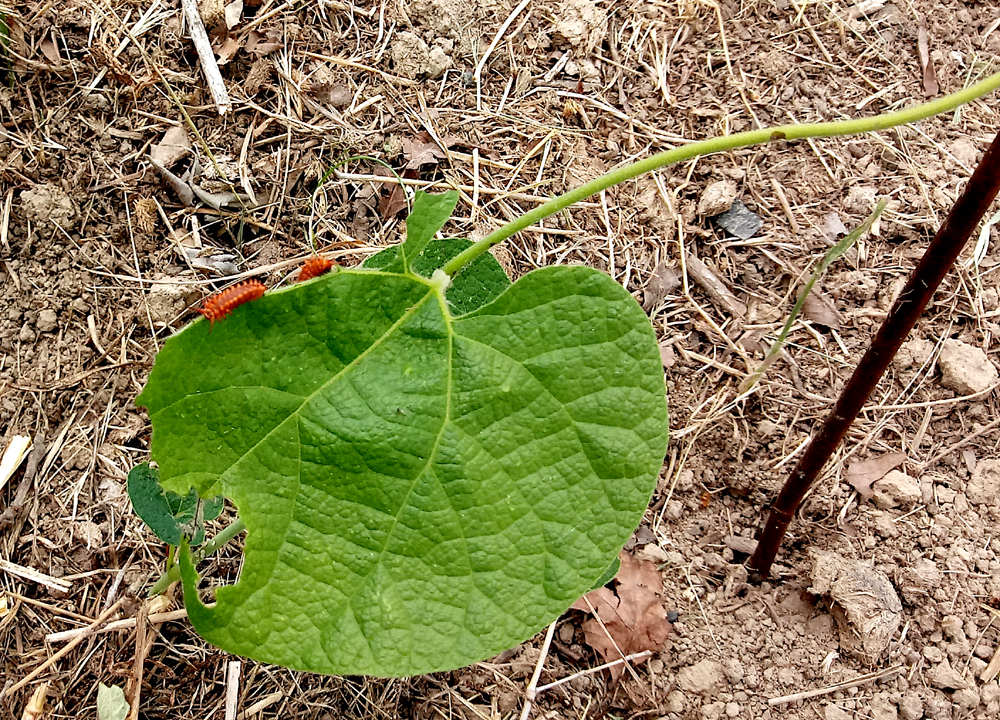
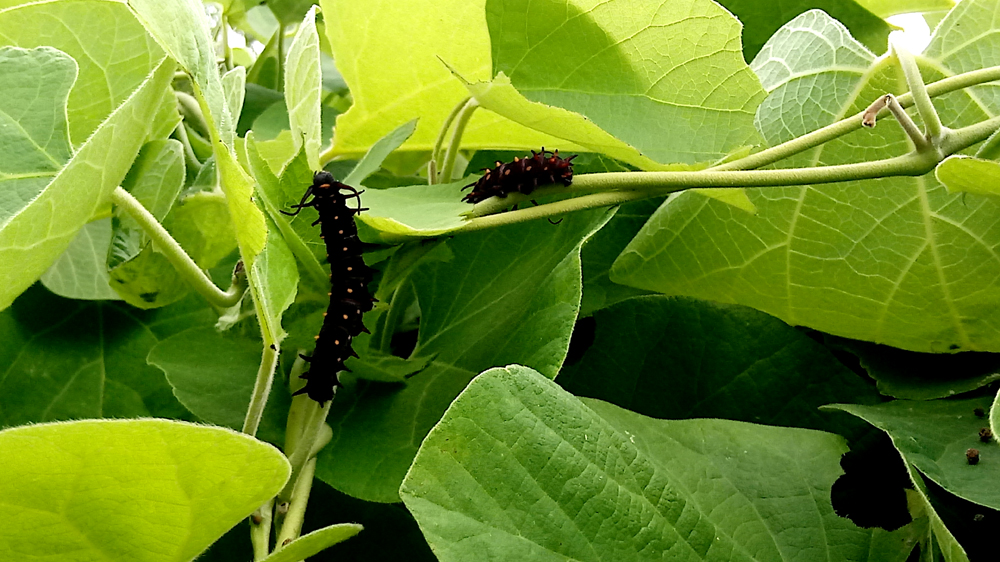
Pipe vine caterpillar before color change.
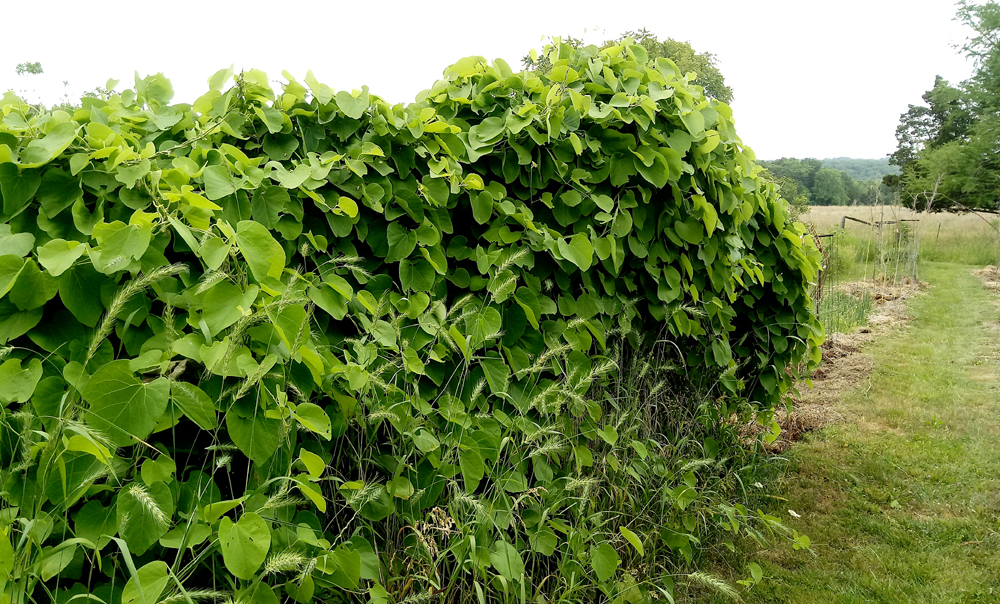
Her garden may be perfect but not to the bees and butterflies. Few pollinators visit. A residue of poison lurks whenever I visit. She forgets my words before I leave and uses her spray can as soon as she sees a bug. Ahhh… So I pondered what she would do if she had a wall of pipe vine growing on her fence instead of the euonymus.
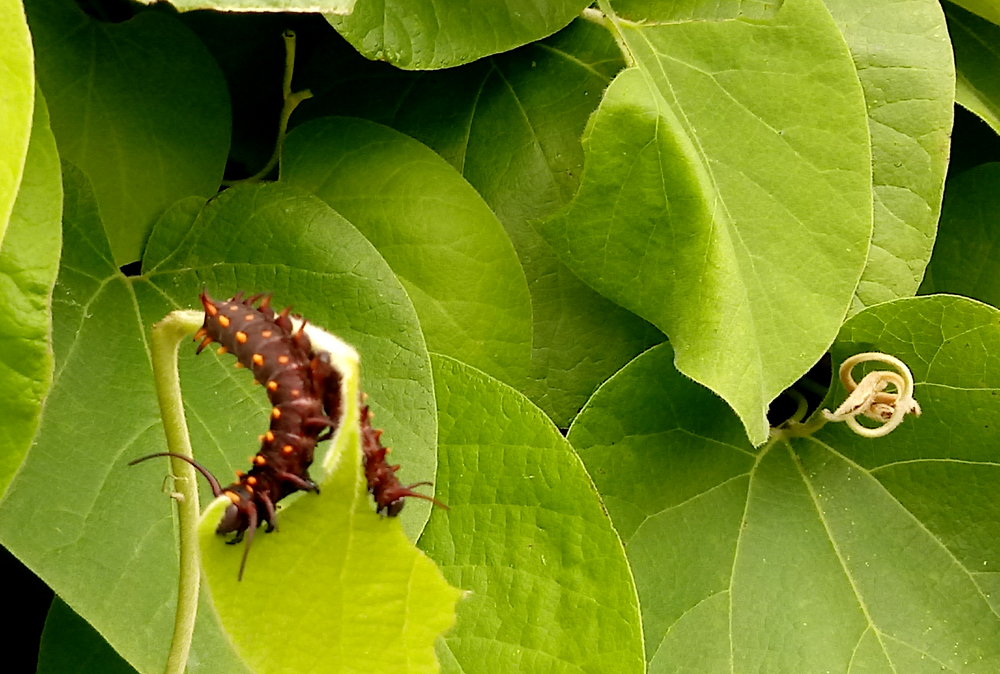
Caterpillars almost ready for chrysalis.
Now hundreds of caterpillars, in all stages of development, devour the leaves of the pipe vine. Sometimes there’ll be two caterpillars on one leaf. (Notice the color change from the young caterpillar to the mature.) In a few weeks we will have riches of this butterfly visiting the gardens.
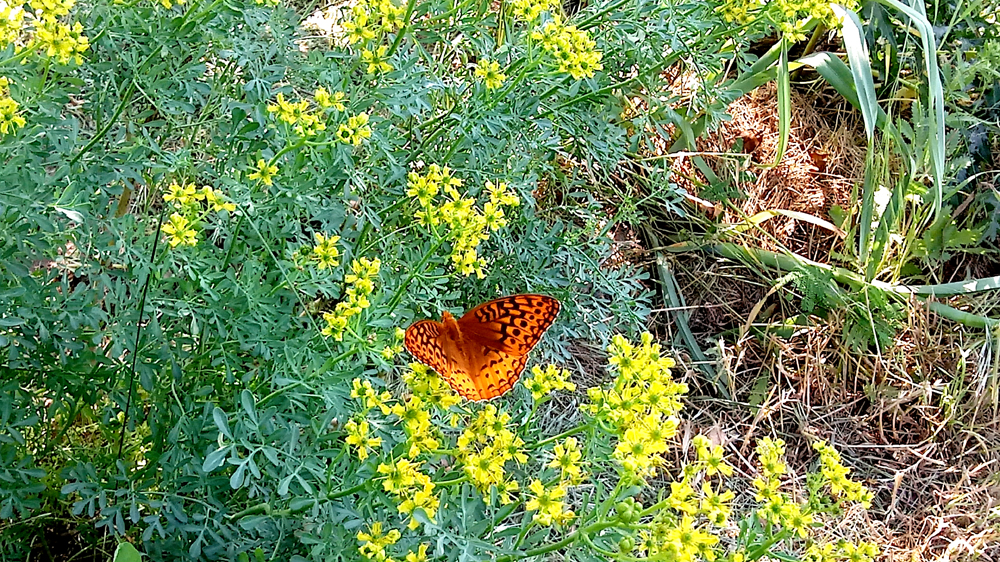
The Great Spangled Fritillary has had its moment. I’ve tried to capture the 15 or more butterflies that will flit around the rue or grey dogwood or red clover at one time, in one part of the garden, but as soon as I move, they fly around. They’re everywhere because the nectar plants they love are too. It feels magical to walk through a haze of butterflies, wondering if one will get trapped in my hair.
Great Spangled Fritillary on the rue.
I came in from weeding and found this inch worm on my shorts. They fascinate me. I kept watching this one scrunch up its body and do the measuring thing. Such fun and what a cool way to move through the world. A great move for a hip hop artist!
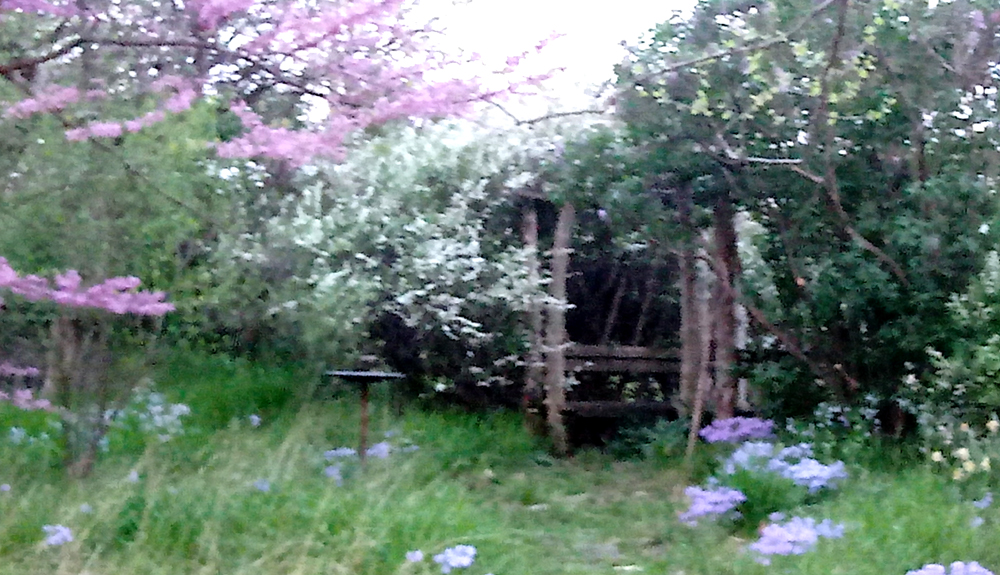
Some times life is out of focus!
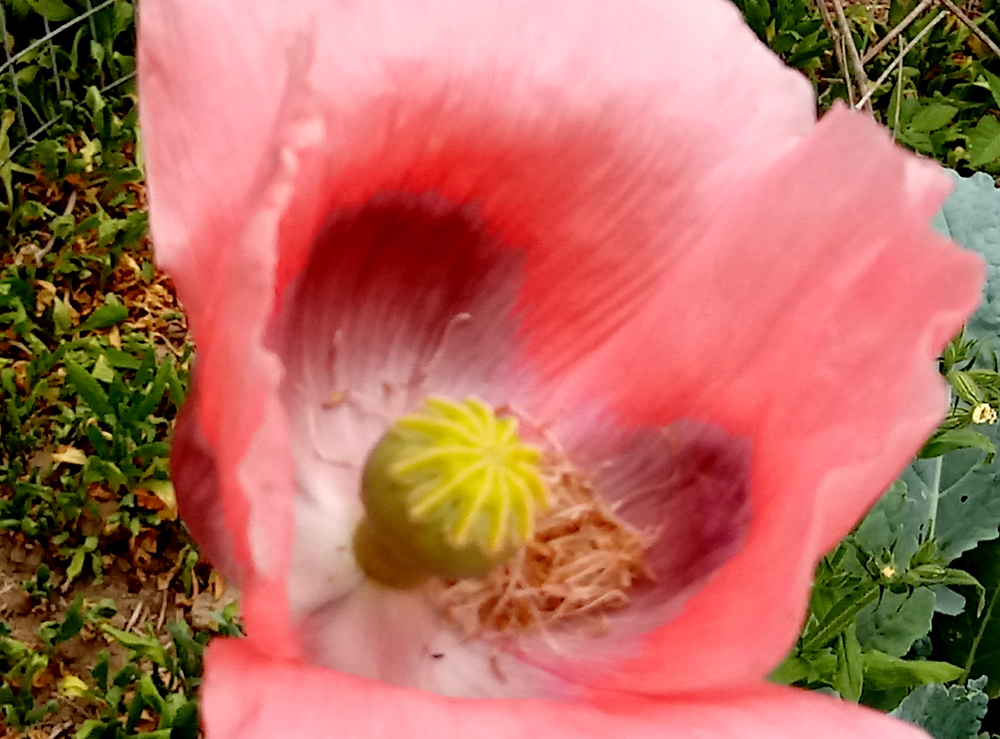
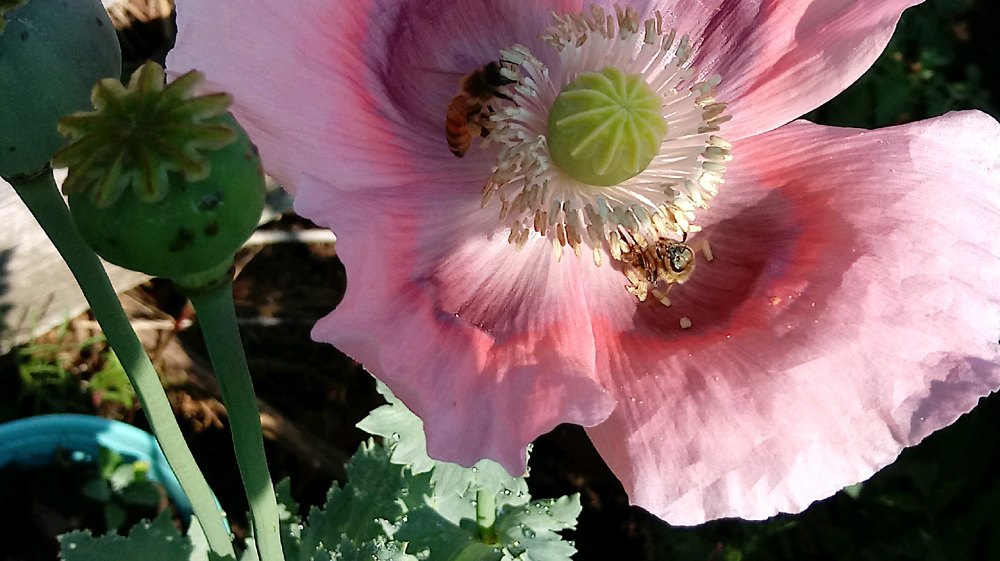
The Flanders poppies bloom around Memorial Day. What a beautiful flower to commemorate our fallen soldiers. The flower makes such a bold presence and I can only imagine what the field in Flanders must have looked like before modern agriculture disturbed the poppies after World War 1.
Notice how the bees have literally rubbed the pollen all over their bodies, hence the stamens, the male part, lays in a puddle while the pistil, the female part, stays erect. Sometimes, early in the morning, while it’s still cool, I’ll find a bee laying on all the stamens in the flower, fast asleep.
Stamens in tatters.
When well-intentioned neighbors stop by to visit and offer to cut my tall grasses and “weedy” areas (their words, not mine!). I demur and say thank you, but I love it just like it is. I feel sure they go away feeling like I don’t know what I’m doing and that my yard just doesn’t look “right”. I understand. We all see the world differently. I try to remember that when someone has a can of poison in their hand.
We’ve been in a rainy weather pattern with grey skies and cool temperatures.My walks in Apple Valley are accompanied by wonderful scents of flowering plum and apple, all the aromas heightened by the moisture. All sorts of birds trill away as I attempt to spot them in the new greenery. My Merlin bird id app heard lazuli buntings, hummingbirds, grosbeaks and tanagers among others today. At first we welcomed the moisture to our parched soil but really – enough already. I’d like to get into my garden and do some planting. And our poor driveway with its rain eroded gullies needs a good grading.
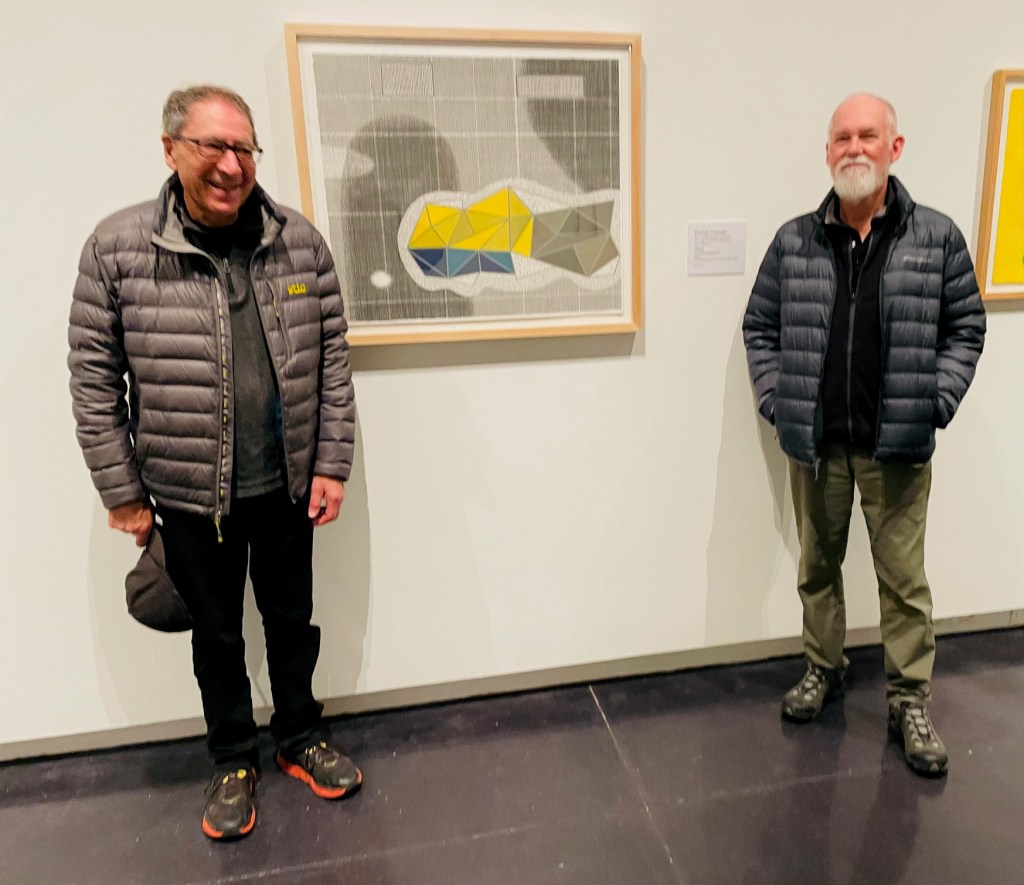
Bud and Rodney at the CU Art Museum exhibition. It’s up until the 15th July. Go see this wonderful show.
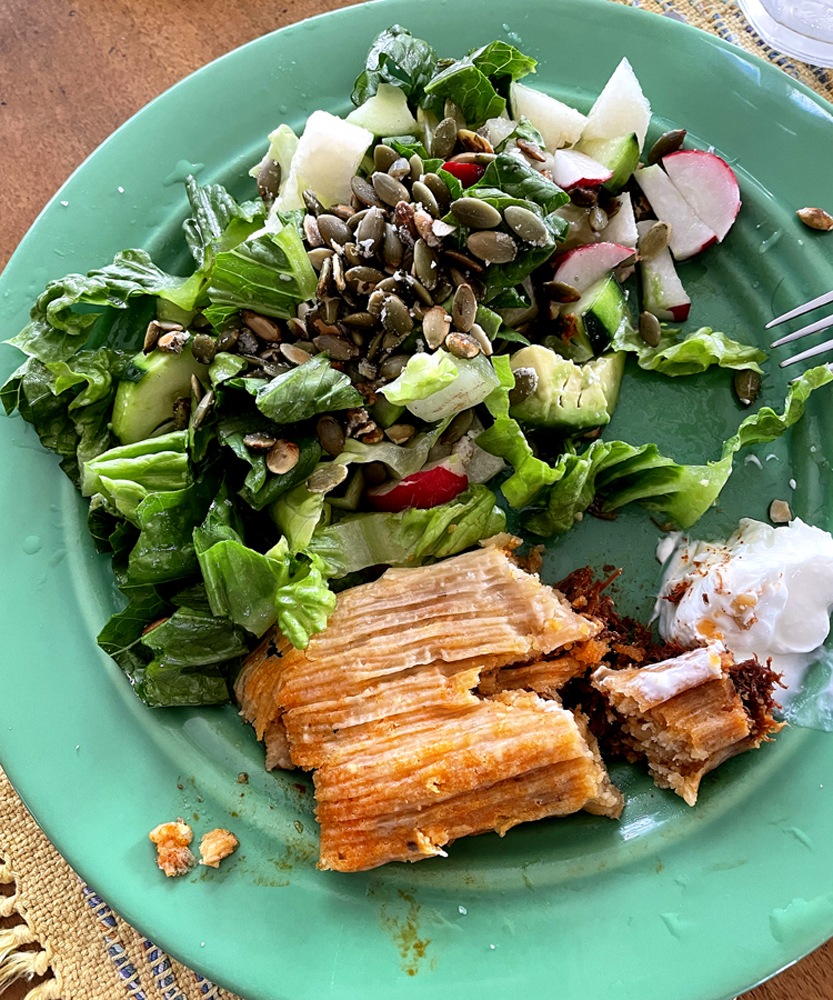
Rodney Carswell was here making prints and we had a great time over dinner reminiscing about our days at UNM, our art professors and fellow art students. And of course we talked about aging, food, movies and restaurants. Rodney brought gifts of New Mexico red chile, Shed Red, and El Poso tamales. One Friday during his stay I made a big salad and shared the tamales with the crew.
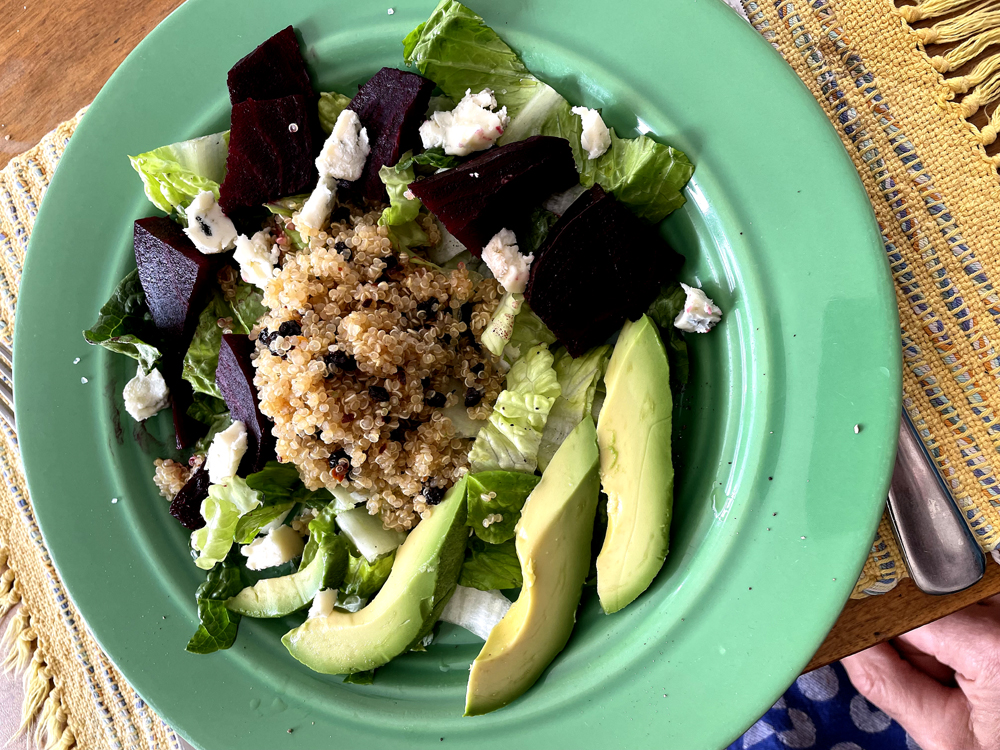
Most days we eat salad for lunch as you know from my many posts about them. I try new combinations depending on what’s in the pantry and fridge, what leftovers need to be eaten up. I have a fondness for beets with blue cheese, white beans with a mustardy vinaigrette and toasted pepitas, walnuts or almonds topping everything. Here is a quinoa salad accompanied by beet wedges, Amish blue, and avocado over chopped romaine.
Cook quinoa like pasta. Fill a saucepan half full of water and bring to a boil. Add a cup of quinoa and cook for about 12 minutes, until tender but not mushy. Drain. Combine the cooked quinoa with this vinaigrette: the juice of a lime, 1 teaspoon freshly ground cumin seed, a big pinch of hot red pepper flakes, salt, 3 tablespoons olive oil, 2 tablespoons of dried currants.
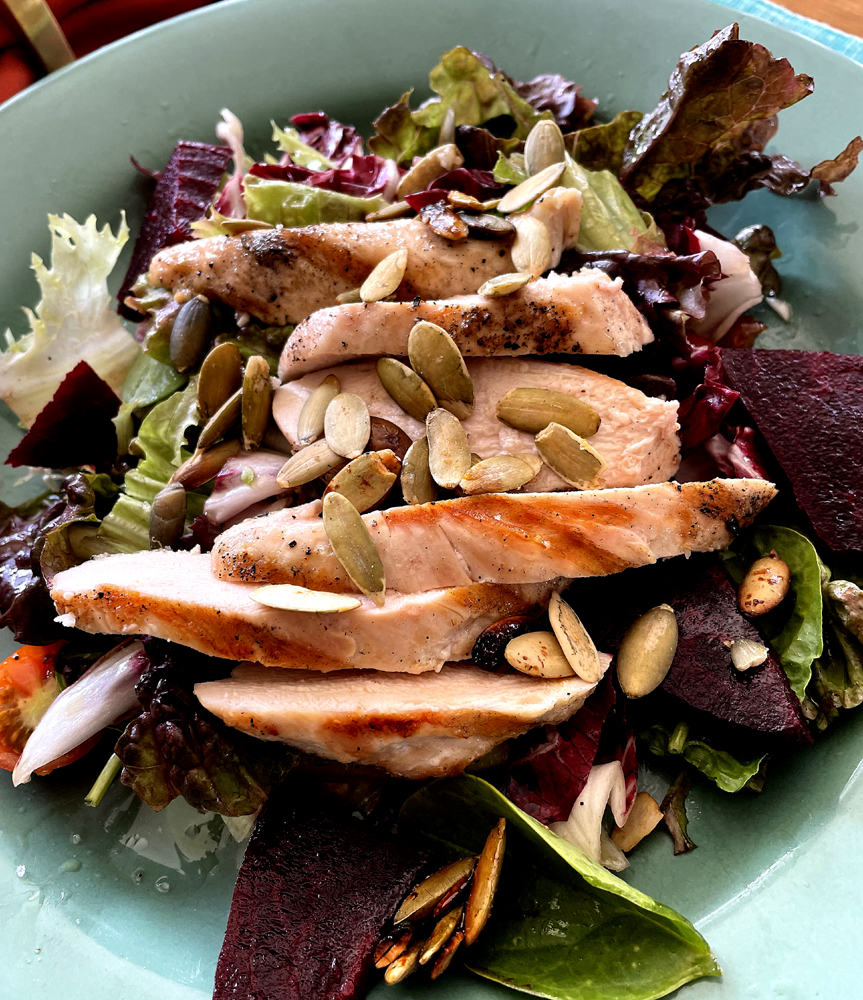
We had grilled chicken over a salad of radicchio, arugula, and red lettuce with beets, cherry tomatoes and toasted pepitas. I have found that out-of-season tomatoes are greatly improved by marinating them with salt, pepper and some olive oil while assembling the other parts of lunch.
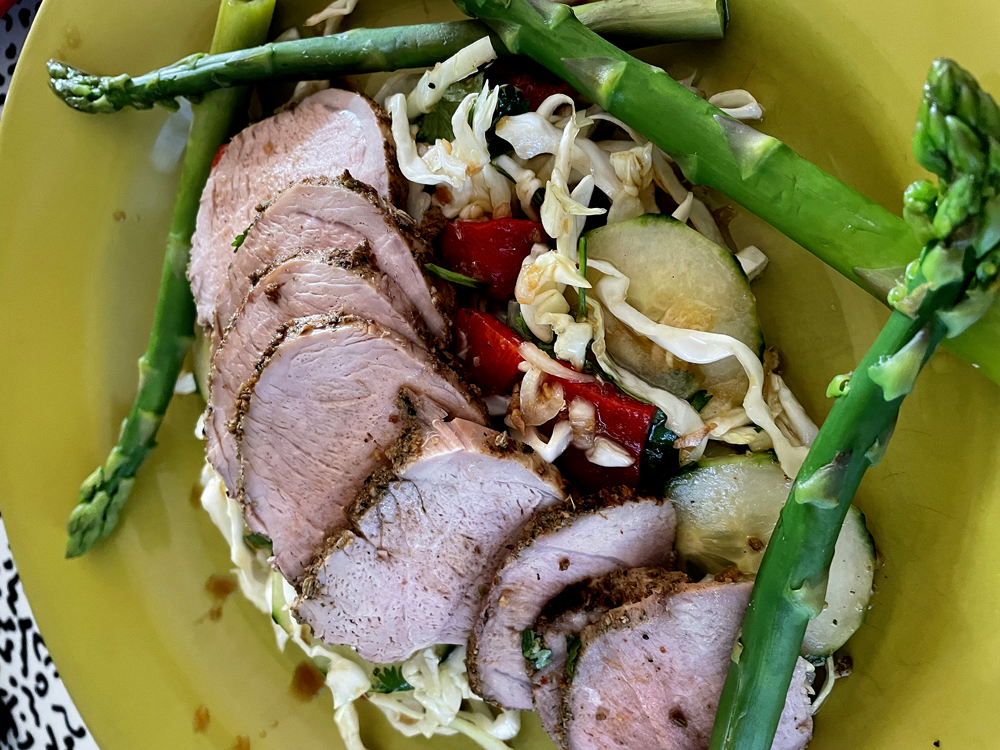
Pork tenderloin is a delicious addition to a salad.
Make a dry rub with ground fennel seeds, red pepper flakes, salt and pepper and let the tenderloin sit in the fridge until time to grill. Drizzle with a bit of olive oil before cooking. On a hot gas grill, (400°- 450°) cook for 5 minutes, turn on edge and cook for 5 minutes. Turn again, cook 5 minutes and then on the last side, for 5 minutes. An instant read thermometer should read 145°. Let rest for ten minutes before slicing. I served this with a cabbage slaw, roasted red pepper, cucumber and asparagus.
On one of the cold, rainy days I made a Bison Bolognese sauce to have with pasta.
In a heavy pot like a La Creuset dutch oven, heat a tablespoon of olive oil and sauté a chopped onion, a chopped carrot and a chopped rib of celery until lightly cooked, not browned. Add a few cloves of garlic, chopped, and a tablespoon of tomato paste. Stir in a pound of ground bison, breaking it up, and cook until the pink is gone. Pour over 1/2 cup white wine and let it evaporate. Add a small tin of chopped tomatoes and a cup of water. Bring to a simmer and cook at low heat, covered, for as long as you have, preferably two hours. Check to be sure the mixture doesn’t dry out. Add water or stock if necessary. Serve tossed with pasta. Top with chopped parsley and parmesan to add at the table.
The grass is tall, the apple tree is blossoming, more rain in the forecast. Ah, Colorado spring.
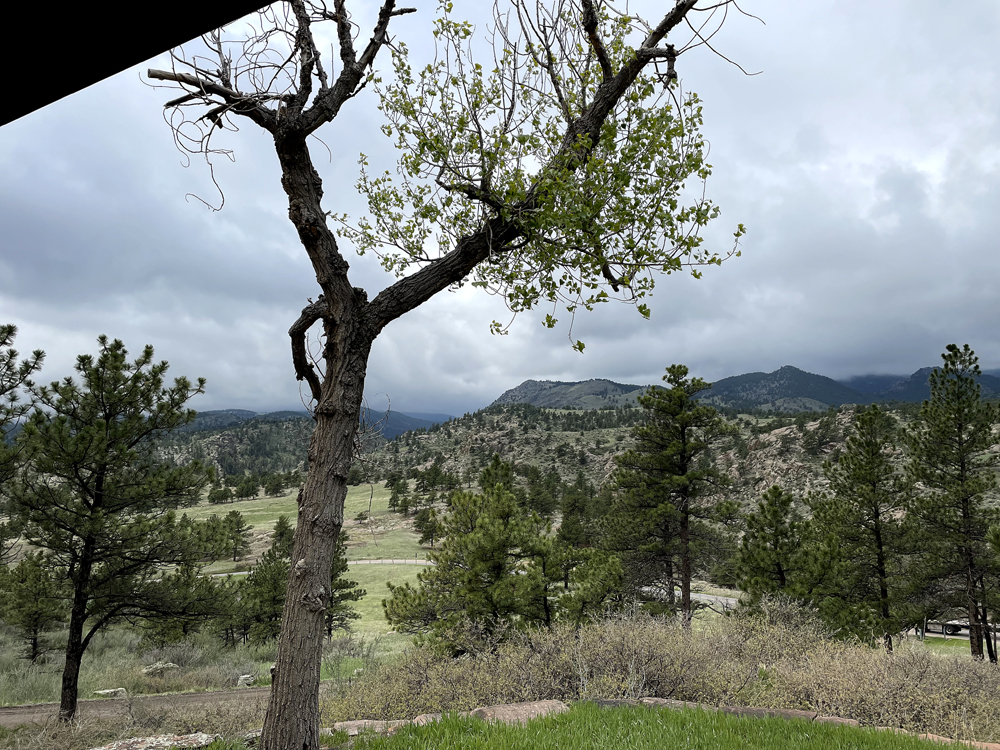
A huge cloud above the sandstone cliff before the rain.
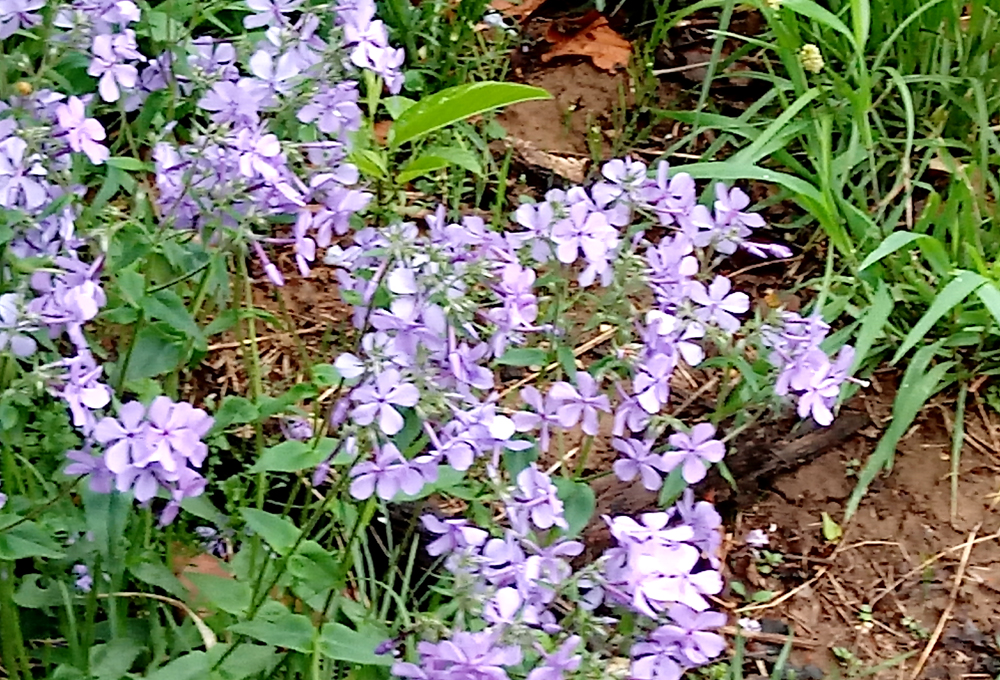
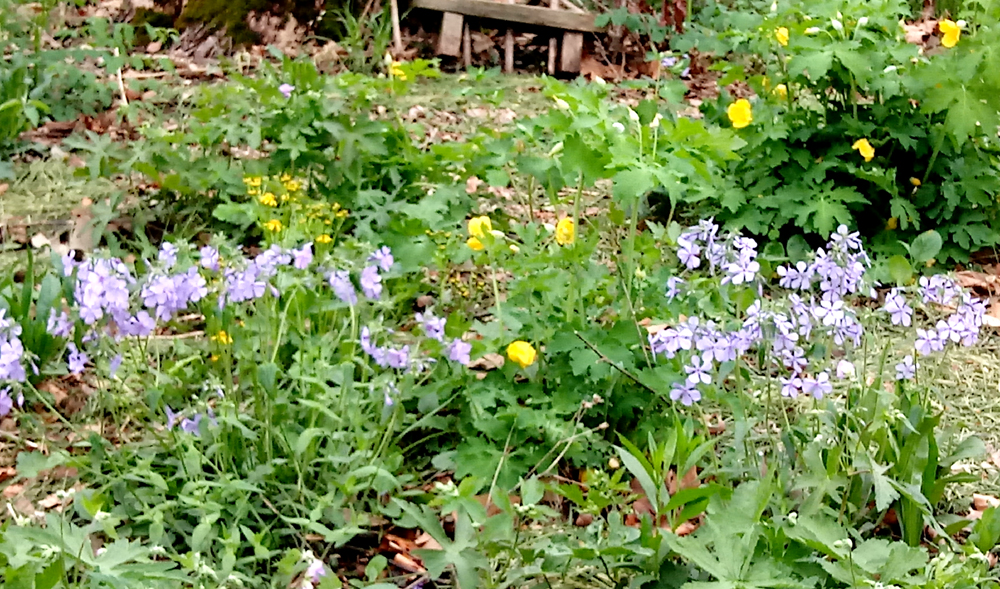
Our homestead finally decided to embrace wild Sweet William. For 41 years I’ve admired this early spring wildflower richly blooming along creek banks and in those shady areas on the edge of woodlands. In spring when we’d drive ‘Ol Red, our 1962 red International pick-up, to visit friends in Bay, we’d pass by Second Creek where the trees hadn’t leafed out to hide the show the Sweet Williams put on. It was simply breathtaking, all that lilac-purple caressing our eyes after a winter of browns and grays. Ron always drove slowly but when we’d approach Second Creek ‘Ol Red crawled. We both felt spellbound by the soft haze as a spring breeze enticed the flowers to sway. It was a gentle prayer to spring and all her possibilities.
For years I tried to get a start of this flower. They were not easy to dig out of the gravelly soil and I didn’t have enough experience to know just what to do. I simply wanted them and kept trying and failing. In 1989 I discovered Missouri Wildflower Nursery in Brazito, a long drive from Strawdog, especially in the old truck. Every spring I would make the pilgrimage and look and look at all Missouri’s native plants, then buy a few, always a wild Sweet William. I still didn’t have a sense of how to recognize where a plant would grow, perhaps because the homestead hadn’t developed enough to have micro-environments. When I look back at all the failures I realize what persistence it takes to make anything thrive, except of course, that which we don’t want. It’s a fickle world indeed.
Finally, after 15 years, one plant survived under the wild plums we planted along the walkway to the house. And then that Sweet William came back in spring with another seedling, precious jewels to my eyes. As they slowly, slowly increased, I would move one seedling to a new spot. Sometimes I chose well, other times they didn’t make it through the spring season. (I think of Dolly Parton’s song, Wildflowers. There’s a line, part of a refrain, “wildflowers don’t care where they grow”. I want to write Ms. Parton and explain to her that they do care where they grow, they have particular demands, but once you meet those requirements, they luxuriate and thrive. But of course that truth would ruin her song and she’d have to come up with totally different lyrics and since it’s such a pretty song, I let that one go.)
Now that hundreds, maybe thousands, of plants grow with abandon, I remember the process of making a home for these beloved wildflowers. How do you teach an adult in our digital culture, let alone a child, to have faith in time and experience and not expect immediate results? For me, not a patient person, I realize my main gift remains persistence in the face of defeat and feel humble and grateful for that seemingly bland quality. Of course the head gardener guffawed at the philosophizing that I regrettably shared with her, including the Dolly Parton story.
Sweet William and celandine poppies
After I’d pointed out the redbud seedlings we’d left over the past few years, she interrupted me and said, “Not WE, that was just you. I wanted to leave them all. You do all that highfalutin’ talking about where a wildflower will grow and how you’re so persistent and then when a redbud decides to grow somewhere, you don’t let it. You’re just all talk. And then to think you’d go and ruin Dolly Parton’s song!” Oh dear what a land mine I stepped into. Maybe I do talk too much with the head gardener. She doesn’t get my sense of humor. If she knew she had been pulling up thousands of redbud seedlings over the years, she’d be livid. She doesn’t recognize the seedlings when they’ve just sprouted and I say, yes, that one should go, when we’re weeding together. Redbuds would grow in every nook and cranny of this fertile soil, if we let them.
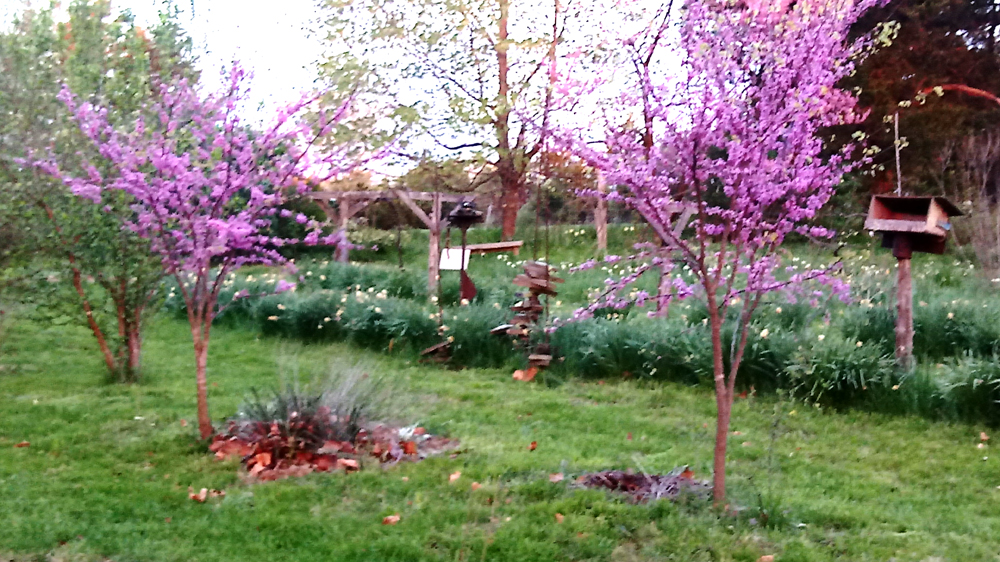
I try to explain to her that one redbud tree will provide enough shade so we can sow specific native plants under the canopy, decrease the grass growing there and thus allow us to stop mowing. My big goal is to reduce the mowing so when I’m not so strong, there won’t be much to mow. Maybe a pipe dream, but… And it’s working. Look at these 4 year old young redbuds grown from seed, blooming for the first time. There are perhaps a dozen trees just like these scattered around the homestead. When a seedling escapes my attention, as SHE would never notice, I scan the territory and decide if it’s a good choice or not. The seedlings are easy to pull up the first year but require great effort the next and so on as they have a magnificent tap root.
Four year old redbuds
So I ask her, “Don’t you love the shade those trees provide on hot summer days, just slipping into the shadow of their leaves, lingering for a few moments, maybe even taking a brief rest?” “There you go again!”, she says, “always having to say something fancy. Just get on with the work.” I look at her and smile, maybe she has a bit of Ronald Reagan in her I think, then agree, and say yes, let’s move on.
After this conversation with the head gardener, I refrained from opining with her on how the redbud trees add another dimension to the landscape, I guess you could describe them as a flourish, that magical element that brings the surrounding trees and understory alive. I could not have pre-planned this. I did not have the vision or the luxury of time to see all the possibilities of the homestead. My nose was to the grindstone, like most of us in our daily working lives. Now that I can lift my head and stroll around, seeing what seedlings appear where and how they’d fit into the entire landscape, I have a new freedom. It excites me every day. Of course now I run out of energy and have to pace myself, but the vision becomes clearer and gives a thrill to these spring days.
And the early spring days fill with mowing and weeding, sowing seeds, setting out early transplants that can handle a late frost. I’ve admired this anemone, named after William Robinson, an English gardener in the late 19th century who advocated wild gardening, revolutionary in a time of formal gardens in England. A small colony has grown over 25 years and I revere this anemone as a tribute to him.
We now, finally, have some sensible spring weather after the heat wave of over 80 degrees for at least a week causing gardeners to lose their minds and set out tomatoes and peppers, sow bean seed and otherwise lose all control and run wild, working until after dark. Spring does do that to us, makes us madder than hatters running around like chickens with their heads cut off. Oh, too much philosophizing, I’ve been warned and will simply go gently into the spring’s night air letting all the fragrances seduce me as only spring can.
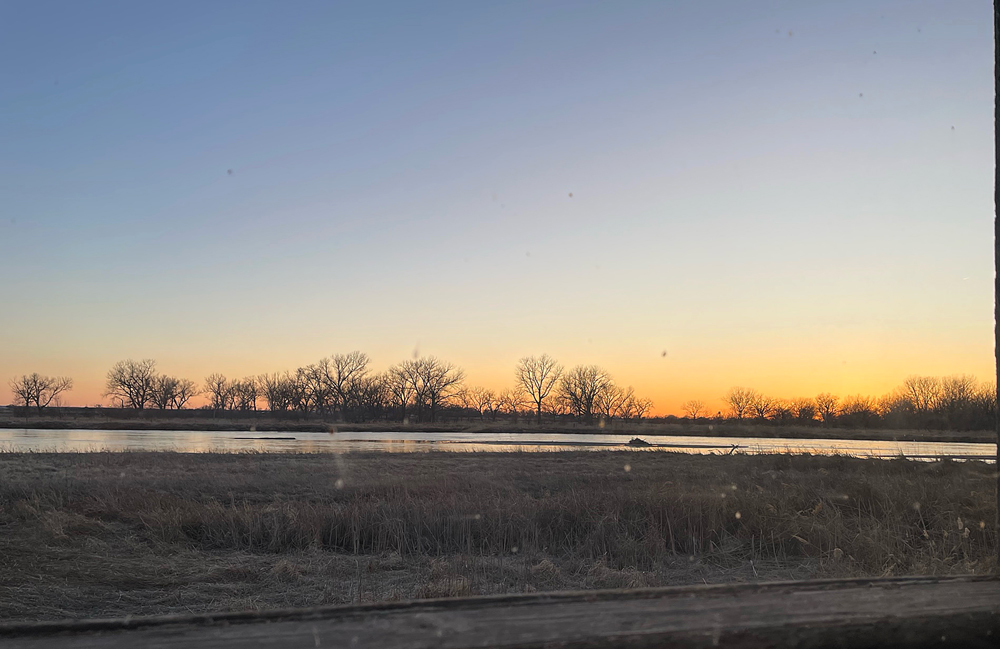
Twilight in Nebraska. Lines of cranes just barely visible in the darkening sky. Photo by Zoë
We took a trip to Nebraska to see the Sandhill Cranes on their migration north. Not knowing what to expect, we were stunned by the number of birds in the cornfields around North Platte, feeding during the day, then massing to roost in the river in the evening.
Thousands of cranes flying in long lines, swerving, flapping, forming v-patterns in the darkening sky. Swooping over the blind where we perched to watch this overwhelming sight accompanied by the cacophony of their calls.
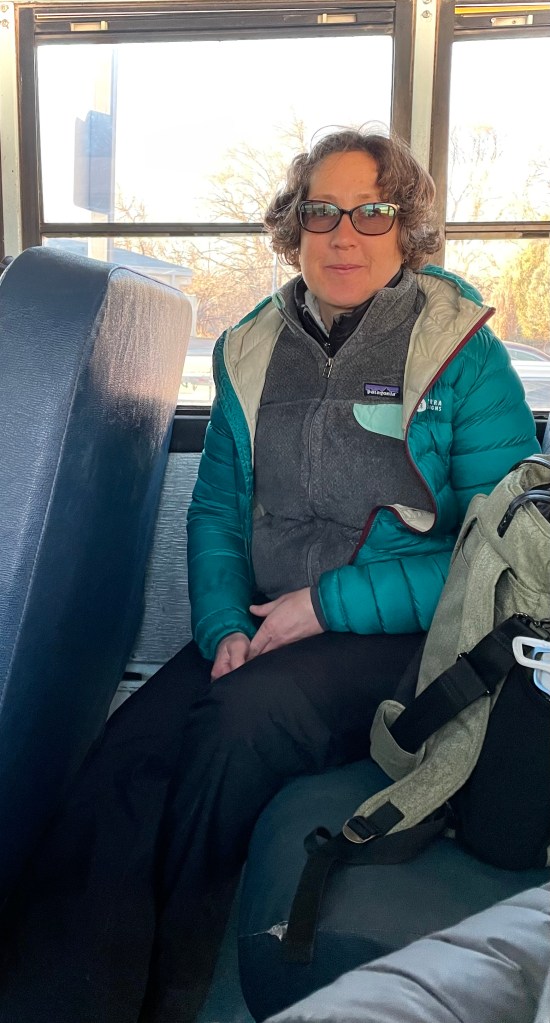
Zoë bundled up on the bus to the bird blind.
Today on Blue Mountain Road it’s windy, unsettling, howling around the house. I inventory the things on the porch and patio, checking to see if anything has flown. The ground around the house is scoured clean. We watch the acrobatic nuthatches, chickadees and finches at the feeders swinging in the turbulence, holding on for a bite before winging off. The laundry flaps and comes loose and I struggle to capture the sheets before they fly off.
The weather is changeable, deciding whether it’s winter or spring. Typical of our Colorado conditions this time of year. It’s been very cold in the mornings, winter cold, then sunny and in the 50’s.
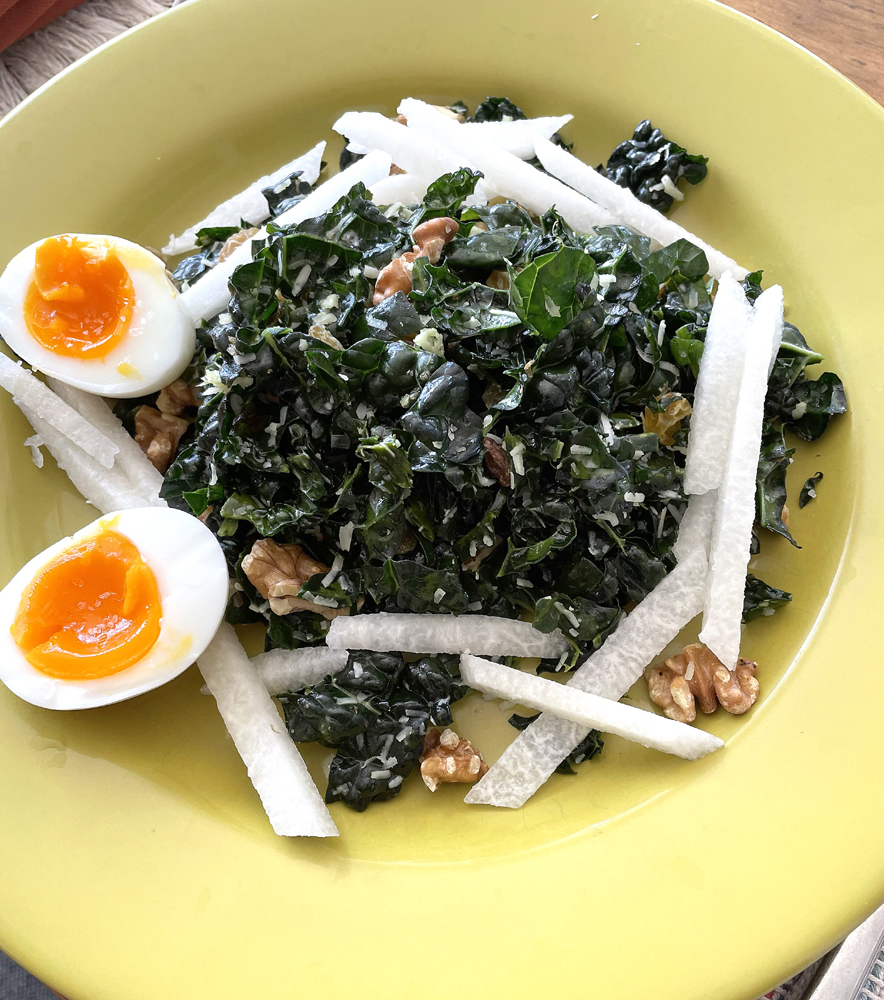
It’s hard to choose what to cook – a hearty pasta or grilled chicken and asparagus. I’ve made avocado toasts with smoked salmon and a kale salad with sultanas, walnuts and parmesan.
Kale Salad
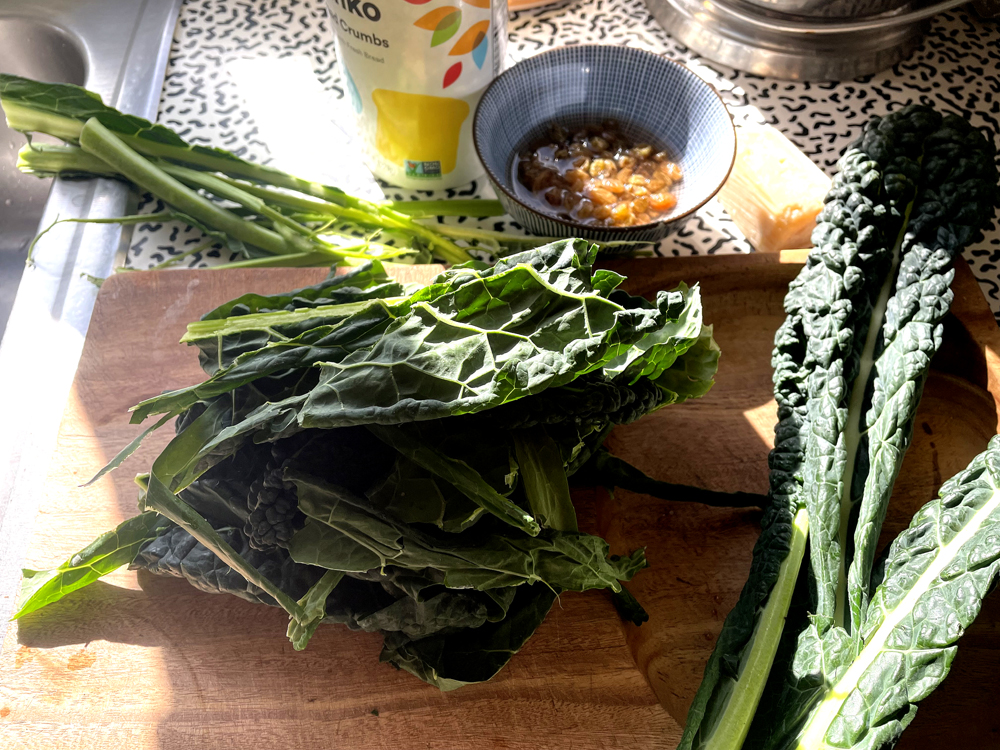
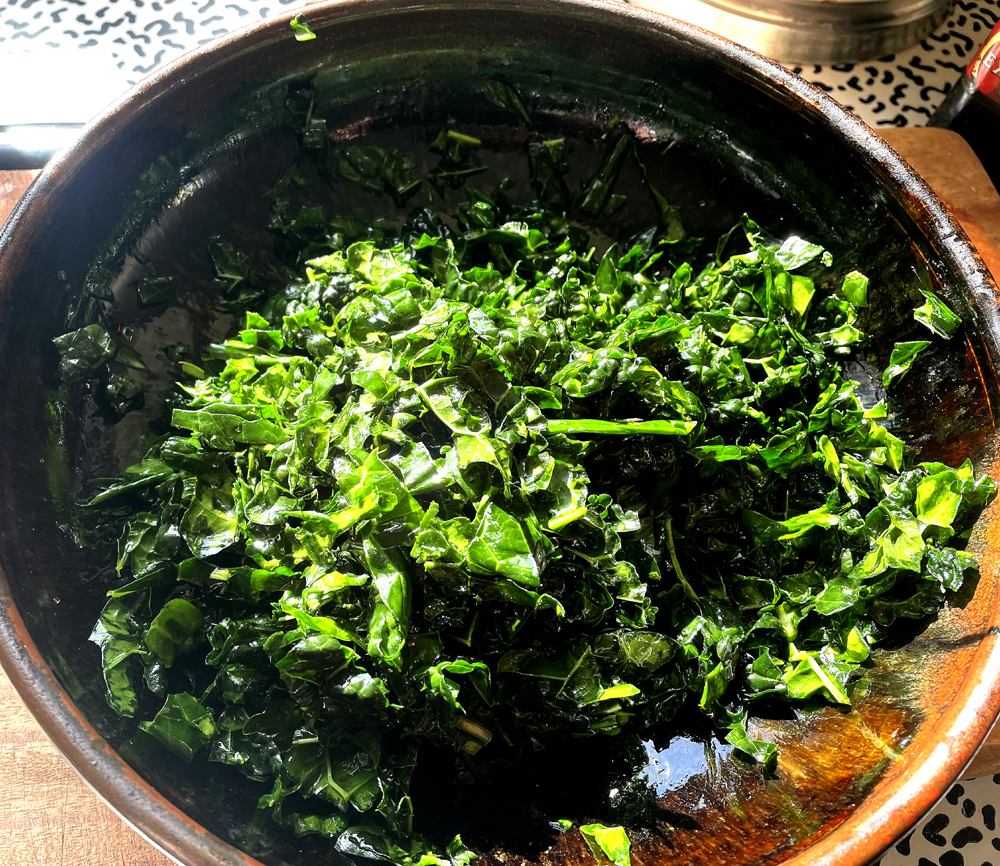
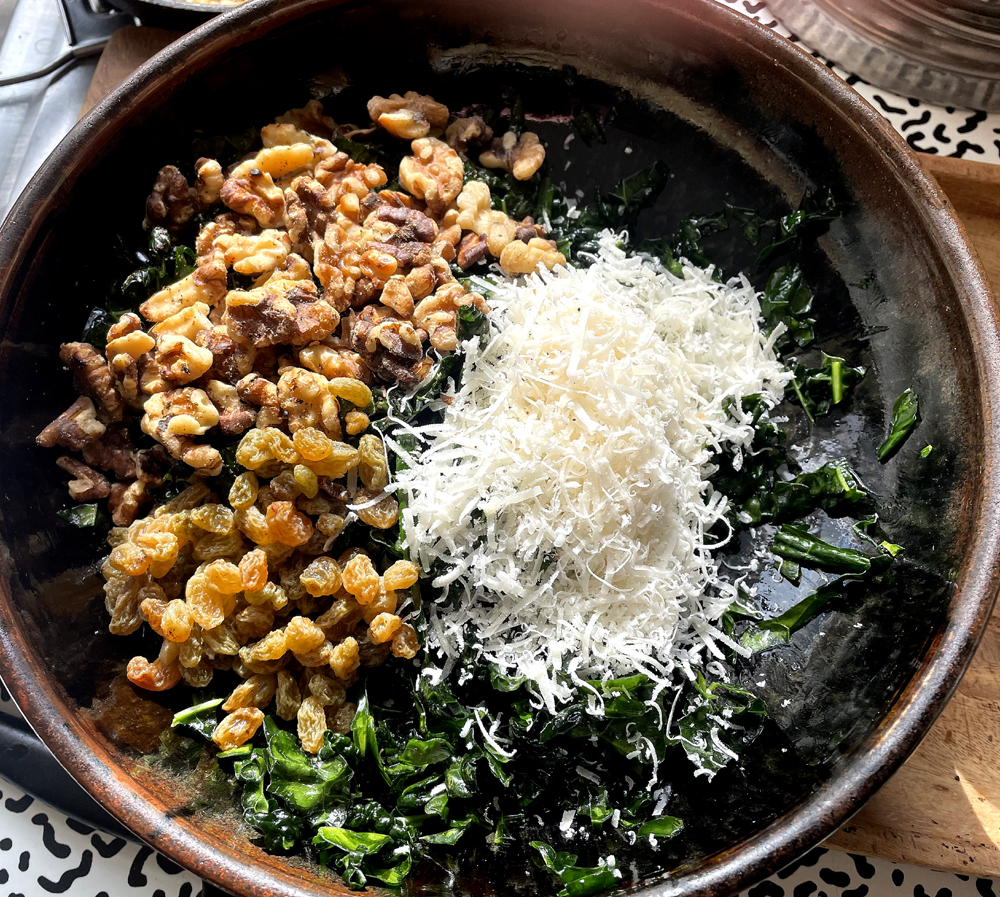
Cut the kale leaves away from the tough stems and slice into narrow ribbons. Put into a large bowl and add a tablespoon of olive oil and a big pinch of salt. Massage – squeezing and rubbing the kale until reduced to half its bulk, about 5 minutes. In a small bowl cover 2 tablespoons of sultanas (golden raisins) in a tablespoon or two of red wine or cider vinegar. Let marinate while you toast 1/2 cup walnuts. Stir 1/2 cup of grated parmesan into kale, add drained sultanas and walnuts. Garnish with julienned jicama, boiled eggs, avocado slices or cherry tomatoes.
For a celebratory dinner with Mimi Shark, due to visit this week, I plan to serve salmon skewers, (recipe here –Busy September) a barley and celery salad (After the holidays) and roasted asparagus.
So onward and upward. Spring vegetables are beginning to appear in the grocery stores and the farmer’s market opened this weekend. Hurray – and hurry – Spring!
I had to laugh. I sat down to write and immediately needed a title. That’s my way, a title before I begin to write. The title helps guide me, focuses my mind. This February has seemed like a little of this, a little of that, so I said: “Odds and Sods”, then, “didn’t I use that title before?” And sure enough, I looked in my files and found it. “Well, February doesn’t change names, why should I have to?” And so I haven’t, hence, Odds and Sods II. February makes me feel that way, although with the way the world spins, that may change in the future. Time will tell, as it always does.
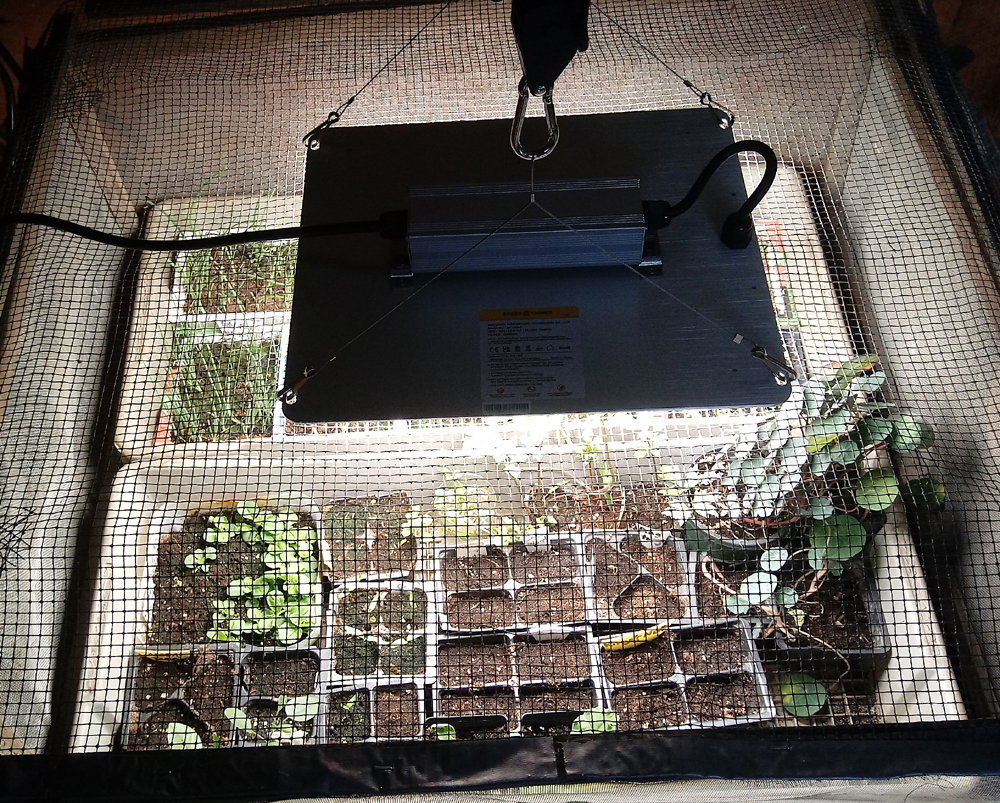
The Spider Farmer LED light has done its magic with the seedlings. The onions have had 5 haircuts since mid -January when the seed sprouted. And how satisfying to hold the mice at bay with the wire fortress I spent hours and hours making and remaking until it held together and I could easily take off the top to water, prune and transplant. This light has pulleys so getting in and out of this contraption takes no time. And seeing the seedlings in the morning, when the light comes on at 6 am, gives me a rush of happiness. The lavender seeds sat in the fridge vernalizing for 2 months. When I’d open the fridge I’d look at the flat and imagine seedlings filling it. Within a week after coming out from the cold, the new seedlings made me swoon. Seeds don’t come with guarantees, you never know if they’ll come up or not and you’ll often hear gardeners proclaim, “My (fill in the blank) germinated!!” A joyous moment indeed.
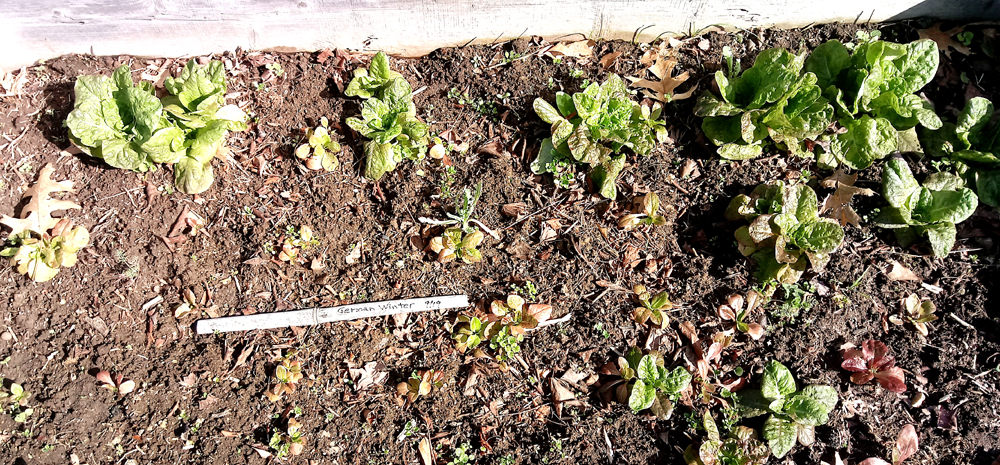
The German winter lettuce in the cold frame germinated last fall but has only recently become lush enough to make into salads. After a winter of eating cabbage salads, the fresh lettuce tastes like a gourmet treat. I put screens over the top at night as the ground hog continues to haunt the homestead and adores, absolutely adores, the fresh lettuce. We have that in common, I tell the head gardener, and she shakes her head at me like I have a screw loose.
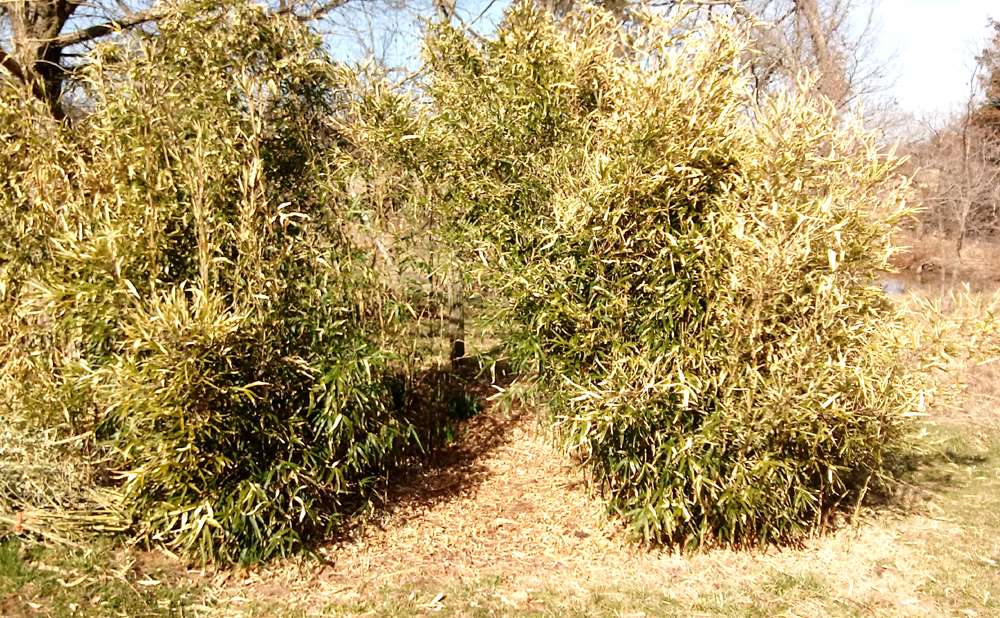
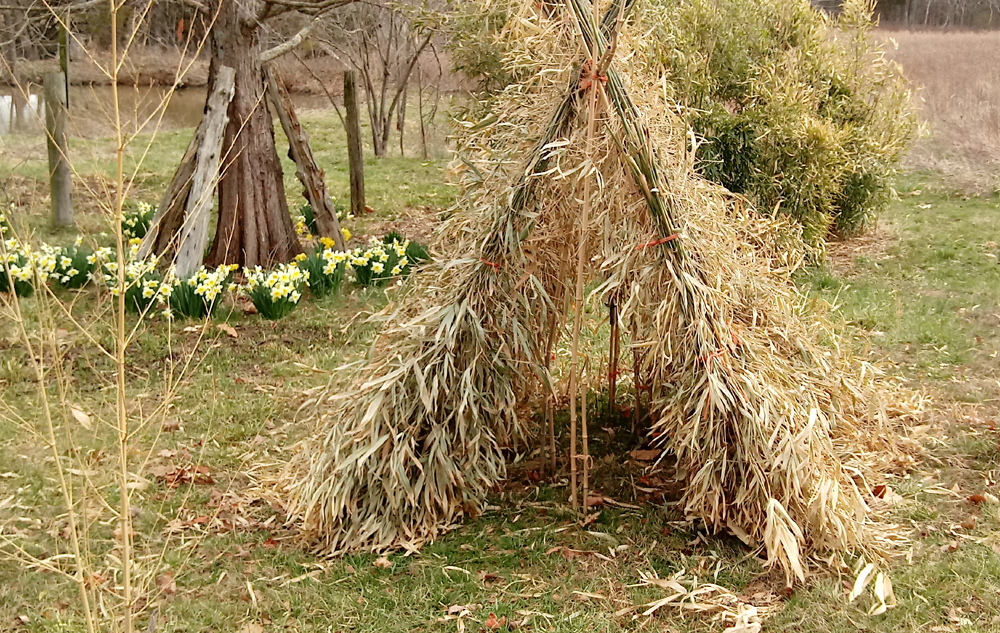
Near the cold frames stands the new bamboo drying rack. The bamboo grove had offered comfort only for the birds, not for me. I couldn’t get inside, feel snug and cozy out of the wind and blowing snow like I did as a girl under cedar trees. This demanded changes. On several sunny days, down on my hands and knees, I cut one bamboo cane after another until carved paths emerged and a refuge established.
I bundled 20 canes together and began to erect a bamboo drying rack. Once the leaves all fall off, I can trim the tops out and use the long canes in the garden or make trellises, etc. The rack is a place to store the cut bamboo. The stalks are so tall, it’s almost impossible to lay them down anywhere, plus, I get the sculpture the bamboo makes on its own. It took 5 iterations before the wind decided not to destroy my work and for a graceful structure to claim the territory. I call this “whirling dervishes” especially when the wind ruffles their gowns.
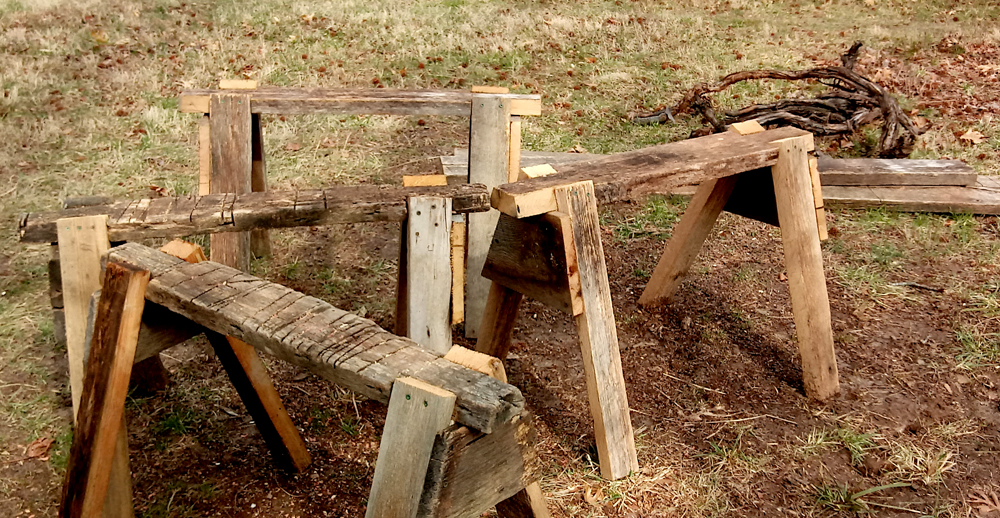
The legs of our saw horses finally collapsed. I decided to build new ones. Once into the process of cutting 18 degree angles on the top piece, where the legs will rest, I needed to enlist Patrick to do the plunge cuts on the side my saw couldn’t figure out how to cut, and too dangerous for me to attempt. After that rigmarole, I reclaimed the old tops, spending a day taking them apart, pulling nails, etc. and cutting new legs, all out of used wood in the old hay barn, my museum of many flavors. You can see the saw cuts on the old horses, such beauties, such history in each cut.
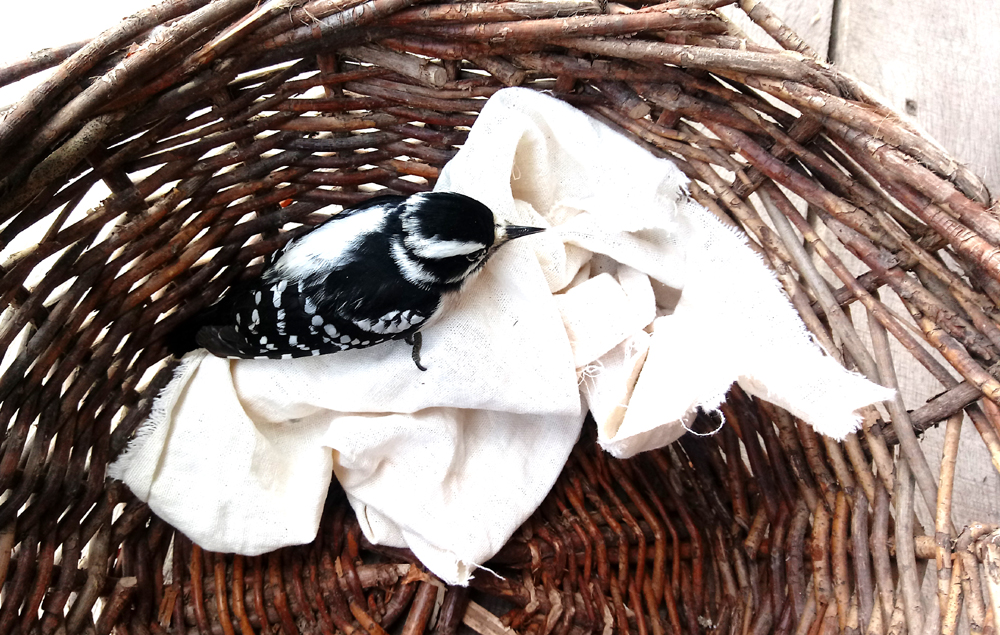
As I carried in wood for the night, I spied a downy woodpecker lying on the ground. When I came back for another armload of wood, she remained in shock, not moving. I feared perhaps Ninja, Petra and Patrick’s beloved cat, would come prowling by and decide on her for dinner. Ordinarily I don’t touch wild birds or any wild critters except the occasional tortoise on the road. Somehow she called to me and I brought her inside, put her in this basket, set it close to the fire, and hoped she’d revive. There was no movement for ever so long. Still, a basket over the top seemed prudent. Hours later I gently lifted the lid and saw her eyes blinking and just as quickly I closed the lid. I went up to bed hoping I’d find her better in the morning.
At about 3 am, as habit dictates, I came downstairs to feed the fire. It felt hot by wood stove and I worried the downy female might not like Florida, so I pushed the basket away from the stove. As I pushed, the lid tilted ever so little giving the now active female a chance to escape and me to groan at my foolishness. I have spent hours trying to get trapped birds out of the house, but never on a freezing night.
For 30 minutes it was a comedy act. She was obviously healed and not cooperative. She flew up, then over and down, high and low, in and out. With the front door open, the house cooled down in a hurry. Finally I trapped her, I think she was exhausted, and put her back in the basket, lid firmly attached, the house freezing. I would release her when the sun came up and watch her fly away, her ladder -back pattern disappearing into the white oak. Now when I see the female downys, I wonder if it’s her.
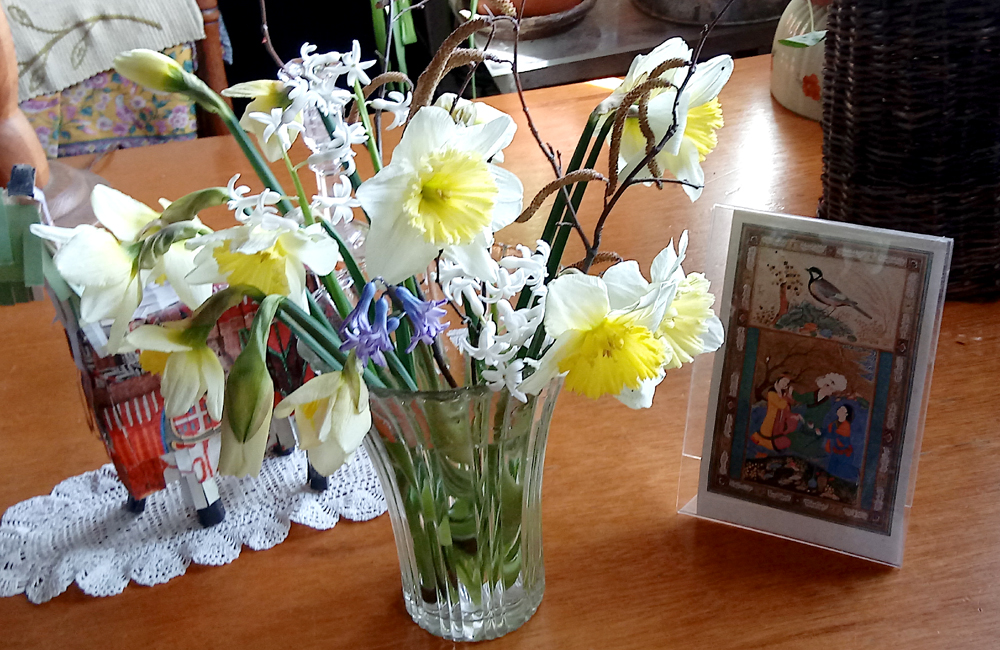
This is the 5 March, Year of the Dragon bouquet I sent virtually to my daughter-in-law, Lynda. For years I’ve written to her as Year of the Snake, only to discover I was off by a year. And she never called out my error. The hazelnut catkins and Roman hyacinth turned these ordinary Ice Folly daffodils into a lovely bouquet.
Indeed I’ve had computer problems. I never get headaches except when I have computer or phone problems, then I feel semi-crazy. Petra, Erik and Hilary saved me, with good advice, calmness, relating bigger and more serious problems making mine seem trivial and simply solvable with patience and logic. Grateful beyond words and a new computer to boot. Sometimes the cost of learning how to cooperate with technology seems way too high, but like all of us, I’ve grown used to the convenience and immediate gratification, so I pay the price, though not without complaining.
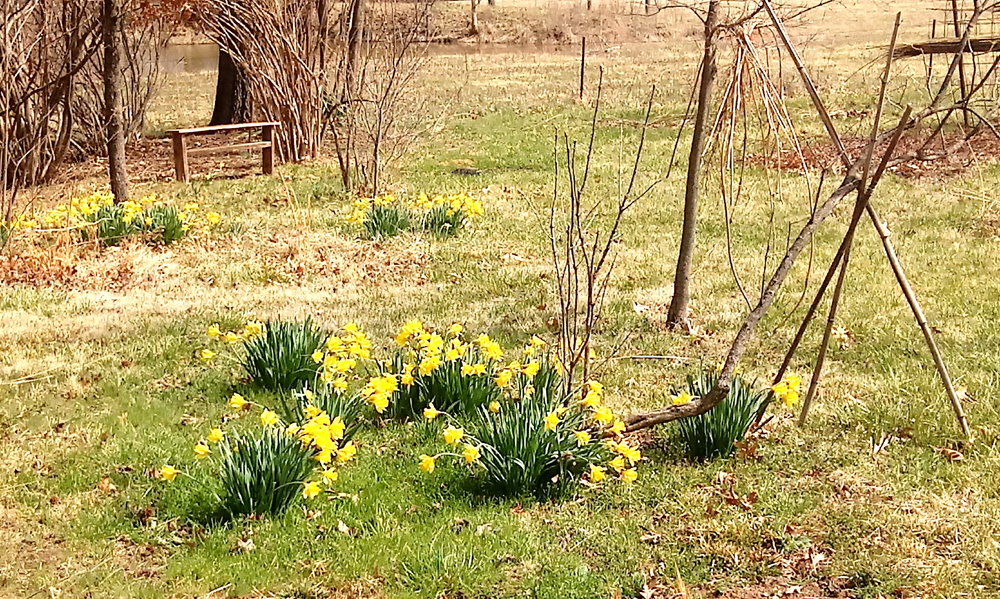
March came in like a lamb and now shows lion-like ways, chilly, damp, strong winds. The birds hit the suet feeders, I haul in more wood. Soup’s on the menu, red chile-potato with lots of fresh cilantro. Let the March winds blow as the daffodils proclaim spring.
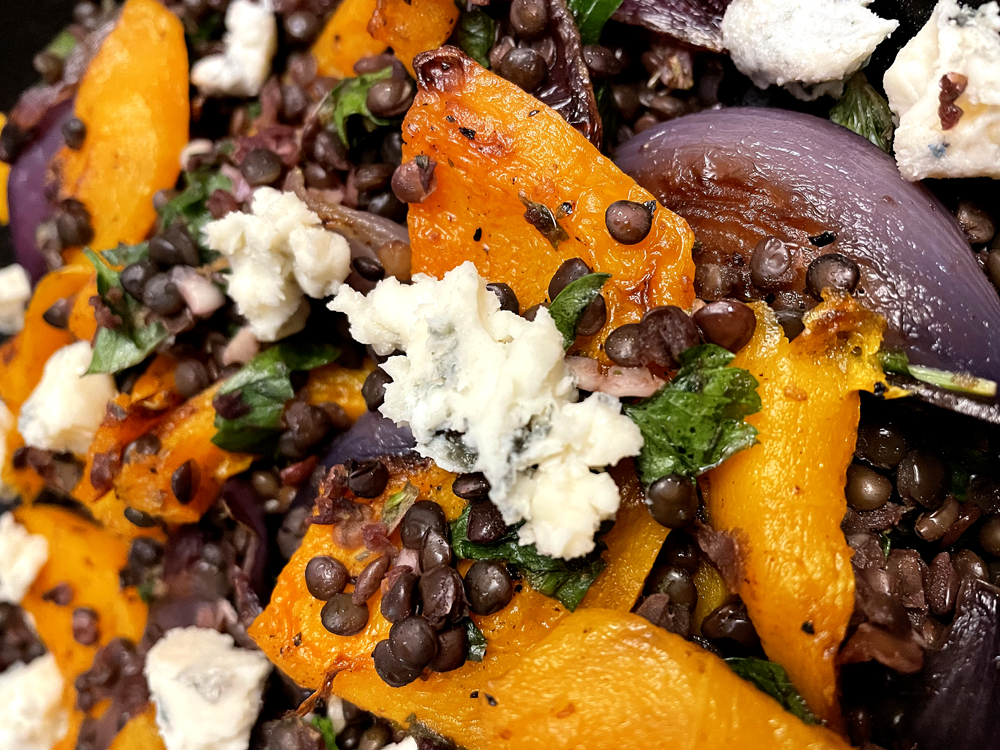
Mimi’s computer got fried so her essay and photos are temporarily lost. In the meantime, I thought I’d write about a delicious lentil dish I’ve been making. The recipe is in Ottolenghi Simple. Some would say that no Ottolenghi recipe is simple but with a little messing with ingredients and technique, they are well within a home cook’s abilities and time. This one in particular comes together with ease.
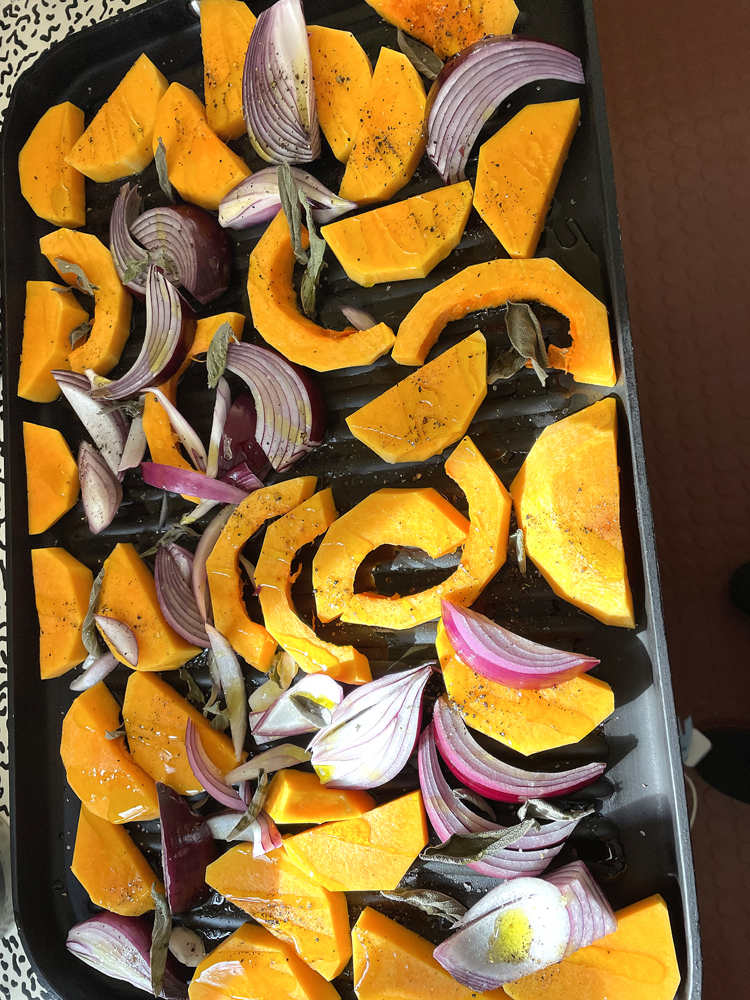
Roast 1/2 inch wide half-moons of a peeled butternut squash and wedges of a large red onion. Add 10 – 12 sage leaves if available. (I left these out of the final dish.) Toss with a tablespoon of olive oil, a sprinkle of salt and fresh-ground pepper. Place on a grill pan or baking sheet lined with parchment paper and roast at 400° for 20 minutes. Turn the squash pieces over and continue roasting for 10 – 20 minutes longer, until tender and a bit browned.
While the veggies roast, cook the lentils. Fill a medium sized saucepan halfway with water and bring to a boil. Add 1 cup of lentils, green, brown or black – don’t use orange lentils for this dish. Lower heat and simmer for 20 minutes or until tender.
Drain, then place in a large bowl. Stir in 2 teaspoons grated lemon peel, 2 tablespoons lemon juice, 1 garlic clove, minced, a handful of Italian parsley, roughly chopped, one of mint, if available, and one of cilantro. Add a pinch of salt and a drizzle of olive oil.
Top with 2-3 ounces of gorgonzola torn into smallish pieces. This is best warm or at room temperature.
I plan to serve this when Terry Maker and Chris come for lunch this week after she signs the edition of her beautiful new lithograph.
Terry Maker and Bud goof off by her beautiful new lithograph.
After a long break without artists in the Shark’s Ink. studio artist Terry Maker arrived to make a new print. Each day I prepared a special ‘artist’s’ lunch. As is my wont, I mostly served salads accompanied by Moxie bread – brought by Terry from the original bakery near her home in Louisville, Colorado. (We also now have a Moxie Bakery in Lyons, lucky us.)
Here is a selection of some of my concoctions.
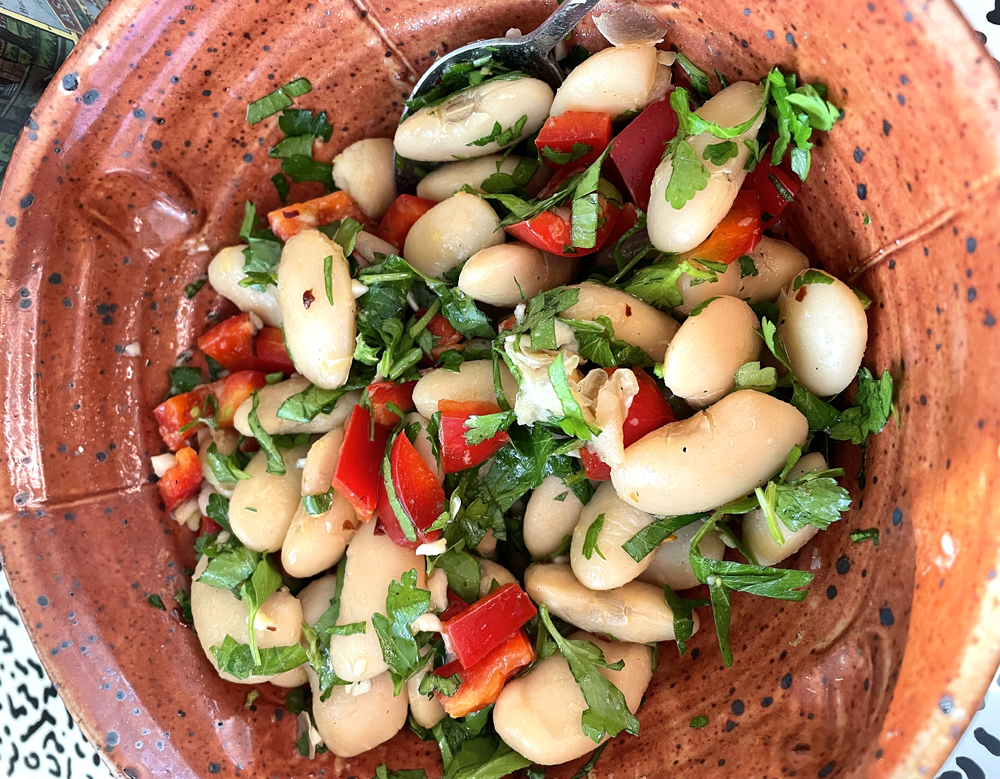
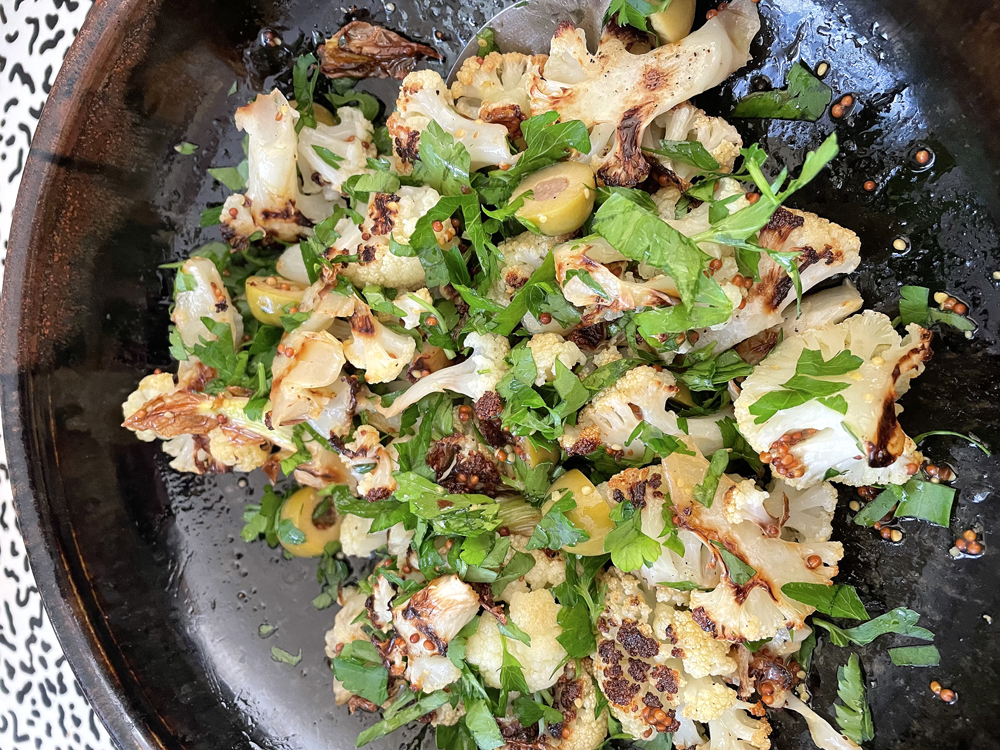
White bean saladRoasted cauliflower salad
I had a bag of Royal Corona beans in my Rancho Gordo stash, perfect for a winter salad. After cooking them until tender I marinated the large beans in a lemony, garlic vinaigrette, added diced red pepper and parsley. For the cauliflower salad go to Busy day dinner for the recipe. I had wonderful anchovy stuffed Spanish olives – a gift from the VanDyks – to add to this favorite dish.
I’ve been making a new kale salad adapted from one in The Smitten Kitchen. Remove the kale leaves from the tough stalks and slice very thin across the leaves. Place in a large bowl, add a pinch of salt and a tablespoon or two olive oil and squeeze and massage the kale. It will shrink to about half the original quantity. In a small bowl combine a tablespoon of vinegar and one of water. Add a ¼ cup of sultanas (golden raisins) and let macerate while you prepare the other ingredients.
Toast ½ cup of walnuts, watching carefully so they don’t burn, about 3 minutes at 250° in the toaster oven or in a small, heavy skillet on the stovetop. Combine ½ cup panko or other bread crumbs and a clove of finely chopped garlic in a small skillet with a tablespoon of olive oil. Toast until light brown, a couple minutes over medium heat. Grate ½ cup parmesan. Toss together the kale, walnuts, parmesan, and the drained sultanas. Top with the bread crumbs just before serving so they stay crunchy.
We still enjoy the kale salad that is inspired by one we often ordered at long gone Acorn in Denver. Go to First post for the recipe.
One day Terry brought a dense loaf of Moxie Bakery’s rye bread that seemed perfect for avocado toast. To the mashed avocado I added a squeeze of lime, a pinch of salt, and a minced green onion. Then placed slices of cucumber and a shower of pomegranate arils over all.
To end the week I celebrated my birthday with Sheila, Walt, Moira, Zoë and Bud at a Sunday lunch. I made grilled salmon skewers with salsa verde, a big green salad with roasted butternut squash, fennel and pomegranate. Zoë made a cranberry ricotta cake and good fun was had by all. I do love cooking for dear ones.



























 How I Learned to Cook, an Artist's Life ─ Barbara Shark