We’ve been living in a bit of domestic chaos aside from the national woes and concerns for our country. Our sewer line needed to be replaced and that required jack hammering the concrete floors in the laundry room and art storage area. What a mess. Then a crew dug a four foot deep trench outdoors to replace the line to the septic tank. Lots of noise and activity, then lots of cleanup. We are back to normal and I hope, finished with major home repairs.
On these cold, gloomy days full of national turmoil and worry I look to comforting dishes to cheer us up. I have many new cooking inspirations and often forget past favorites. Then the yen for those familiar flavors pops up. This fish soup had been a mainstay of my cooking, a favorite dish for company. One cold evening a simple take on the recipe seemed like just the thing for our dinner. I usually have most of the ingredients in my pantry and freezer.
Fish Soup
Makes two servings.
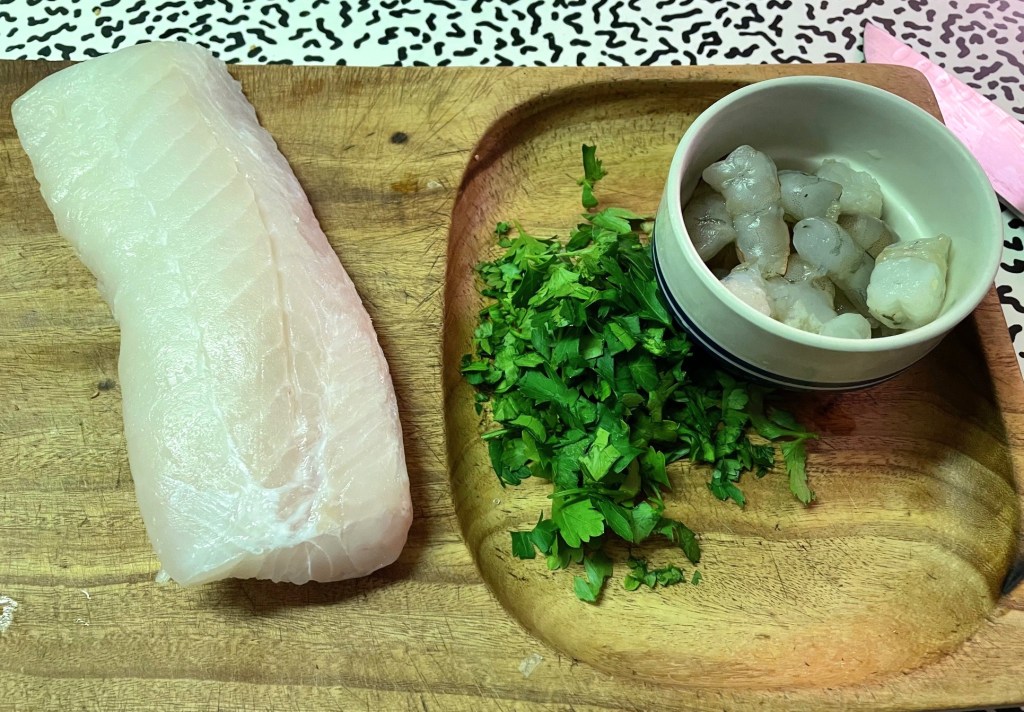
For the soup base: chop an onion and a head of fennel into bite-sized pieces. Sauté in a tablespoon of olive oil until translucent and starting to get tender, about ten minutes. Add a half teaspoon of crushed fennel seeds if you have them and four cloves of garlic, chopped. Stir in a small tin of crushed or diced tomatoes and two cups of water or fish stock. (I keep shrimp shells in the freezer to make a light stock. Cover with water, add some parsley stems and simmer for 20 minutes. Strain.) Bring to a boil then simmer for 20 minutes until veggies are tender.
When it’s time to eat, bring soup base to a simmer and add eight large shrimp cut into bite-sized pieces, and half a pound or more of fish chunks – cod, hake, halibut or whatever you or the fishmonger have. Cook only until done, just a few minutes. Garnish with chopped parsley. This is my everyday recipe. For a fancy version, add mussels, scallops and/or squid.
Arugula and Orange Salad
I like the sharp, sweet flavor of oranges with fennel and fish so I made this salad to accompany the fish soup. Peel an orange with a sharp knife: take a thin piece off the top and bottom then remove peel and white pith. Slice into ½ inch half-moons. Combine with arugula, avocado and thinly cut red onion. Dress with olive oil, salt and pepper. Top with toasted, sliced almonds.
Roasted Cherry Tomatoes
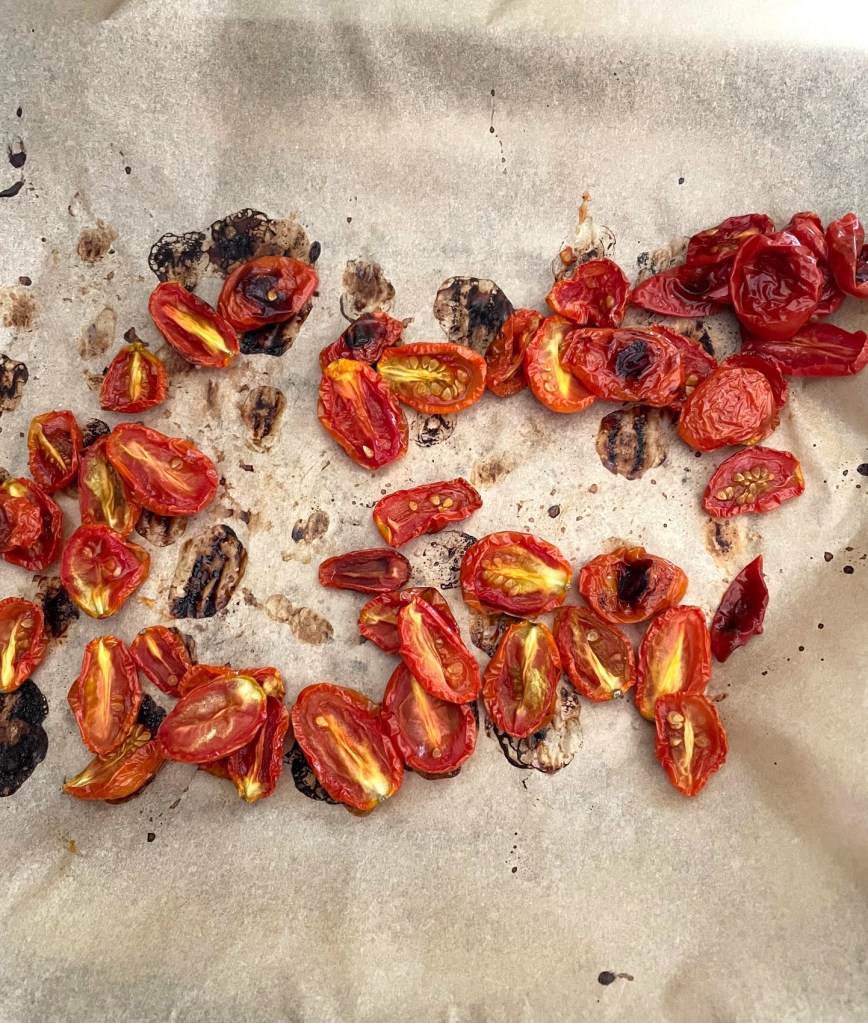
Deep in winter I long for the sunny taste of garden tomatoes. Alas, winter produce just isn’t the same. But the readily available cherry tomatoes are delicious when simply roasted. Halve the little orbs and spread on a baking tray lined with parchment. I do this in my toaster oven. Lightly sprinkle with coarse salt, just a couple grains on each tomato. Bake at 350° for an hour. Watch in the last minutes so they don’t burn. Store in the fridge and add to salads and pasta dishes.
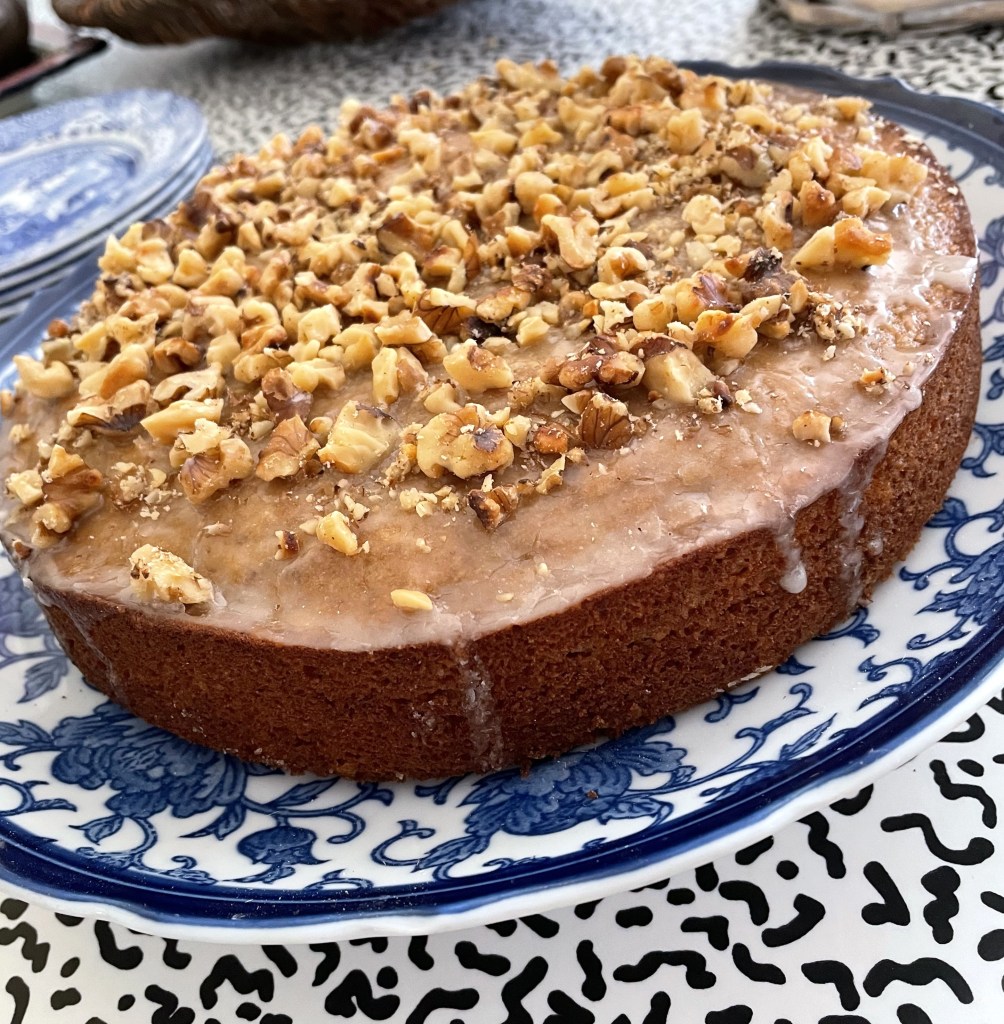
Mimi recommended a banana cake recipe from “Good to the Grain” by Kim Boyce, a baking cookbook introducing whole grains like amaranth, millet and buckwheat. This recipe includes quinoa flour and is a winner. My new favorite banana cake. At Mimi’s suggestion I ground whole quinoa seeds in my spice grinder, a dedicated coffee grinder, rather than buy expensive flour.
Banana Walnut Cake
Preheat oven to 350°. Toast two cups of walnuts until fragrant 5 – 10 minutes. Watch them! Grind one cup in the Cuisinart and coarsely chopped the second cup. Grind ½ cup of quinoa seeds into flour. (Use a spice or coffee grinder.)
Cream together four ounces (one stick) of unsalted butter with ½ cup brown sugar and ½ cup white sugar. Add three ripe bananas, then two large eggs. Stir in 1/3 cup sour cream or yogurt and one teaspoon vanilla.
Fold in the quinoa flour, the ground walnuts, one cup unbleached flour, one tablespoon baking powder and one teaspoon kosher salt. Scrap batter into a buttered nine-inch springform or round cake pan. Bake at 350° for 50 – 60 minutes until a skewer comes out clean. Cool in the pan for ten minutes. Remove and top with a thin glaze – ½ cup sifted powdered sugar mixed with a teaspoon or more of lemon juice. Top with the chopped walnuts.
We’re snowed in, or more like it, iced in. An arctic blast moved across the Midwest and into the east Saturday night and lingered until Monday morning, dropping sleet, ice and snow leaving us with single digit temperatures, some without power and a travel advisory. As I shoveled snow off the deck, ice thickly coating the boards, my mind drifted back to my childhood in Superior, Wisconsin.
It was a frigid winter day. I was bundled in snow pants, boots, my alpaca winter jacket, mittens and probably a scarf, tied under my chin. We’d sledded all morning and after lunch I headed back across the street to Central Park. It could have been THE Central Park, so huge, limitless, and beautiful it seemed to me. We could find anything we might possibly want in that park, swings, a baseball field, a creek that froze where we ice skated until we were frozen, hills to sled down, countless trees, magical adventures and at the far, far end of the park where it must’ve dissolved into the poorer side of the park, a small trestle where we could look down on the creek. We seldom ventured into this far away area. From a child’s perspective, it portended evil, spoiled by who knows what, always junk down there, but still a place for adventures, that children love. This time, trouble.
I’d played along the edge of the creek that afternoon with a bunch of other kids, horsing around, like we always did. Slowly we made our way further and further down the edge of the creek until it felt almost like time to go home. The light fading, my hands frozen, balling them up inside my mittens to coax the cold out. When we got to the trestle, I went down by the creek while a few boys stood up on the trestle, throwing things onto the ice, laughing and whispering. One of them shouted down to me, “I bet you won’t walk across the creek to the other side!” That seemed like a silly thing to say. We always crossed over in the wide parts of the creek where we skated, it was so narrow here, it would be nothing to cross. So I stood up and walked across. I heard the ice breaking when I was almost to the other side. I also heard the boys running away. I fell in, fell into the cold water, into a goo-like oil and started to cry. I don’t remember anyone there. I don’t remember how I got out of the icy water or how I got home, a couple blocks away. I only remember crying without stopping, somehow getting home, going in the back door where my mother helped me out of my snowy, gooey clothes. Then I was upstairs in the bathtub with hot water pouring in, crying and crying, the hot water coming forever.
It takes a frigid joyless winter day to dislodge a memory like that, one that seldom has come to me in almost seventy years. The next few days on Strawdog were cold, but the sun came out, making the icicles glisten and the world look enchanted. I made dozens of trips to the woodshed, wearing my nanospikes to keep from falling on the ice. Ron called weather like this survival weather and I did feel vulnerable. One false step and who would feed the fire? Everyone felt the same way. While my phone still worked, friends and neighbors called inquiring, “how are you doing?.” It’s encouraging to hear another voice when we feel isolated. Everyone was iced in. Nothing moved.
The birds devoured the suet. Sometimes there were four different birds taking bites out of one suet cake. I put out another holder with suet so they wouldn’t fight so much. Of course that didn’t really work. The small birds, chickadees, nuthatches, sparrows, cardinals and snowbirds, cooperated but oh my, the jays, the woodpeckers, the mockingbirds, insisted they have the suet to themselves. They kept me entertained as I watched their dramas unfold. The bamboo jungle gym stayed active. Birds darted up and down, swung on the long bamboo string, pushed each other, puffed up their feathers until they looked three times their size.
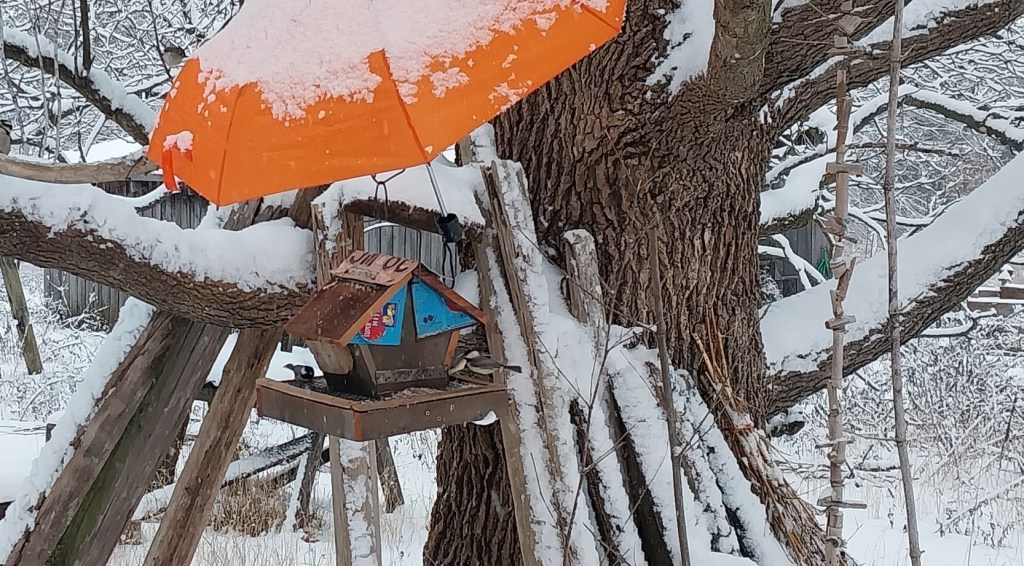
I had to bring in the squirrel-proofed bird feeder as the ice fell so thickly into the seed, the birds couldn’t reach it. Would an umbrella protect the feeder? I’ll try it and see what crazy results I get. The Head Gardener will give me a rough time with this, but sometimes I purposely do these ‘unique’ things to get her goat.
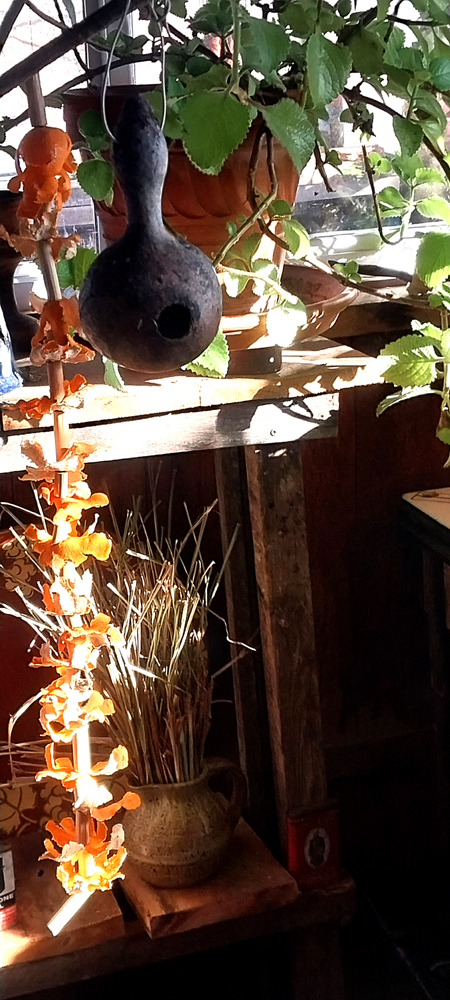
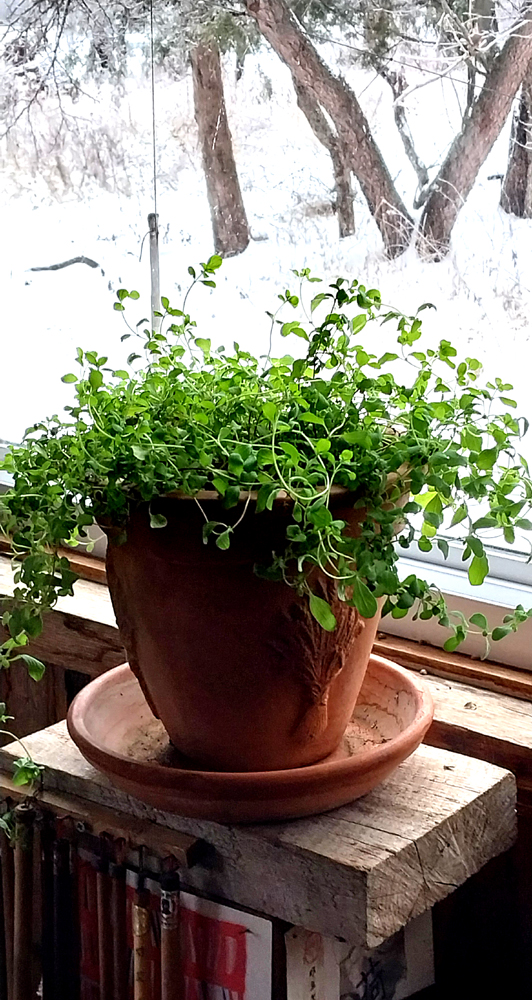
Inside I’d walk by the rosemary and marjoram, rubbing their leaves. The fragrance buoyed me and the simple beauty of the plants did as well. It’s like having a silent friend in the house, marjoram my favorite. I carefully took off the skins of my clementines, also fragrant, and strung them with these bamboo pieces to add cheer to the house. I’d brought up potting soil and containers before the storm and sowed the onion seeds, the red Wethersfield and the yellow of Parma. By mid-March the seedlings will be large enough to plant in the garden. Spring, just the word gives me hope.
I re-read some childhood books including John Steinbeck’s THE RED PONY. The watercolors of the horses and the landscape are beautiful and evocative of life on a ranch. I haven’t reread those stories since childhood and was shocked at how much sadness was in the stories. After dinner and the dishes I’d lie on the sofa, watching the fire and listening to music, reading, not unlike what we did growing up on cold evenings, all of us together, quietly engaged. The fresh, cold air I’d soaked up from my outside chores, insured me a good sleep, other than coming down every three hours to feed the fire, check that the water was still running in the bathroom, flushing the toilet and getting a big glass of water, my alarm clock.
On one of the sunny afternoons I made a snow angel, remembering the one I made for Mom when she was in the retirement community, throwing a snowball up to her window so she’d look down and see me. She laughed and smiled her wonderful smile, turning me into a girl all over again. This time I looked up to imagine seeing the Head Gardener. Oh dear, her scowl and disapproval would make me want to laugh, but I hoped instead, I’d bite my tongue, and say, “Come on, make one!” and watch her stomp away. I needn’t worry. No one was going anywhere.
If you’re ever in a conversation with a group of folks, and one of them, a man in particular, happens to laugh about the time he teased a girl into crossing a creek he knew was filled with oil that was keeping the ice from freezing, you’ll know that he’s talking about me.
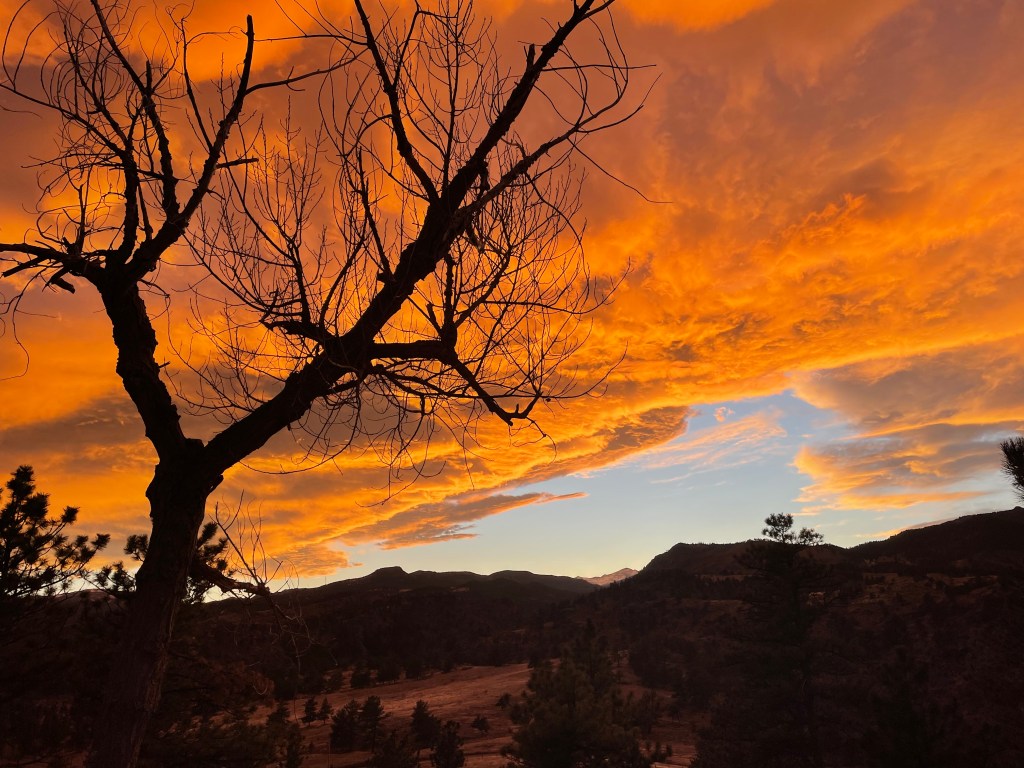
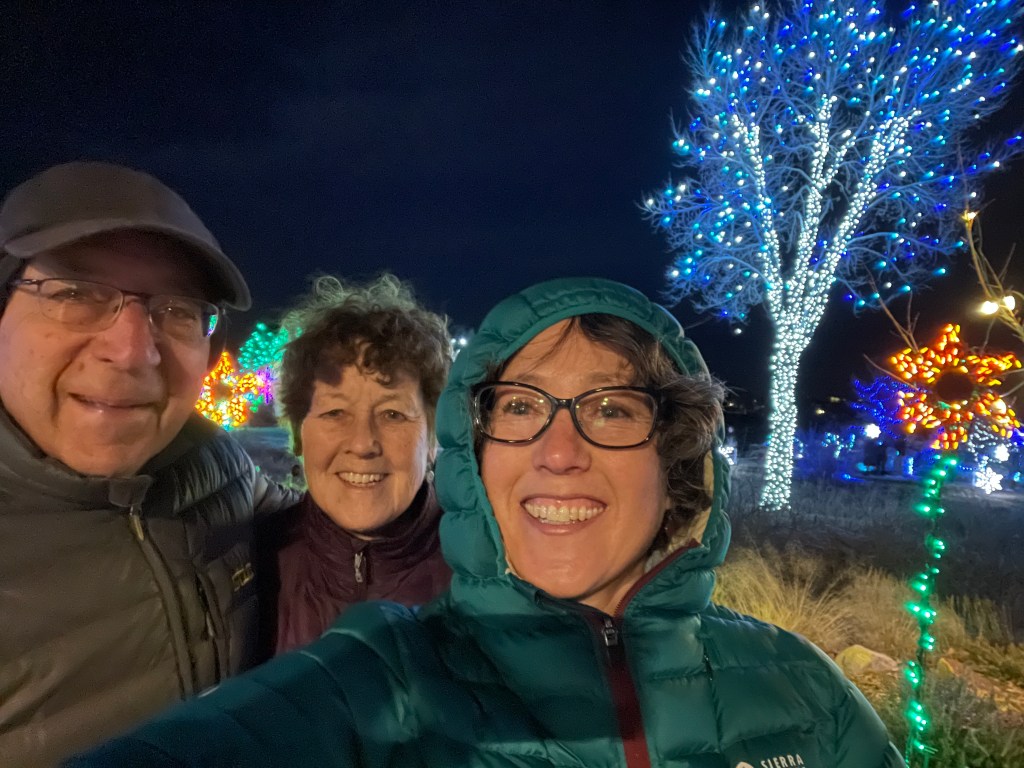
What a winter we are having here on Blue Mountain Road. Warm daytime temperatures, mostly sunny skies, amazing sunsets, and hardly any snow. But we are getting into the holiday spirit seeing friends at a party at BMoCA, a visit to the show of lights in Fort Collins at the Gardens on Spring Creek with Zoë, and an expedition to the remarkable exhibition “Wild Things: The Art of Maurice Sendak” at the Denver Art Museum.
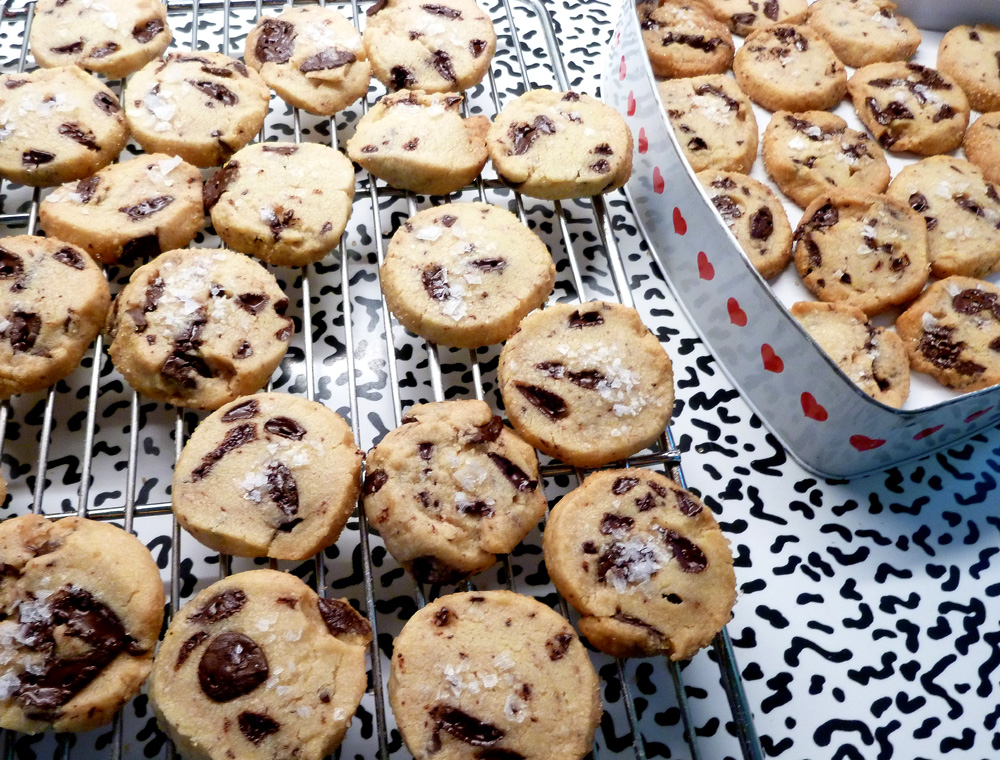
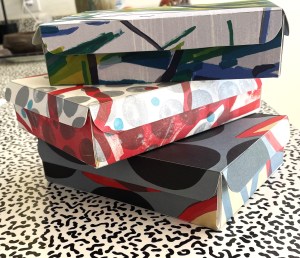
And I have begun my holiday baking. Each Christmas I prepare special cookies for friends. They go into beautiful boxes Bud has fashioned from discarded prints.
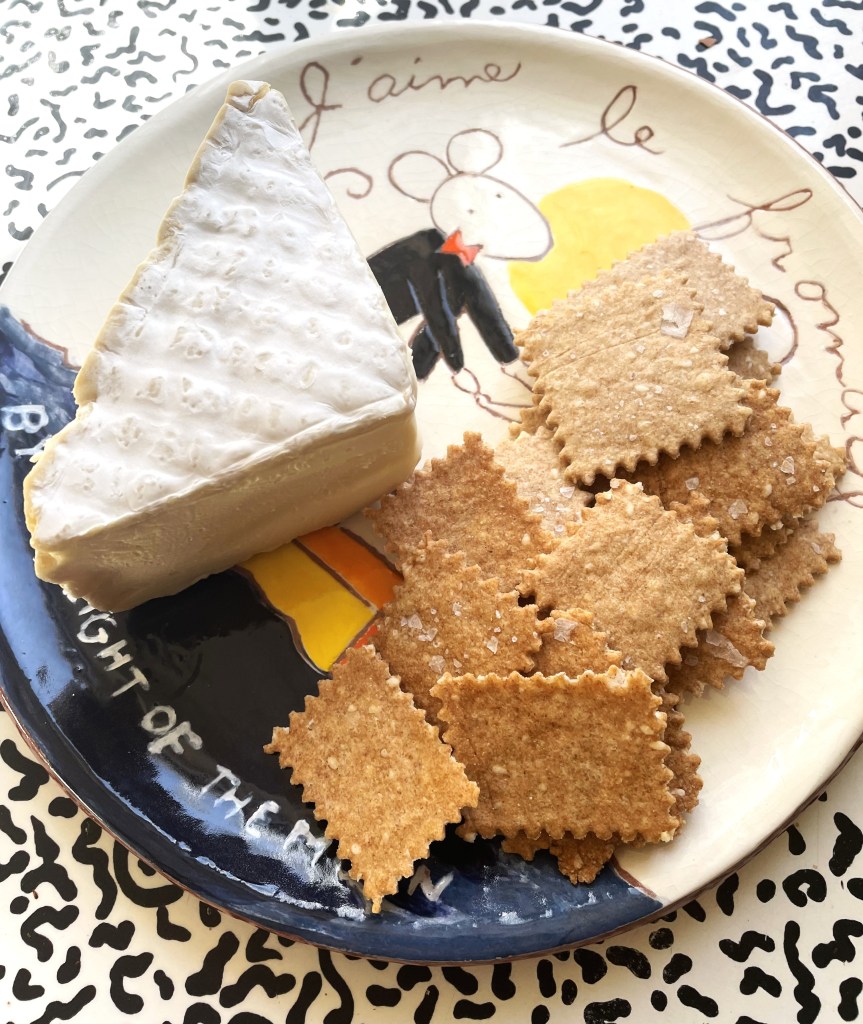
After baking several kinds of holiday cookies, I am ready for something savory. Over the years I have accumulated recipes for homemade crackers and written about them for the blog. Here’s a reminder. They make a delicious gift with a hunk of a favorite cheese.
Plate by Susan Hall
Thin Wheat Crackers
Combine 1 cup unbleached flour, 1 cup whole wheat flour, 1/4 cup sesame seeds, 1/4 cup sugar, 1/2 teaspoon salt.Cut in 4 tablespoons butter. Stir in 1/2 cup milk or enough to make a workable dough. I find I need about 3/4 cup but add slowly. Dough should be pliable but not sticky.
Divide into three pieces and roll, one at a time, extra thin – 1/16 inch if possible – between parchment sheets.Slide bottom parchment with dough onto a baking sheet. Cut with a rotary cutter into 1 x 1/12 inch pieces.Sprinkle lightly with Maldon or other flaky salt, rolling over lightly to press into dough. Bake at 325° for 20 -25 minutes until a little browned. Cool on a rack.
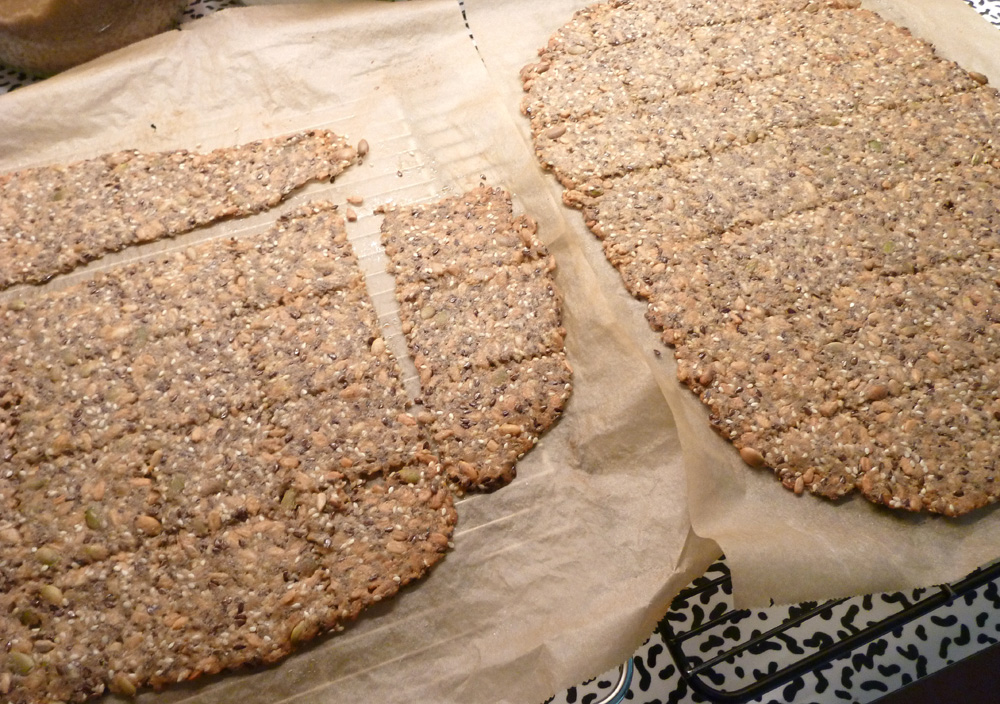
Roseanne’s Seedy Crackers
Combine 1 cup spelt, wheat flour, or your favorite non-gluten flour, 1/4 cup pepitas, 1/2 cup sunflower seeds, 1/4 cup sesame seeds, 1/4 cup flax seeds, 2 tablespoons chia seeds, and 1 teaspoon flaky sea salt. Stir in 1/2 cup olive oil, 1/2 cup water, 1/2 cup grated parmesan (optional but very good). This makes a wet dough but it rolls out easily.
Divide in two and roll each piece thinly, say 1/8 inch, between sheets of parchment. It will be oily. Lightly score the dough (I use my serrated roller) and slide the dough and bottom parchment onto a baking sheet. Bake at 350° for 25-30 minutes, until lightly browned and firm. Cool then break apart on the score lines. They may not break evenly but that’s part of their charm.
Recipe from “Against the Grain”
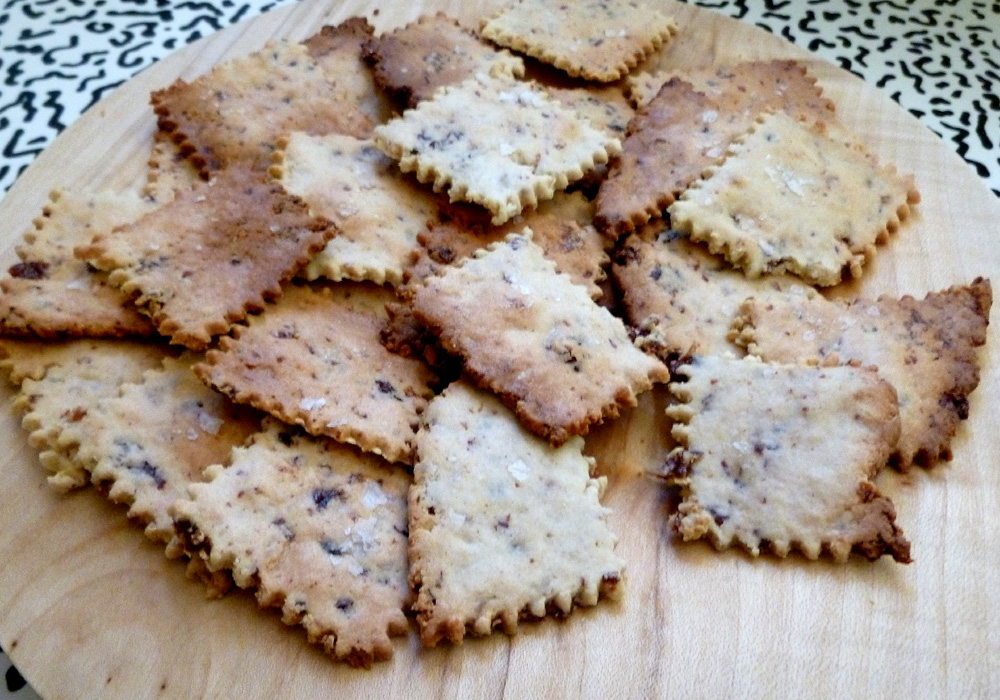
Gluten-free Crackers
In the food processor combine 1 cup almond flour, 2 tablespoons raisins, 2 teaspoons sunflower seeds, 1/2 teaspoon salt, 2 tablespoons water, 1 1/2 teaspoons olive oil. Whizz until thoroughly combined then add 1 teaspoon sunflower seeds and pulse once until roughly chopped.
Form into a ball and roll between sheets of parchment until 1/8 inch thick. Use a serrated cutter, pizza cutter or a knife to score into 1 inch squares.
Transfer paper to baking sheet and bake at 350° for 15 – 20 minutes until set and golden. Cool on a rack for 15 minutes then carefully break apart.
Sending good wishes to you for this holiday season. Thank you for reading How I Learned to Cook, an Artists Life. Cheerio!
Early October was a good time for me to leave the farm and see the family, even though I knew there was a small chance there’d be a hurricane. I left for the airport in Saint Louis in high spirits. My ‘96 Honda Accord shows small signs of age, especially when it comes to zooming into action. I sweat bullets every time I need to go somewhere. Definitely a PTSD of sorts. When I mentioned this to Hilary, she said, “Mom! You’ve always had car problems.” And as I let my mind dip into the past I thought of Ol’ Red, the Ann Elizabeth, the Golden Chariot and I had to agree. Car problems have been as constant as the rising sun. And so has my reaction. I cheer when she starts.
Saint Louis sits about two hours away from Strawdog if I kick up to sixty mph. Fun to watch the yard signs and how they changed from red to blue as I approached the city. The autumn colors kept me dazzled. When I arrived at Super Park, I backed into my parking space, just in case the Honda had a fit.
My flights were flawless. We arrived in Florida ahead of time. There was chatter everywhere about a storm. While waiting for my luggage I talked with a woman close by, asking her if she’d heard about the storm. “Do you know who I am?” I assured her I had no idea. She said her stepfather was head of hurricane prediction in Miami and that yes, a hurricane was coming, Milton, a big one. and he said it’d be a bad one. Oh wonderful, I thought. What great timing. Maybe I should head out of Dodge…
Hilary picked me up and we chattered away as we drove to their river home in Melbourne Beach, a few blocks from the Atlantic, with the Indian River in their back yard. Water, water, everywhere.
Piles of seaweed after Milton
The family was in good spirits. I was starving and ready for a beer. Kerry parked me on one of their decks, facing the setting sun as Hilary finished up dinner preparations. He introduced me to Oscar the osprey and pointed out the dolphins, the schools of fish and Harry the Heron balancing on one leg in perfect tai chi form. We toasted with our Hawaiian beers without even a mention of the pending disaster. I’d never been in a hurricane.
Logan, my youngest grandson, wasted no time in showing me the weather maps and where Milton was building up pressure. Ever since a small boy, he has talked authoritatively about the weather. No kidding, He seems like the real deal. He knows the lingo, pays close attention to the weatherman and assured me, “Oh yeah, it’s going to be a bad one!” From that moment on, he kept pulling me downstairs to the weather channel to show me what Milton was up to. He has the homeopathic approach to dealing with stress.
Everyone had things on their to do list. The first morning Hilary was keen to finally plant the plumeria cuttings she’d rooted and had in pots for over a year.. Kerry dug the holes while Hilary and I figured out where each plant should go. Their sandy soil is perfect for Hilary’s favorite small tree as frangipani, another name, will rot in heavy soils. I imagined their tropical paradise filled with five more of these fragrant plants and wondered which pollinators they’ll attract. I also thought about what Milton might do to these newly planted cuttings and hoped they wouldn’t be flung out of the earth before they could make contact. Anxiety number three.
We had several days of normal life, following the routine of the boys. Logan had Brazilian Ju Jitsu lessons and I wanted to see him practice. Kerry was interested in sandbags, the first concrete notion I’d seen of the pending hurricane. While Kerry went on his fortuitous search, I watched Logan wrestle with a Gray belt. He held his own and made some great moves, never having to tap the Gray belt’s shoulder.
On the way home we saw people shoveling sand into bags in near darkness. Kerry saw his opportunity and turned the car around. People had been waiting hours to fill up their bags so we felt lucky there was still sand and a couple of men willing to help fill the bags. Logan was out in a flash with the men and from inside the car I heard happy chatter as they filled, tied and carried the bags to the trunk. I was impressed, each one weighing at least thirty pounds and Logan ten years old. When we returned home, Hilary and Brady came out and worked in the dark to get the sandbags to the back of the house. We were getting prepared.
By Tuesday I’d made enough trips downstairs with Logan’s doomsday forecast to last a lifetime. How could he remain so calm? I imagined downed palm trees blocking the roads and highways, power out and water gushing into the house. Maybe the roof would blow off. Brady, oblivious, but conscientious about his homework, sat in the cozy little nook looking out to the Indian River, with his computer and head set and wandered into that sacred world only teenagers can enter. I felt jealous.
That afternoon Kerry took the boys to watch Transformers at a movie theater rented out by friends of theirs, just for these forty teenagers. Kerry assured me I would not want to go with them. Popcorn was thrown, ice spilled and teenage boys were screaming and laughing.
Hilary had scheduled a pedicure for the two of us, Since I’d never had one, she thought it would be fun to have a moment of pleasure before who knows what would happen. And it was. My rough garden feet felt pampered and loved. A delightful young woman had her work cut out for her and she met the challenge. We left smiling, well aware that Milton was making tracks, as everyone was putting things away, stocking up, preparing for strong winds and flooding.
School was canceled for the rest of the week. Whoops and hollers followed. A few groans from the parents. Hilary continued working from home. Kerry and I, plus the boys now and then, collected everything that might blow away, found special battery chargers, flashlights and coolers. Kerry bought bags and bags of ice before the stores ran out. We forgot about getting gas until there was no more to be had. There was quiet discussion among the parents as to whether or not we should evacuate. Logan kept showing me category 5’s for Milton, now doing his worst to Mexico. Evacuate?!
That thought gave me great anxiety. I imagined being stranded without gas, a flat tire, or one of a dozen mechanical problems. Where could we stay? What would we eat? I was getting a dose of reality that folks in hurricane country have to face year after year. When we walked down to see the ocean before Milton came, all the neighbors were out too. Mostly unfazed, casually doing the last bit of preparation, stopping Kerry to chit chat. No one was evacuating. No one was panicking. Luckily, Hilary and Kerry decided staying home, with hurricane-proof windows, a better call. I was relieved and wondered how many hurricanes you have to survive to feel relaxed at the arrival of the next one.
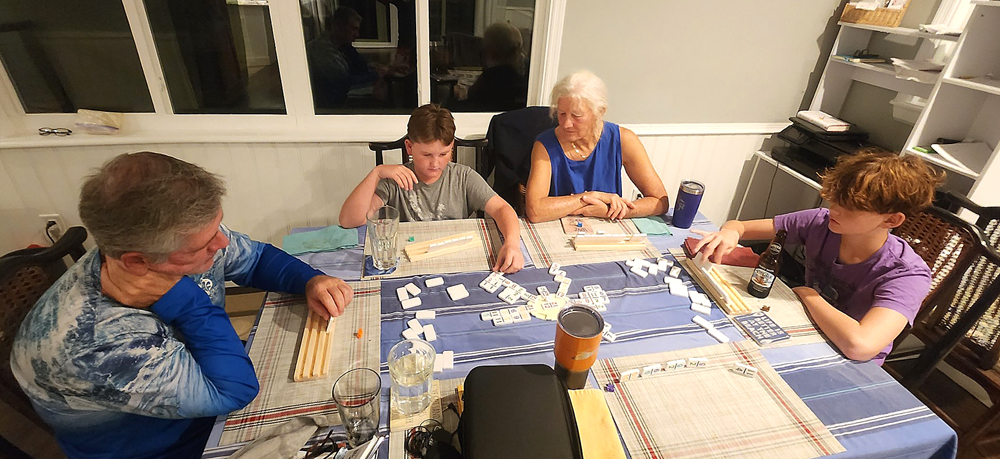
After dinners, we would sit at the dining room table and play games, laugh and tease each other. Our weatherman didn’t even check Milton’s progress. It was peaceful. I almost forgot. Then Wednesday morning rain came in bands, band after band, until evening and into the night. We were in our cozy nest. We felt nervous except for our weatherman and teenager. Waiting for the unknown requires lots of deep breathing.
Logan slept with me and fell asleep immediately. In the night, I woke up and could see the palm trees swoop down to the earth as if they were greeting a returning queen. I watched for a while, grateful to have shelter and then fell back to sleep, I couldn’t hear a thing with the hurricane proof windows, only see wild movement.
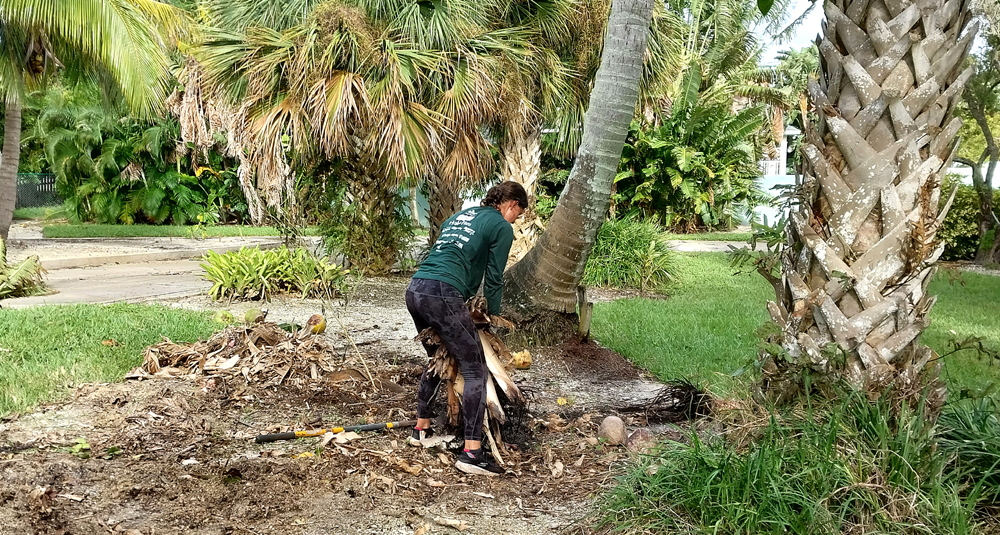
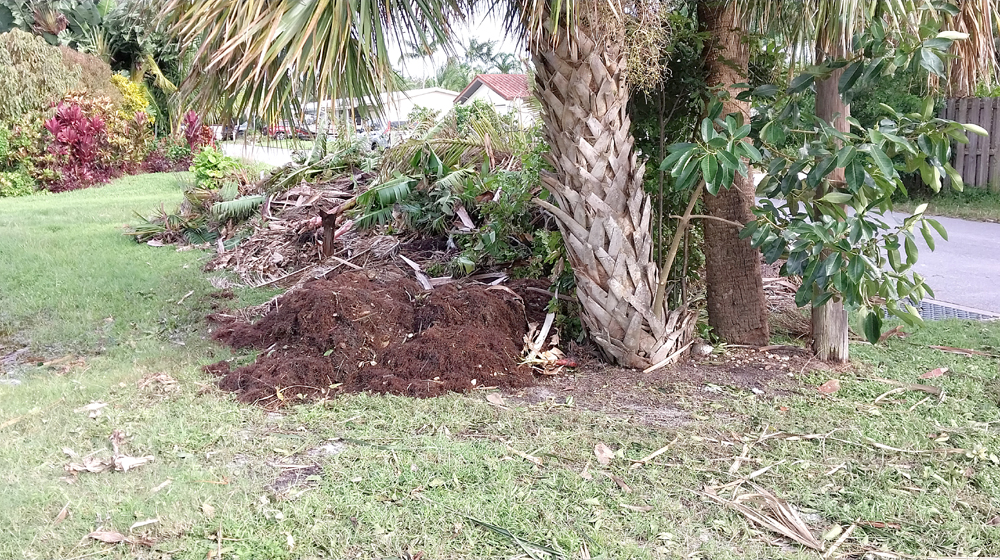
In the morning Logan greeted me with a happy good morning. We were still alive. The yard was covered with branches and seaweed. Soon we’d be out picking up debris and pushing a wheelbarrow to a massive brush pile the city would pick up. The boys complained but did the work. Brady mostly hauled the wheelbarrow while Logan and I loaded the seaweed with our hands. It hadn’t begun to smell yet. Hilary and Kerry worked with amazing vigor. The head gardener would be impressed.
The next day Hilary attacked the banana trees heaved up by Milton. I had brought about 40 cuttings of lemon grass in my suitcase and planted them near the plumerias, all still intact. Kerry cleaned out some of the debris in the pool, with more downed palm tree limbs and seaweed to pick up.
Homemade pizza and a game of Mexican dominoes was our treat after our cleanup. As I looked at each one of my family, I felt a gush of gratitude for them and the calmness they showed me in my first hurricane. Probably the worst that happened during my entire visit was a morning, before school, when Brady got a comb stuck in his hair. Hilary patiently and gently worked to get it out. It was a slow, agonizing process.
Before I knew it, I was back in Saint Louis at Super Park, walking towards my Honda, nervous but hopeful. Oh dear. No luck. My fear only reinforced. I walked to the shuttle bus and asked for help. Luckily the woman who takes care of problems was close by.
I’d made plans to visit my friend Jessie and her new boyfriend, Daniel, before I left the farm. I hadn’t met Daniel or seen their new apartment. Still somewhat traumatized by the Honda not starting and memories of the week, I tried to relax. I parked right on Lindell Boulevard, a four-lane highway in the midst of the city. Walking up the four flights of stairs to their apartment, I was reminded of the excitement of a city. It was good to meet Daniel, from Brazil. He knew many of the places I knew in my time in Rio de Janeiro. We tried to fit a lifetime of stories into a few hours, before leaving for an orchard over in Illinois, where we’d meet their friends, pick apples, and enjoy an autumn afternoon.
When we returned, Jessie thought the Honda would be safer in their apartment complex’s underground garage. We walked out to the Honda laughing and chattering away. Only to find she was dead. I used the TackLife charger Kerry had given me to bring her to life, grateful we didn’t have to jump her with another vehicle. After shutting down the Honda, in a darker space, I saw the front brake light on. Jessie needed to start dinner for more friends so Daniel and I tried to figure out what was going on. I called Kerry, he gave us an idea what to look for and Daniel immediately went to YouTube, looked up the problem, and found a solution using a penny and double-sided sticky tape.
We found the brake light switch stopper, on the floor under the brake pedal. Daniel put the penny where the brake light switch stopper was so I could drive home and address the problem later. He felt ecstatic that he could solve the problem as his family claims he has no mechanical skill. As a neurologist, I think he can be forgiven.
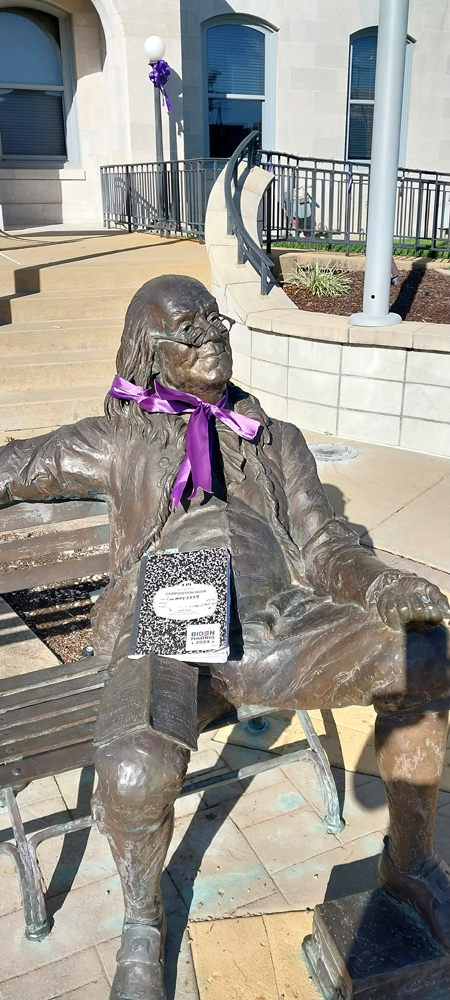
I left early Sunday morning, with memories of old friends and some new ones, driving through a quiet part of Saint Louis I’d never seen before. I felt peaceful, having survived a hurricane, an old Honda and a multitude of anxieties. I decided to stop at the courthouse in Union, in Franklin County, and write in my journal so as not to lose a day. Benjamin Franklin invited me to sit. I’ve never sat with a statue before. I found him charming and funny, as I celebrated my autumn odyssey. He was smiling at his Poor Richard’s Almanac, thinking about what he’d written. I smiled back, happy to be in such good company. If you’ve never sat with a statue, I highly recommend it.
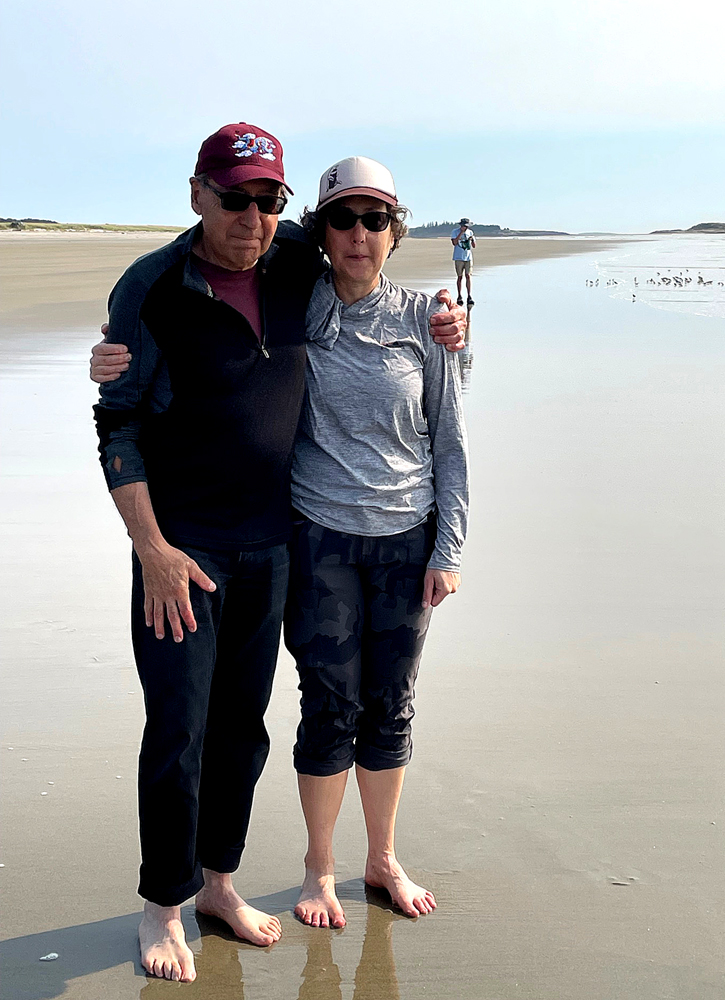
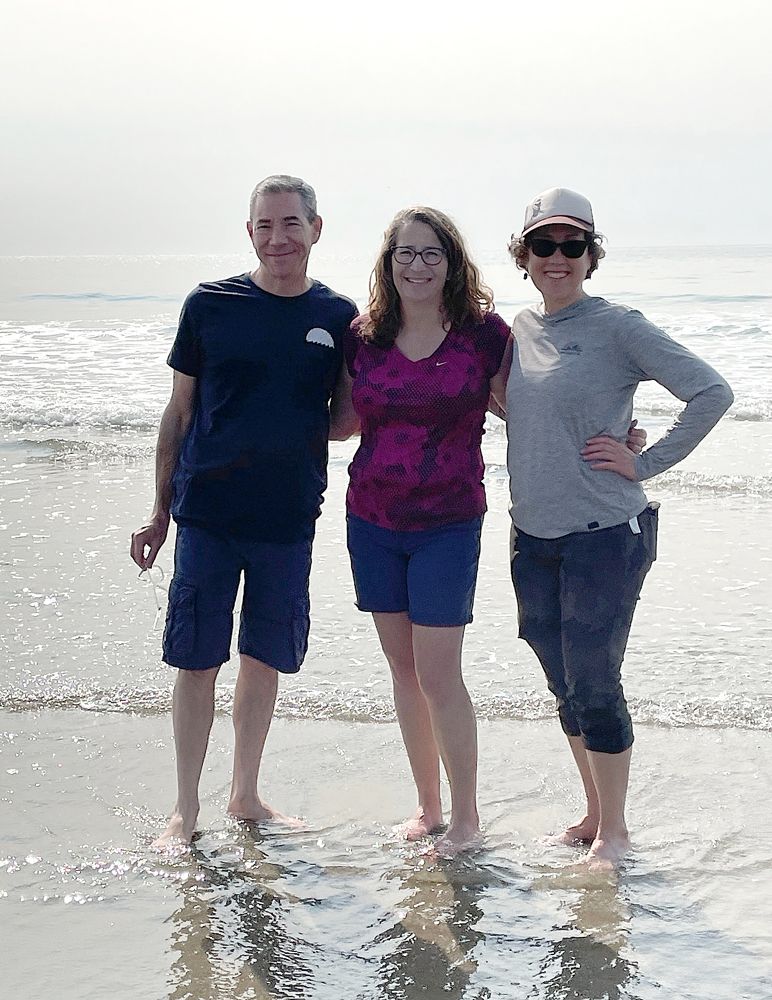
This fall we’ve made several expeditions, one to Maine with Bud’s siblings and four of our grown children. My sister-in-law, Mimi Shark, organized a great week of walks, food and good conversation. Our gang of nine stayed at an old-fashioned resort on Sebasco Bay where we hiked to broad beaches through woods just beginning to change color.
Cousins
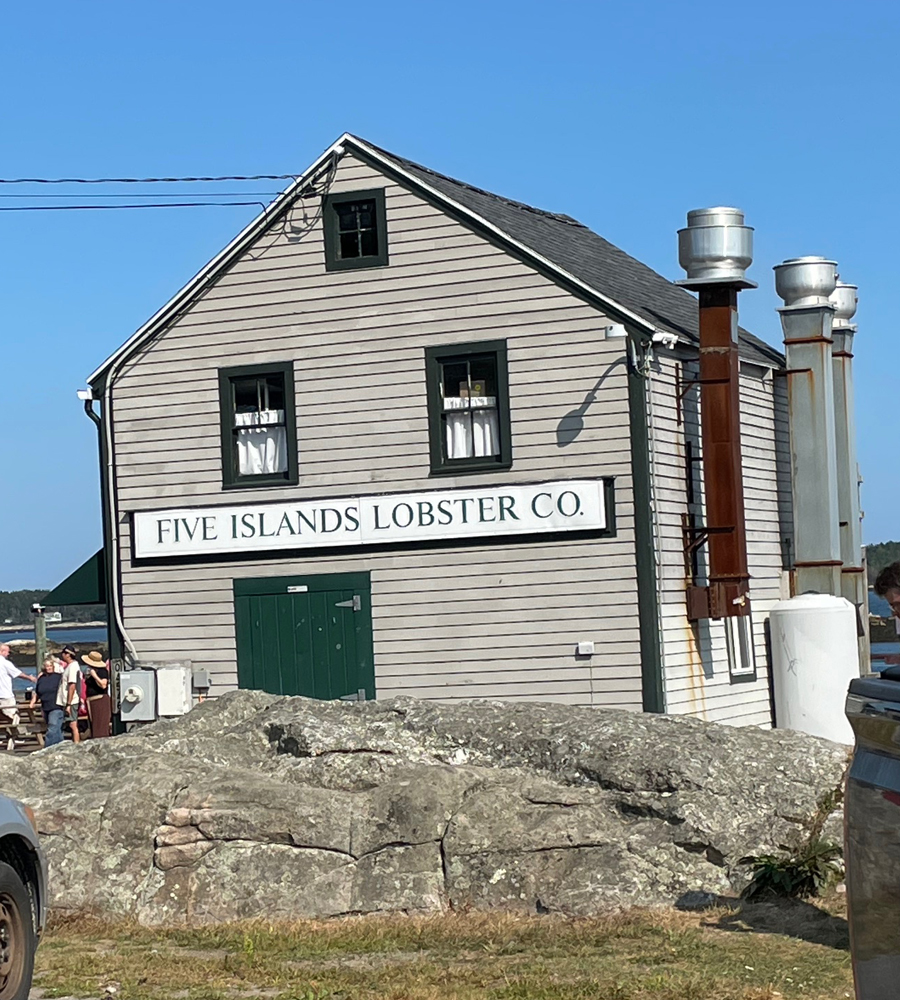
We ate lots of fish and lobster, once at Five Islands where we ate lobster rolls in the sunshine and watched lobster men haul in boxes of the crustaceans. In Portland we had delicious meals at inventive restaurants like Eventide, Scales, and Isa, and walked along beaches to see lighthouses and preening cormorants.
In late September Kara Maria came to the studio to make a new lithograph with Evan and Bud. She always comes with a smile and a gift of fancy chocolates. I enjoyed her company and adapting my cooking for her needs. We ate lots of veggies, fish and chicken. I learn so much about food and making art from our artist friends. I must admit though that we pigged out a bit on carbs when she left.
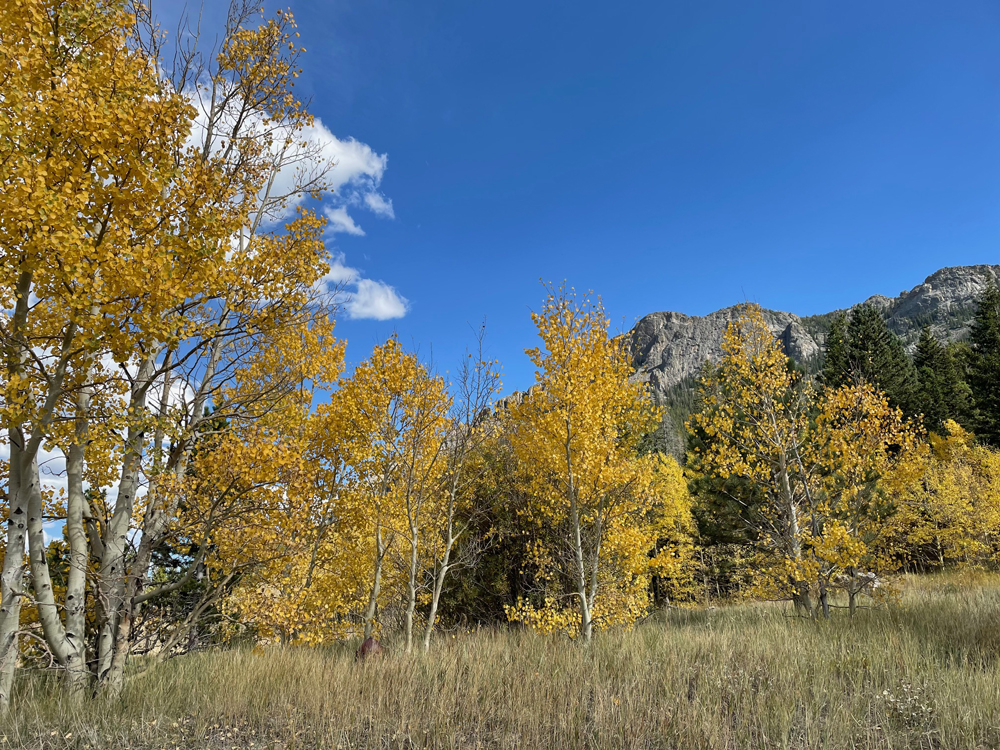
After Bud and Evan finished the editioning of Kara’s lovely new print it was time for a jaunt to Paonia on the Western Slope. The drive west is always a treat. There were spots where aspen groves still wore their golden garb. That color. What is it that stirs me so? Along the river valleys and creeks, cottonwoods glowed with yellow leaves. I thought we’d missed this pageant and indeed, a lot of the aspen stood naked. The white trunks had something of the beauty of the golden-leaved ones – stirring in a different way. The vast bare groves on Kebler Pass road, silvery white in the sunlight, so aloof, so majestic.
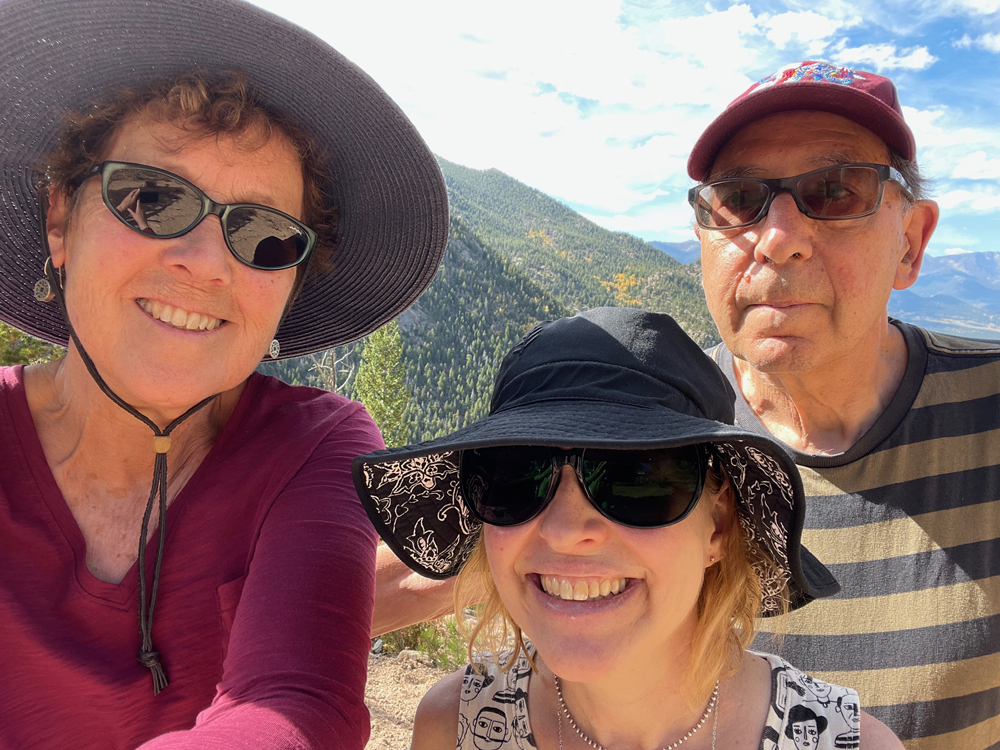
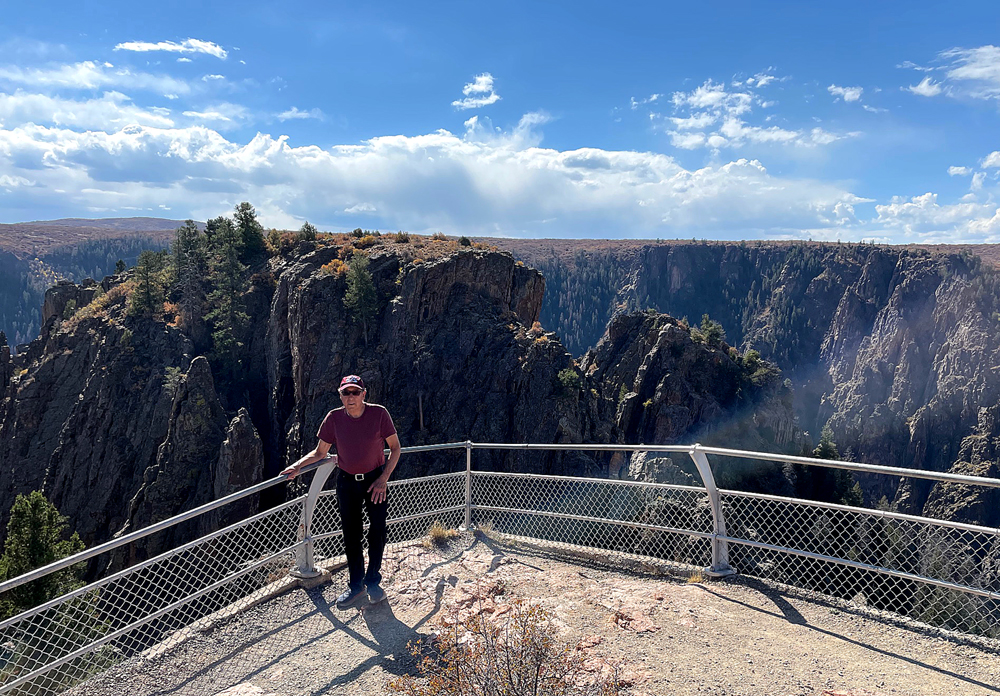
We spent two nights in Paonia at the Bross Hotel, a bed and breakfast in an old Victorian house. On the second day we drove to the north rim of the Black Canyon of the Gunnison to hike. After an eleven mile drive on a mostly dirt road we arrived and found our trail to Exclamation Point. What an amazing canyon, deep and dark, the rock walls threaded with quartz.
This long fall has lulled me into thinking it will last forever. I know that’s not true and will miss the sunny days and evenings warm enough to eat on the porch. I’ll pick the last of the tomatoes in preparation for the cold weather due tomorrow. And I need to shift into fall cooking, leaving eggplant, zucchini and green beans behind.
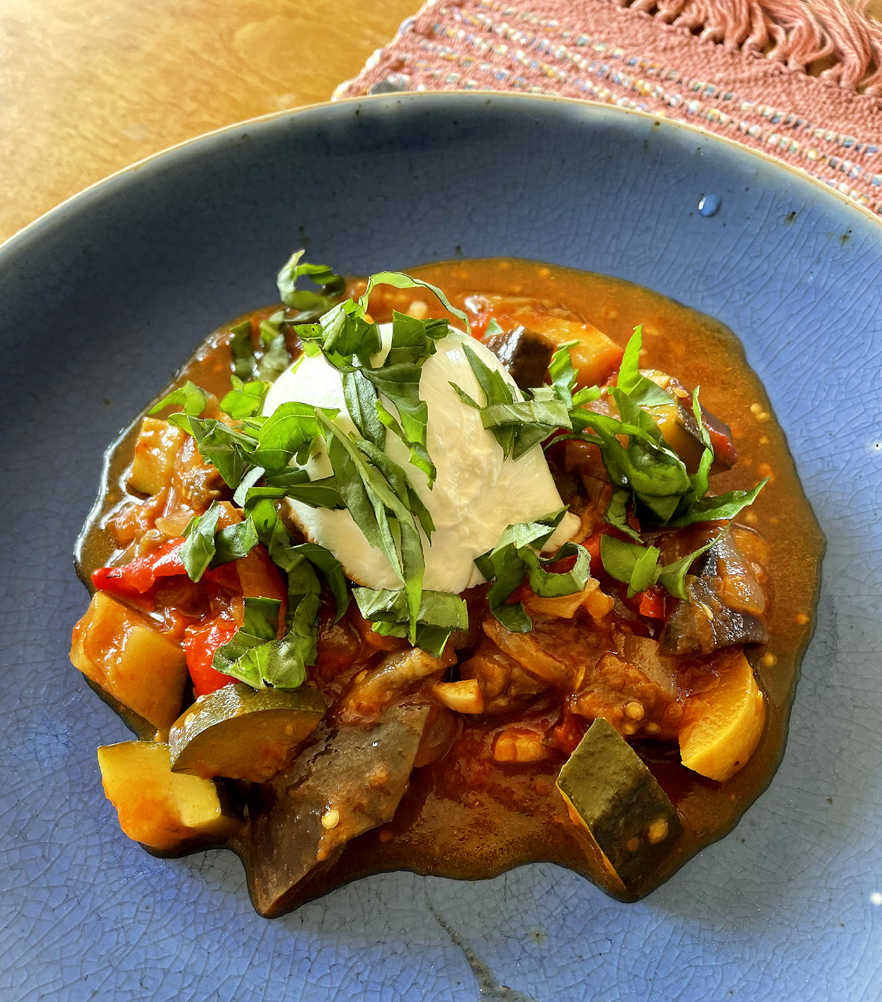
But for one last taste of summer, I got eggplant, zucchini and sweet red peppers on one of the last days that Zweck’s farm stand was open, for one last ratatouille. I served it with portions of burrata, a new indulgence for us.
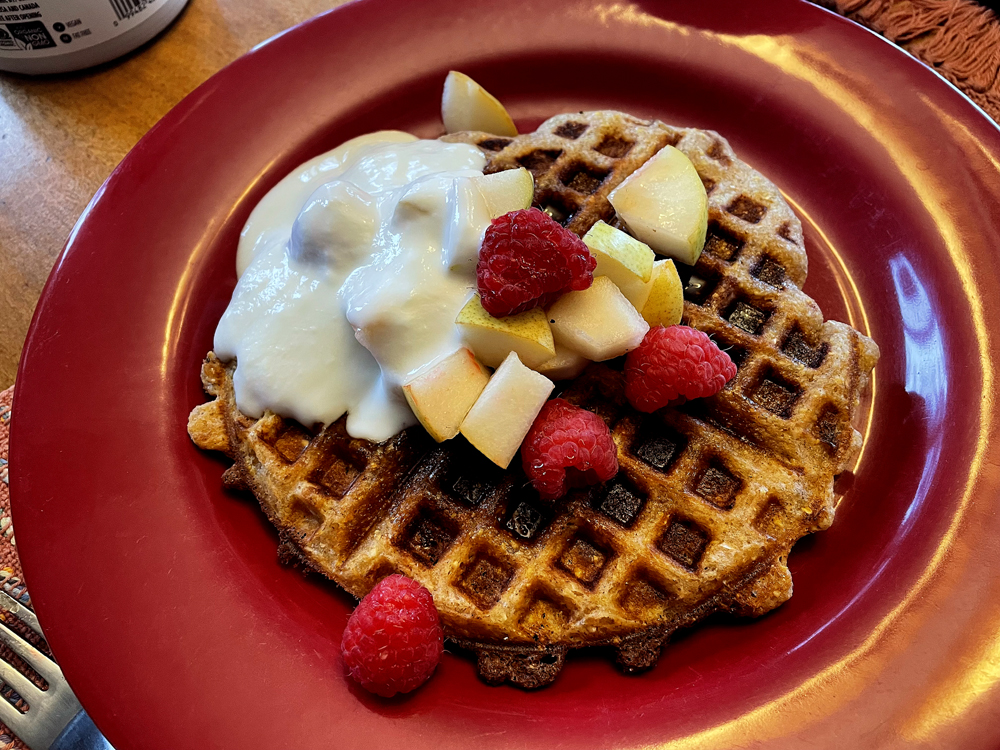
On these cool mornings I sometimes prepare a hot breakfast rather than serve our usual granola with yogurt and fruit. Weekends are a perfect occasion to enjoy a leisurely breakfast of eggs and toast, pancakes or these special waffles. By using whole grains and serving the waffles with yogurt and fruit I ensure that we have plenty of nutritious food to keep us satisfied all morning. The aroma of baking waffles is hard to resist.
Combine ½ cup unbleached flour, ½ cup wholewheat flour, ½ cup cornmeal and a ½ cup rolled oats. Add one teaspoon salt, a tablespoon baking powder, two tablespoons brown sugar. I sometimes add a handful of granola for crunchy texture.
Stir in 1 ½ cups milk (any kind), two large eggs, lightly beaten, ½ cup safflower or other vegetable oil,, and one teaspoon vanilla (optional). Use one cup of batter for each waffle. Bake in a waffle iron until brown and crisp. Serve with yogurt, berries, pears or other fruit, and maple syrup. Makes about six waffles. The recipe is easily cut in half.
If you find it hard to deal with a recipe first thing in the morning, the night before assemble the dry ingredients in a mixing bowl. Store the eggs, milk, optional vanilla, and oil in a covered container in the fridge. In the morning simply mix together and bake the waffles.
How quickly the height of summer has changed to the approaching autumn. I feel both relief and sadness. Walking the paths of the garden doesn’t require a scythe; everything has lightened up, lost weight, let go of their earthly bounds. I can see under the wire frame that the cucumber vines clambered over, pull the grass growing there and wonder if it’s too late to plant more beans. My mind starts to list all the cool weather crops we can plant.
Sunflower heaven
I take note of the skullcap, parsley, Rocky Mountain cleome and countless other plants making seed, some ripe and the head gardener reminds me we must not wait to gather them. Of course she is correct but I haven’t come to terms with saying goodbye to summer, when the house over flows with seed. The coming week of brutal heat should cure me, and probably will, but it’s like all transitions, it’s not easy to let go. Maybe that’s why I shy away from extended goodbyes. After all, isn’t every moment of our lives a slow farewell? Yikes! don’t let the head gardener hear that. You know exactly what she’ll say. I think of Ronald Reagan every time, “there you go again…” and for all I know, she doesn’t remember Reagan, it’s just her way of looking at my philosophical musings that she so disdains.
Seed collecting doesn’t begin in late summer. In spring we collected the first seed, from chervil then the Flander’s poppies. Every week this summer we’ve collected seed from several species. The seed pods first go into a paper bag, a five pound flour bag or a large grocery sack. Some seeds, like the poppies, are so small they get threshed directly into a bowl then poured into a seed packet. If not, the tiny seed would get trapped in the folds of the bag and then mixed with whatever variety landed in that sack next.
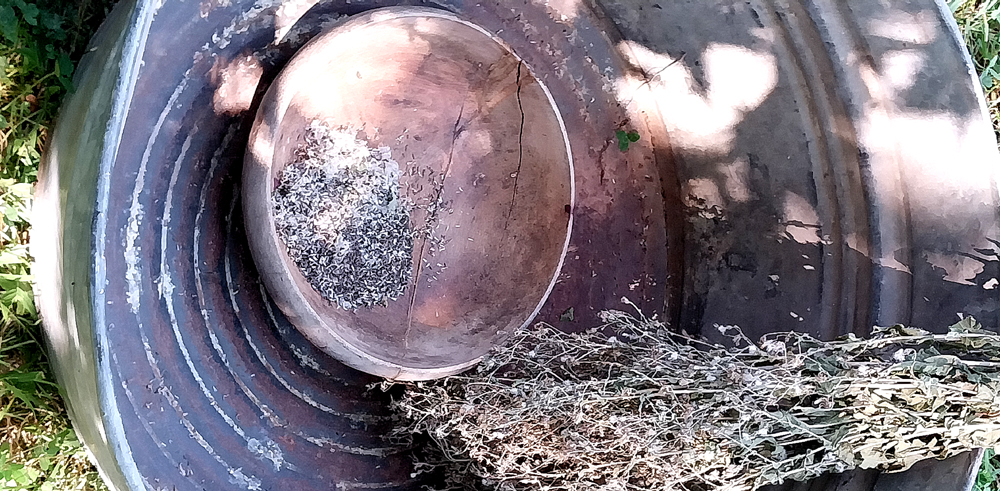
Threshing lettuce seed
We put these sacks on top of the wood box inside, clipping them shut with a clothespin so no mice can decide to investigate and end up feasting on a MRE. (Meal-ready-to eat in the military). Of course we learned the hard way and mourned the loss of valuable seed. When the wood box gets too full, we’ll take the time to thresh seed, always learning more efficient easy ways to do that too. Then the seed gets packaged, labeled and set aside to store appropriately in a cool dark spot.
This year my friend Agnes harvested the wild geranium seed, geranium maculatum. She cut the plants back and threw all the tops, where the seed was, in a big feed sack. We thought the seed would fall off and then sink to the bottom when we shook the bag. I’d never harvested the seed before. I thought about calling the crew up at Missouri Wildflowers and asking, but I didn’t want to bother them. I should have. The seed stayed attached to the tops and we had to go through the entire bag and laboriously, on a rainy day, separate out the seed after we decided just where the seed was. Next year we’ll know. That’s why I suggest to all new seed saver’s that they save some of the original seed, so they can see what it looks like and not feel confused when they go out to collect the seed.
Now we have two varieties of lettuce going to seed. They’re close to each other and will cross pollinate. We cut back the Cimarron lettuce seed heads and allowed the ‘really red deer tongue’ lettuce go to seed.(It IS really red and in addition, delicious!) The Cimarron lettuce will make another seed head later, plants never give up, and by that time we’ll have harvested the ‘really red deer tongue’ seed, so no problem. We’ve been stalking all the wild lettuce around too, as if it crosses with any of the domesticated varieties, the saved seed will produce bitter, bitter, lettuce.
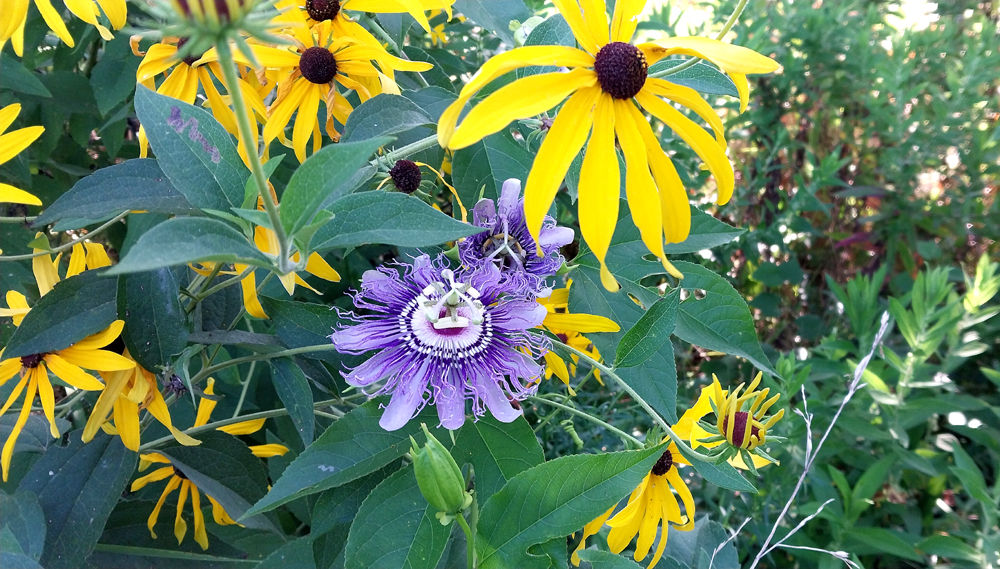
Passionflowers everywhere
The shapes, sizes, textures, colors of seeds and the pods they may come in fascinate me. We strung strings across one section of the ceiling so I could hang seed pods there. After 30 years, those hundreds of bundles of seed pods became filled with dust. A textile artist was visiting when I said I was taking them all down, she asked if she could have them. How convenient, I thought. We piled them into her van and she headed home to Texas with her enormous dog and slightly obnoxious boyfriend. I never heard what she did with them, but it made me feel good to pass them on, though I had to explain this to the compost pile, that had eagerly awaited the fresh ‘blood’.
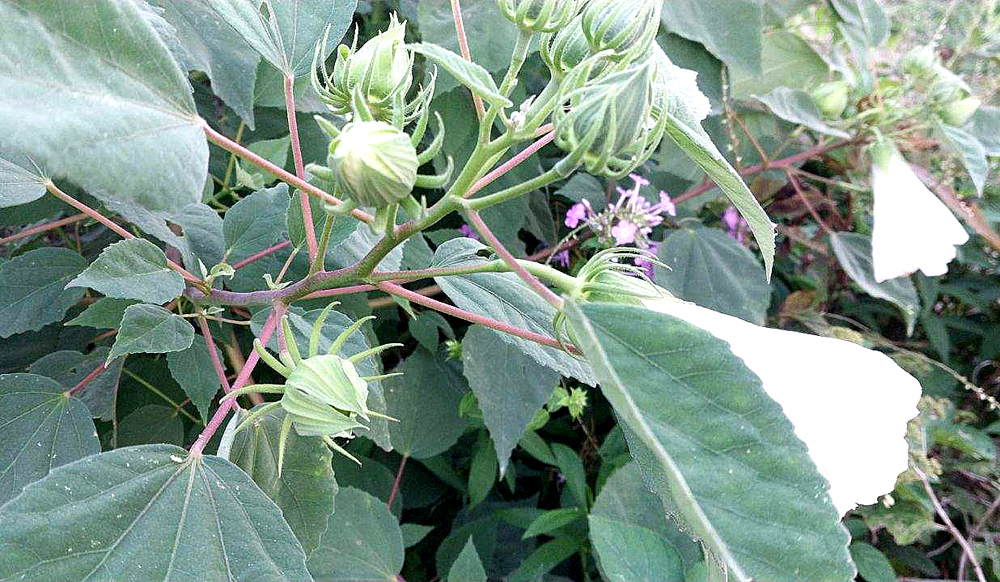
Hibiscus
As much as I love seeds, some seed simply has designs on domination. I cut back the hibiscus to keep it from being a mono-crop in the flower gardens. And then I pull up every seedling that manages to sprout before those roots can go down in calculated aggression and take hold of every square inch of the underground world. “Know thy plants! And their seeds” This adage should be inscribed on every gardeners frontal lobe to reduce the chances of losing control of our gardens. Do not be seduced by beauty! Nip it in the bud. That’s our only course of control. And don’t leave the seed stalks laying around. To the compost immediately. Some seeds will mature even when the seed stalks have been cut down, of course not the seeds you want, but rather the seed of those pesky plants you’re trying to rogue out.
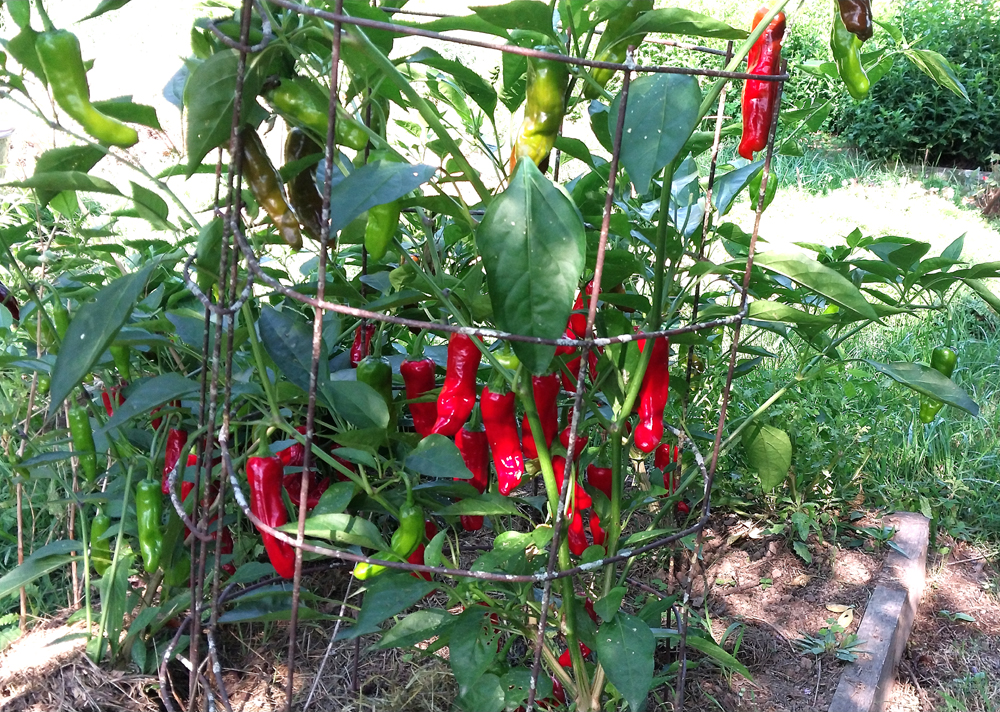
Chilaca pepper
The fall rains will begin with the cooler temps. Now the gardens look tired, worn out, having given their all. When the rains do come, we’ll witness another transformation with the asters and goldenrods of many species providing nectar for the migrating monarchs who have begun to appear. The maestra may have her baton but it’s merely ceremonial. She follows the lead conductor and bows graciously at the mysteries of this universe.
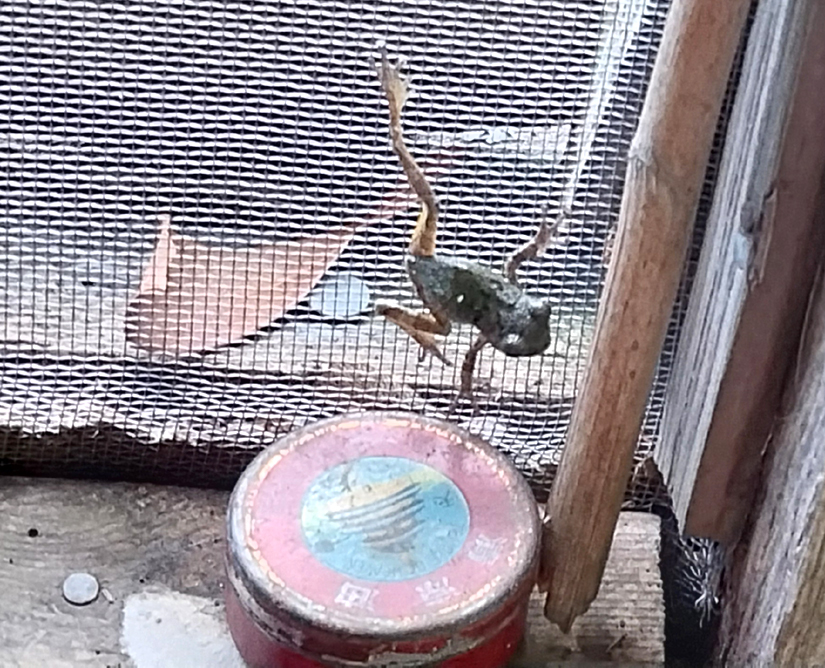
There’s always something interesting to observe on the farm.
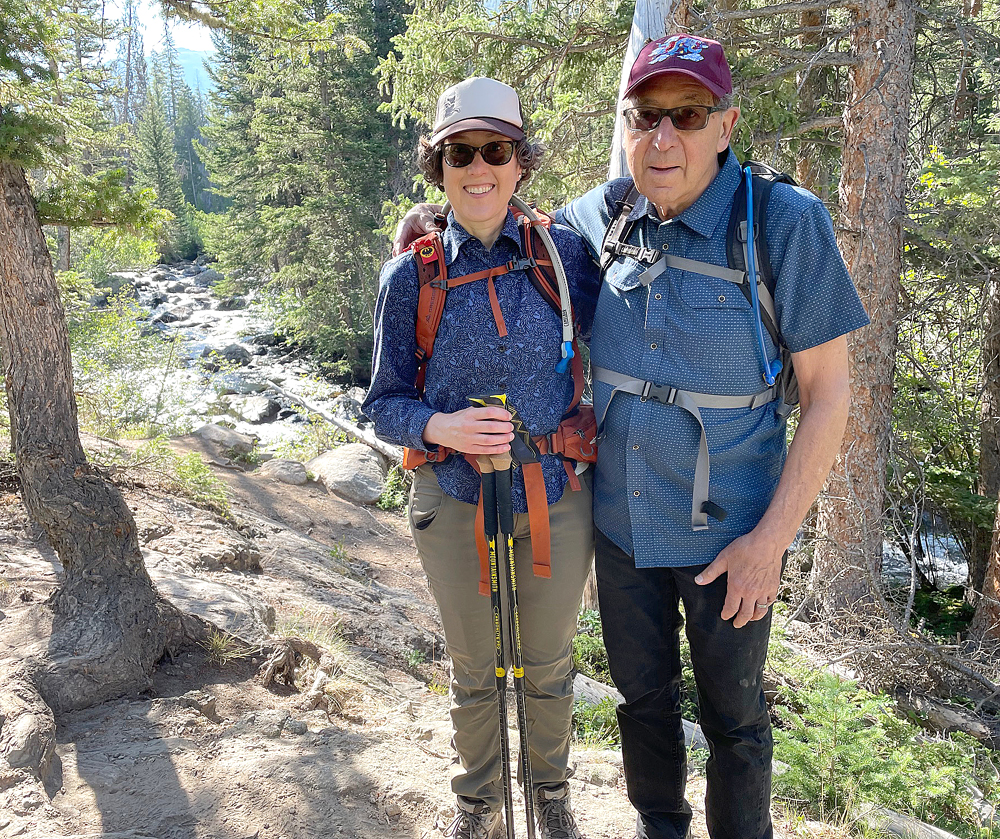
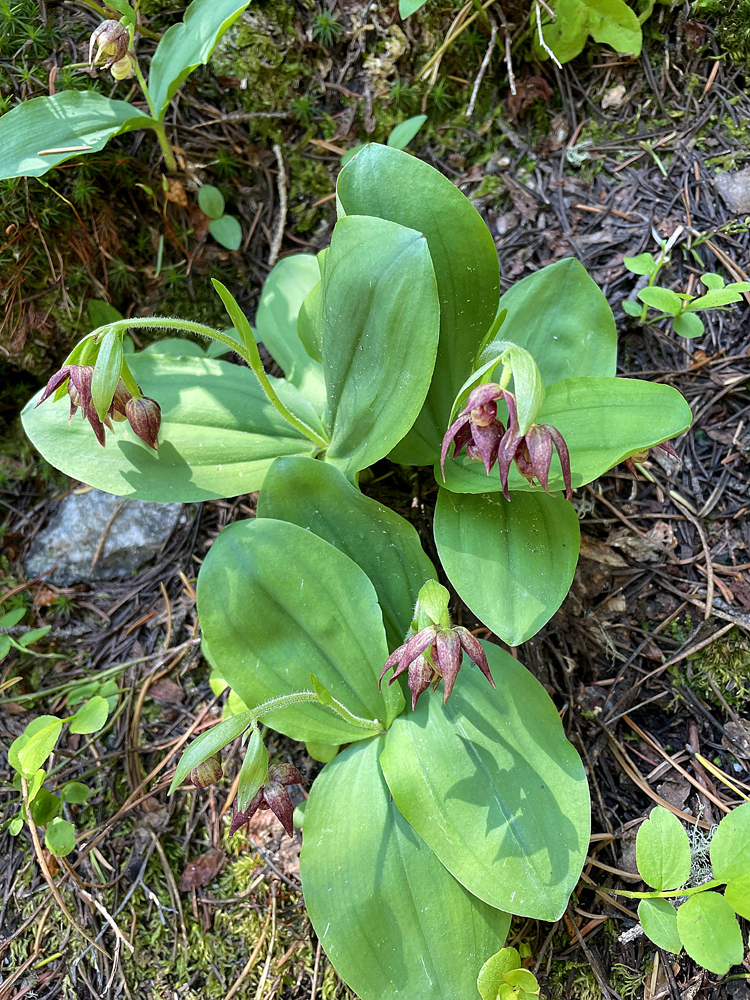
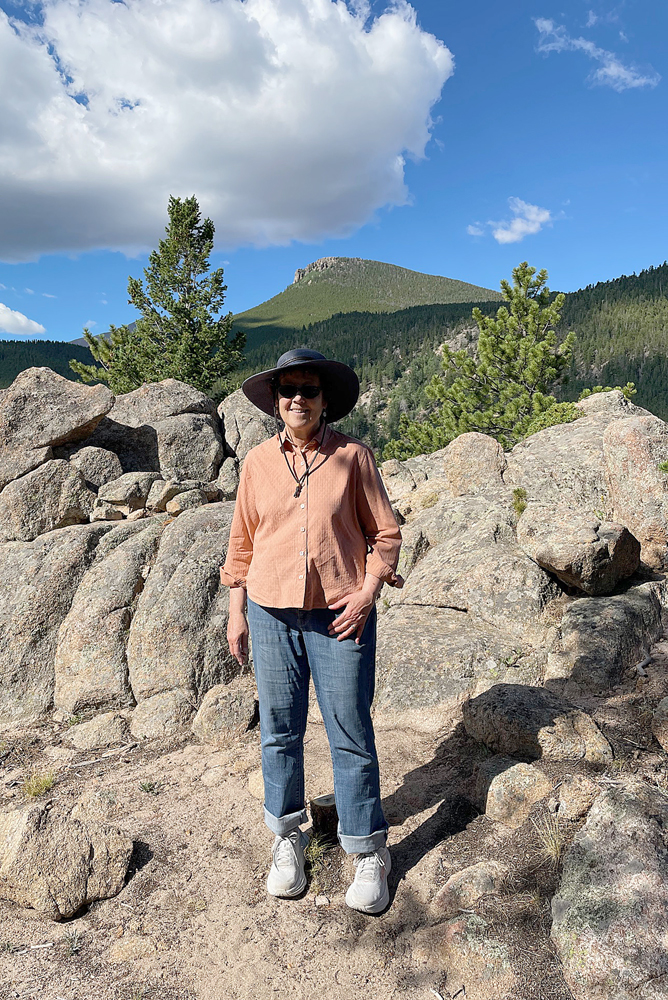
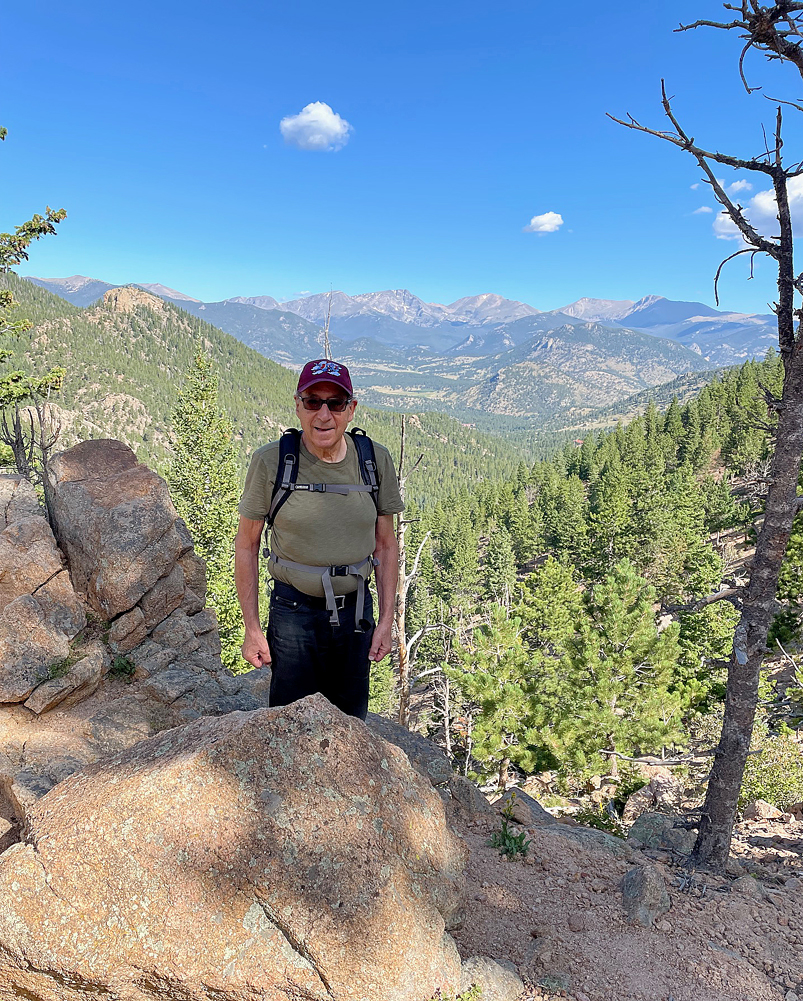
In the heat of summer here on Blue Mountain Road, we’ve taken a few excursions to hike in the high mountains. In July, the flowers were blooming in abundance on the Camp Dick trail. Bud, Zoë and I discovered this sweet orchid, previously unknown to us, in a damp spot along the path and many columbines.
At the end of the month we traveled over Trail Ridge Road to Grand Lake for a two night stay at the Grand Lake Lodge. I was again struck with the magnificence of the Park, the wide vistas of peaks and forests, the precipitous drop-offs, the cold air up on the tundra. The Lodge is a classic log structure with the requisite western décor – antlers and wildlife paintings, a stone fireplace, rocking chairs, and swings on the porch. The comfortable cabins have been refurbished but are still small, surrounded by trees and wildflowers, with lovely views of the lake. We hiked at Adams Falls along meadows and through shady forest.
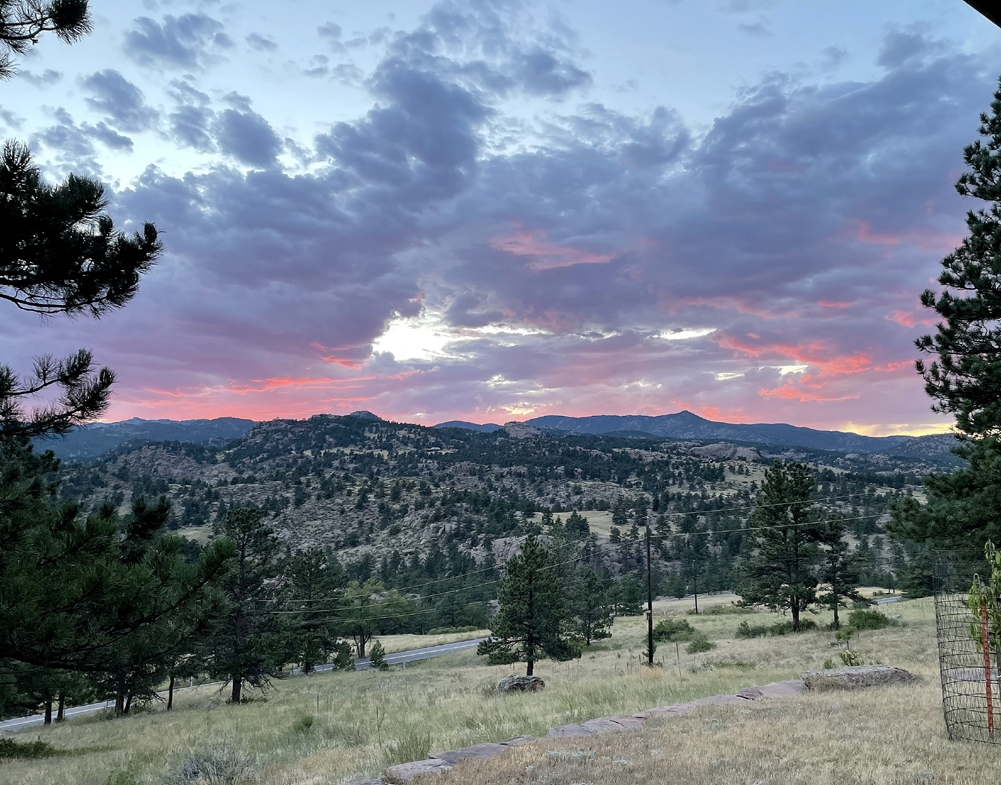
As we drove back home over Trail Ridge we saw a huge cloud of smoke to the north from the Alexander Mountain fire burning west of Loveland. We arrived home to a smoky valley. Zoë was concerned about one of the Fort Collins Natural Areas threatened by the fire and headed home.
Later that day we began to get word of another fire burning to the east of us, two ridges over, the Stone Canyon fire. I blithely spent the day preparing for my weekly writing group until, part way through the Zoom meeting, Zoë called and said, you need to pack and leave, the fire is too close. You’re a quarter mile from the evacuation zone. I was in a tizzy. We had planned for what we’d do in such circumstances but for a moment I was immobilized. I can’t do this, I thought. She said, I’m on my way.
Zoë arrived focused on convincing me we must evacuate. I resisted but we soon began checking our list and packing up. Of course, some of the things we had thought important to take seemed silly, but we gathered them into the cars. We’ll revise our list later, for the next emergency. The big project was unhooking the computer setup in the studio. We decided to take all the parts, monitor, keyboard, mouse, CPU, everything. We put inventory books and other papers in crates and headed to Fort Collins where we would stay with Zoë. By the time we reached her home it was past ten. We were all beat.
Our daughter is a great host and we felt safe and comfortable with her. In the morning she went off to work and we settled in to our books, constantly checking to see the status of the fire threatening Lyons. When Highway 36 reopened I figured we could get home so after dinner with Zoë we headed to Lyons. At the bottom of Blue Mountain Road the sheriff had set up a roadblock. No one could enter. But we live only a half mile up, I pleaded. We’re not in the evacuation zone. No luck. What to do now. I lost it for a minute and couldn’t face the hour drive back to Zoë’s. I called Sherry. She said, come. Our wonderful friends took us into their beautiful home in Boulder for the night.
Now the fire is out, we’re home, we’ve gone on hikes, I cook, back to normal. It will probably happen again and I’ll temporarily freak out. But we know we can do it, we know how long it takes to pack the basics. I feel grateful to the firefighters and sad for those who were more directly in the fire’s path. This was a drill for us, a practice and we did it.
The smoke is gone but it’s been very hot so my cooking is minimal, salads, grilled fish, pizza. Here are some summer recipes for you to try.
This zucchini pizza recipe is minimally adapted from The Smitten Kitchen.
Zucchini Pizza
For the pizza dough, combine 2 cups unbleached flour (I put a heaped tablespoon of wheat germ in the cup before measuring the flour), 1 teaspoon salt, 1 teaspoon instant yeast, 1/3 plus 1/4 cup water, 1 tablespoon olive oil. Stir into a moist dough and then knead until smooth. Place in an oiled bowl and let rise until supper time. The longer the better. I make this in the morning and let it rise all day. Punch down when necessary.
Coarsely grate a pound and a half of zucchini and yellow squash (3-4 medium sized) in the Cuisinart or on a box grater. Sprinkle with a teaspoon salt, toss and let sit in a colander for half an hour. Place in a cheesecloth or light kitchen towel and squeeze the water out. In a bowl, toss with 6 – 8 ounces of coarsely grated Gruyere and a big pinch of red pepper flakes. Pat dough into an oiled 9 x 13 inch sheet pan. It will be thin. Spread squash mixture evenly over the dough. Bake at 500° for 20 – 25 minutes until brown and bubbly.
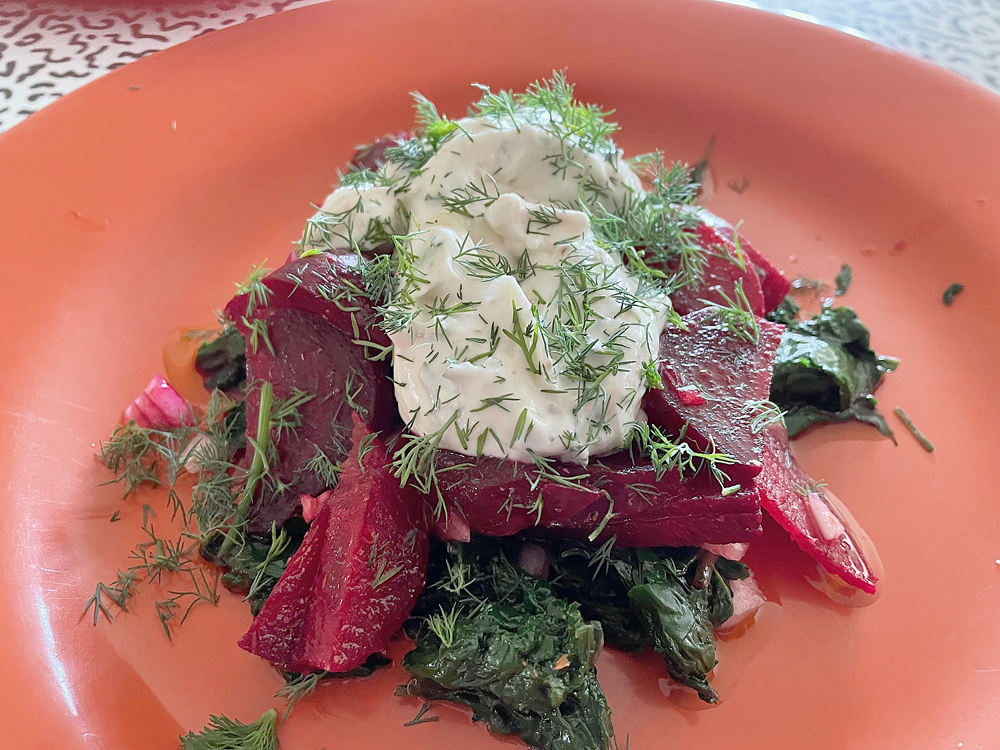
Another favorite during this hot summer is a beet and greens salad adapted from a NYTimes recipe.
Beet and Greens Salad
Steam or roast 3 medium sized beets until tender. After they are cooked remove from pot and use the steaming water to cook the beet greens you have washed, and cut into 1 inch ribbons. Drain the greens and when cool squeeze out the water. Arrange on a serving dish or on individual plates as I did here. Sprinkle with a half of the vinaigrette. Peel the beets and cut into ½ inch chunks. Toss with the remaining vinaigrette and arrange on the greens.
The vinaigrette: Combine ¼ cup red onion or shallot, diced, a clove of garlic, grated, 1 ½ tablespoons red wine vinegar. Leave for a few minutes then add ¼ teaspoon ground cumin seed, ¼ teaspoon ground coriander seed, a pinch of red pepper flakes and 3 tablespoons of olive oil. Salt and pepper to taste.
Top beets with a dollop of yogurt sauce: 1 cup whole plain yogurt, a grated garlic clove, ¼ teaspoon ground cumin seed, ¼ teaspoon ground coriander seed, a tablespoon of finely chopped fresh mint, a pinch of salt.
Strew the salad with chopped fresh dill. Enough for 2.
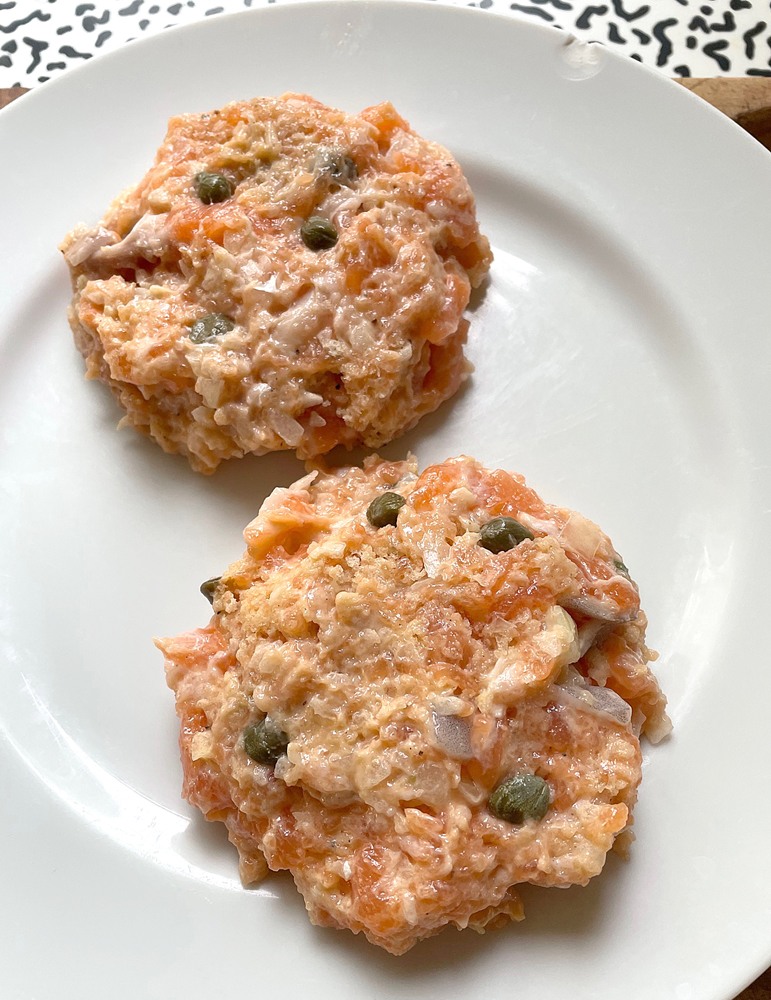
And lastly, a dish I’ve made every week, sometimes twice. Salmon cakes/burgers from Mark Bittman in the NYTimes. I’ve served these with a salad and as a burger on a bun. So good.
I forgot to take a photo of the grilled burgers. Too eager to eat them.
Salmon Burgers/Cakes
For two cakes skin a ½ – ¾ pound piece of fresh salmon. Chop 1/3 of it and puree in the Cuisinart with a generous teaspoon of Dijon mustard and a ¼ cup chopped onion. This acts as a paste. Add the rest of the salmon cut into 1 inch pieces. Pulse a couple times but don’t puree, you want small chunks to remain. In a bowl, combine the salmon with a tablespoon of capers, 2 tablespoons panko and a pinch of salt. Form into two cakes and refrigerate until cooking time. Grill for 2-3 minutes a side or pan fry in butter.
Lost in quiet contemplation, the shouts from the head gardener knock me out of my reverie. “What are you doing down on your hands and knees, staring at the ground? Have you lost your wits? What’s going on, we have serious weeding to do. The vitex needs pruning. There are thousands of mimosa seedlings everywhere. When will we get rid of those nuisance trees?!” I’m looking at her as she delivers her diatribe, amused, but trying to look castigated and ashamed, like a child whose hand is caught in the cookie jar.
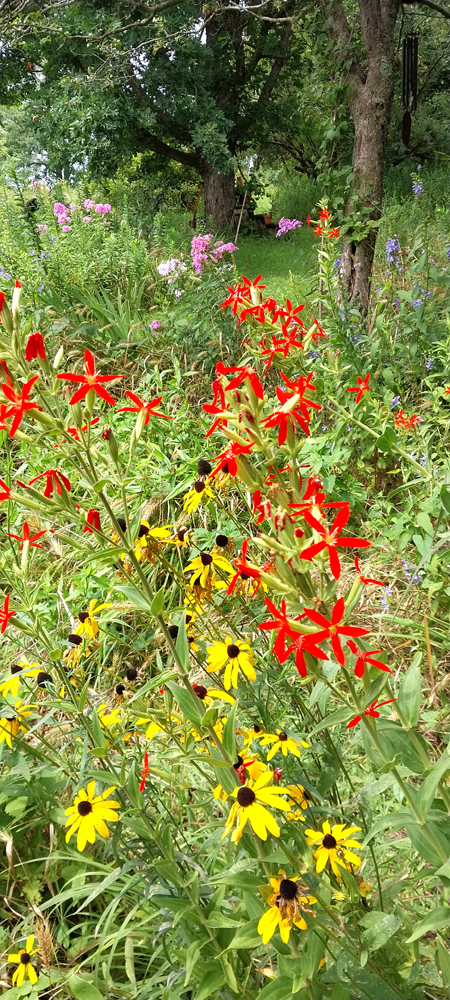
Royal catchfly
I’m doing what I’ve watched many people do as a way to relax, breathe deeply, and let everything float away, a mindless task. For my dad, it was looking for four-leafed clovers. He’d be down on all fours, looking, and always find one maybe two or three. We’d come home from school and find Mom sitting peacefully on the sofa, doing absolutely nothing.
American bellflower – a favorite
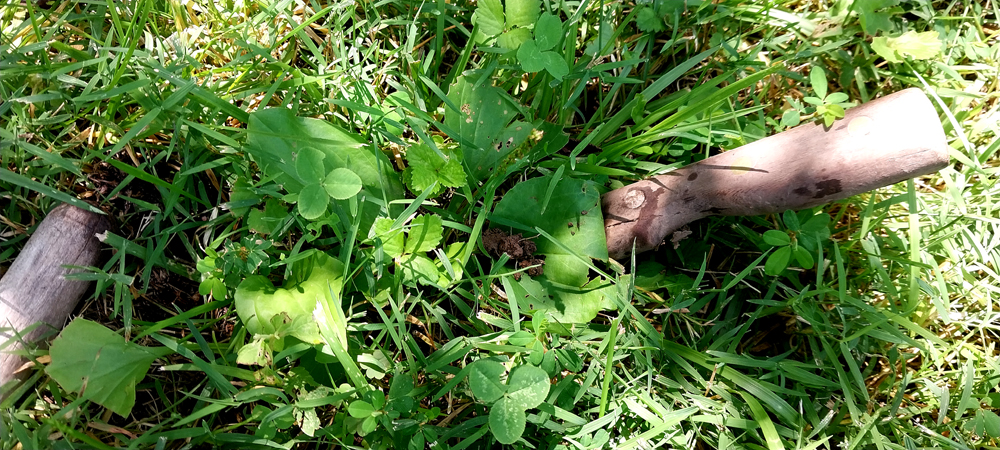
For me on the morning the head gardener found me, I was digging out plantain, the broad-leafed weed the English brought to America. Granted it’s a medicinal plant. I’ll chew a leaf when I get in the way of a wasp and get a nasty sting or when I run my arm through a blackberry bramble, eager to get that juicy berry in the middle of the canes and have a bloody mess. I want to have a few select plantains around.
Longfellow talks about plantain in Hiawatha, calling it the white man’s foot. Everywhere the English stepped they left plantain in their wake. Because it’s a broad-leafed weed, nothing else will grow where it does. When I walk the maze of our gardens, I’ll notice plantain in all the paths. It’s been so wet this summer that I found I could bend over and pull out a plantain, effortlessly. I feel like a kid when I’m doing that, erasing the white man’s foot print. When I find a colony of six or more I kneel down to do the job. I carry an old butcher knife with me in case I encounter stubborn weeds and sometimes the grandmothers need convincing, their fibrous roots firmly established. The seed heads look like miniature cattails. Eunice, a crabby older friend from our early days, used to cuss at the seed heads and call them those “dratted weeds”. She took personal affront at their appearance and Ron would get out her lawn mower and cut them down. Her mood changed immediately and she became demure and sweet until the next offender assaulted her. Believe me, it could be anything!
Hibiscus
I stood up, looked at the head gardener as all kinds of explanations rippled through my mind, but I know her, know how she’ll react and knew if I started philosophizing, which I love to do, she’d go into a tail spin. So, instead, I said, “Shall we get on with it?” And we did.
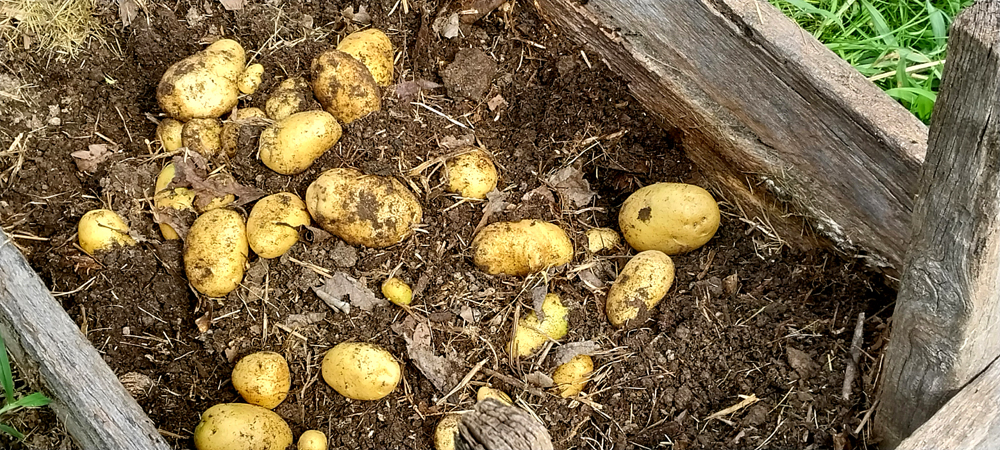
As we weeded, lifted the potatoes out of the straw, marveled at the beautiful summer kale, and admired the palette of color everywhere we looked I thought about how I’ve learned to love cantankerous people and even appreciate their take on this crazy world.
We never know everyone’s full story and my joke is, it’s always hemorrhoids that turns us into monsters of sorts. (I still remember that from giving birth.) We need each other even when we drive each other crazy. Always good to have a friend, or a professional, to help us see the light and navigate troubled waters.
Blackberry lily
No doubt the gardens, working with the earth, give me great pleasure and comfort. I eat simple summer meals, the heat making it unpleasant to make a fire for any longer than cooking a grain, roasting a few peppers or an eggplant, a patty pan squash. Soon I’ll have beans.
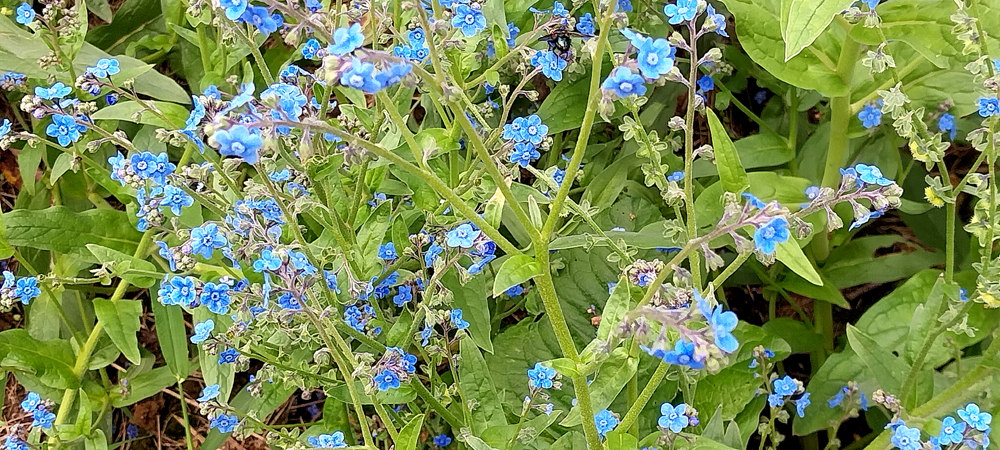
Forget-me-nots for Dad
I sit on the summer kitchen when the sun’s in the west and look out at the colors enticing the pollinators. When it cools down enough, I walk the paths, picking and admiring the jungle-like growth as a new batch of pipe vine swallowtails flit in and out, dazzling me again and again. And if you see me bending down, you know another foot print has disappeared.
Pipe vine after feeding pipe vine swallowtail caterpillars
Bud, Zoë and I set off on a road trip to visit Mimi on Straw Dog Farm in central Missouri. I dreaded driving across the flat, empty plains of eastern Colorado and western Kansas but of course, we discovered they weren’t empty at all. There were flat, straight sections on I-70 that made it hard to stay awake but we also encountered unexpected things to see. We drove through Post Rock country where, lacking wood for fence posts on a treeless prairie, early settlers had quarried limestone posts and strung them with barbed wire. The posts are weathered and irregularly shaped, fascinating. We finally got some elevation as we passed through the Flint Hills, a preserved tall-grass prairie stretching for miles of glorious rolling green hills.
We planned a midway stop in Salina Kansas, six and a half hours from home. I had booked a table at a restaurant that I hoped would suit us – Yaya’s Bistro. It did. We had a lovely meal of Mediterranean flavored food. We looked forward to returning for dinner on our way back home in a week.
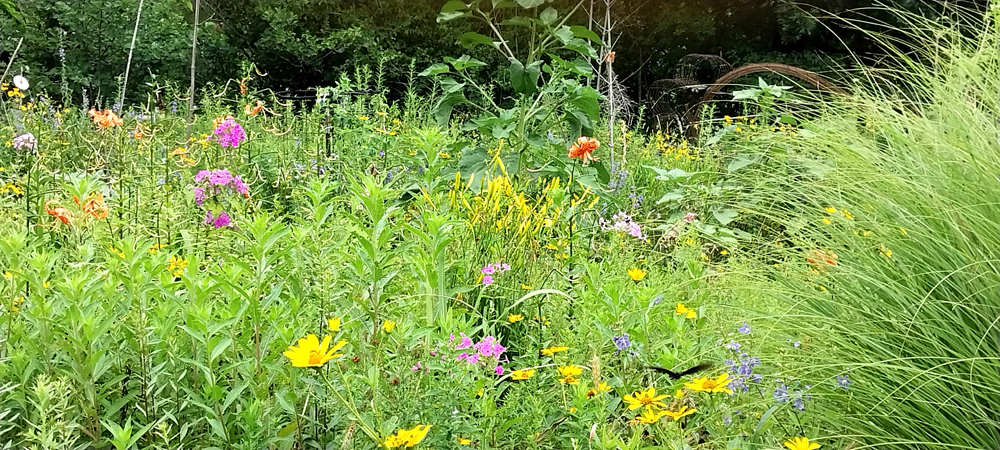
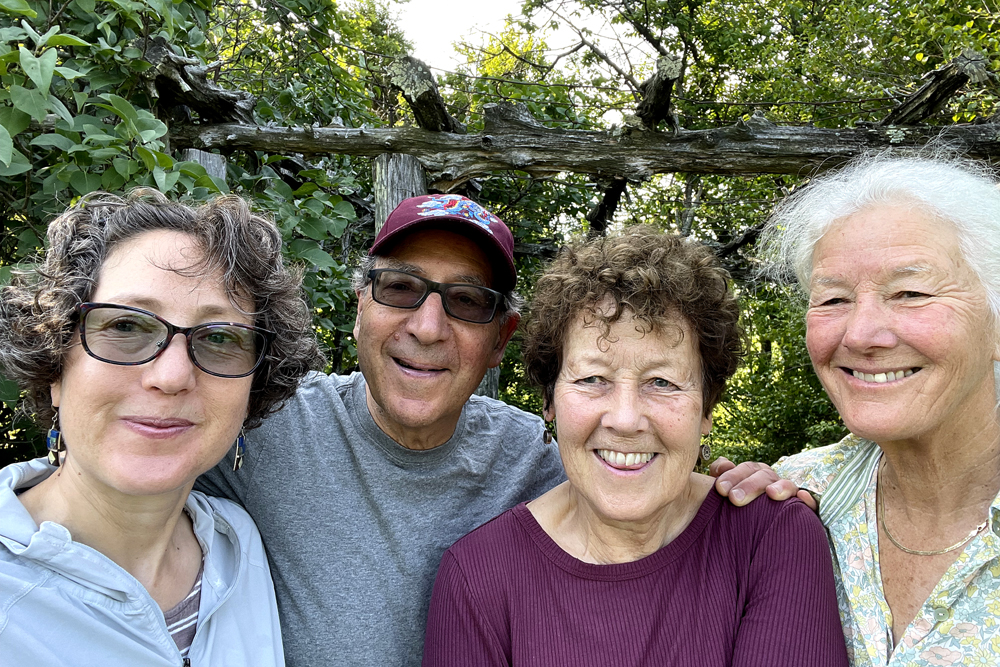
Mimi welcomed us at the trellis marking the entrance to Straw Dog. We got settled in the house then had a walk in the gardens. Everywhere wildflowers attracted butterflies, moths, bees and other pollinators. She told us that many local folks consider these plants weeds. They don’t recognize that she has cultivated a paradise of native plants where the bugs and other critters thrive.
We walked the mown paths beside meadows of wildflowers buzzing with activity. We admired the thoughtfulness with which Mimi has organized her cultivated garden beds, letting a bit of chaos reign as the plants have their way.
Black cohosh blooming amid skullcap.
Zoë noted that the once bare acreage she remembered from her last visit as a college student now has many mature trees. Sweet gum and redbud, sassafras and dogwood and many other trees foreign to our arid Colorado foothills. Much has changed in the forty two years Mimi has worked this land.
We cooked together using the bounty of the gardens. Peas, asparagus, herbs, lettuce, berries. Mimi made her delicious flour tortillas on the wood stove top in the summer kitchen. We ate bean and veggie burritos for Zoë’s birthday dinner.
A snack on the summer kitchen.
We had a lentil curry, watermelon and feta salad, spring rolls with three sauces, and day lily salad. Zoë and Bud prepared handfuls of orange day lilies by pulling the petals from the stamens to make a beautiful salad dressed simply with olive oil and vinegar. The taste was magical, crisp and vegetal. After that first salad, Zoë insisted we add day lilies to each meal. I thought of how the deer love them too. Here on Blue Mountain Road I dare not plant them.
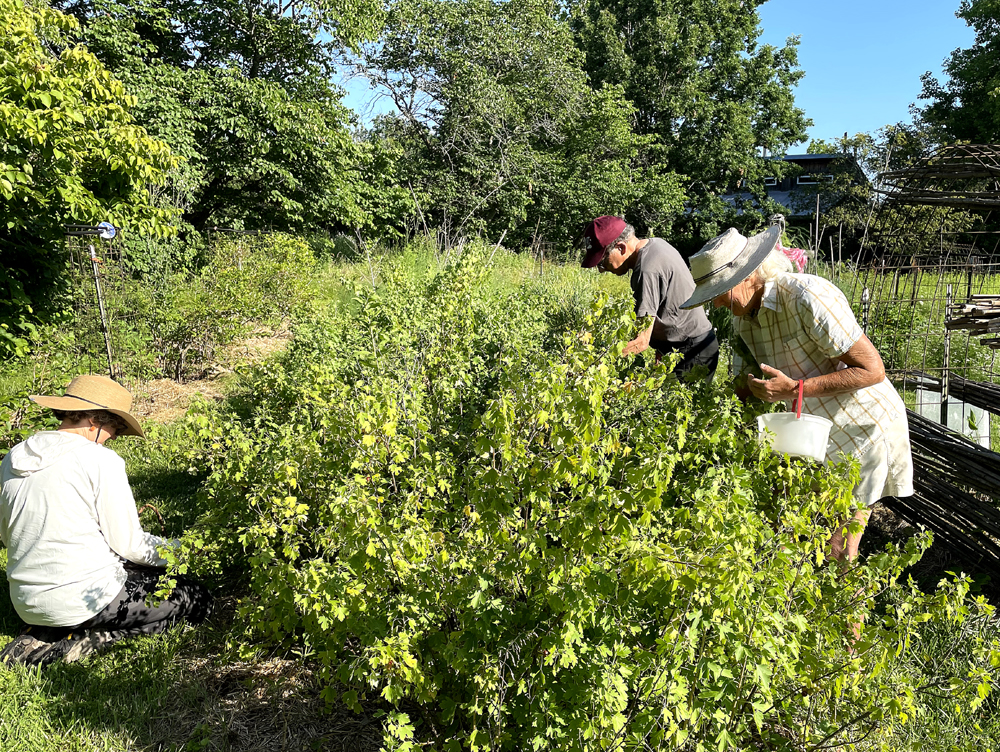
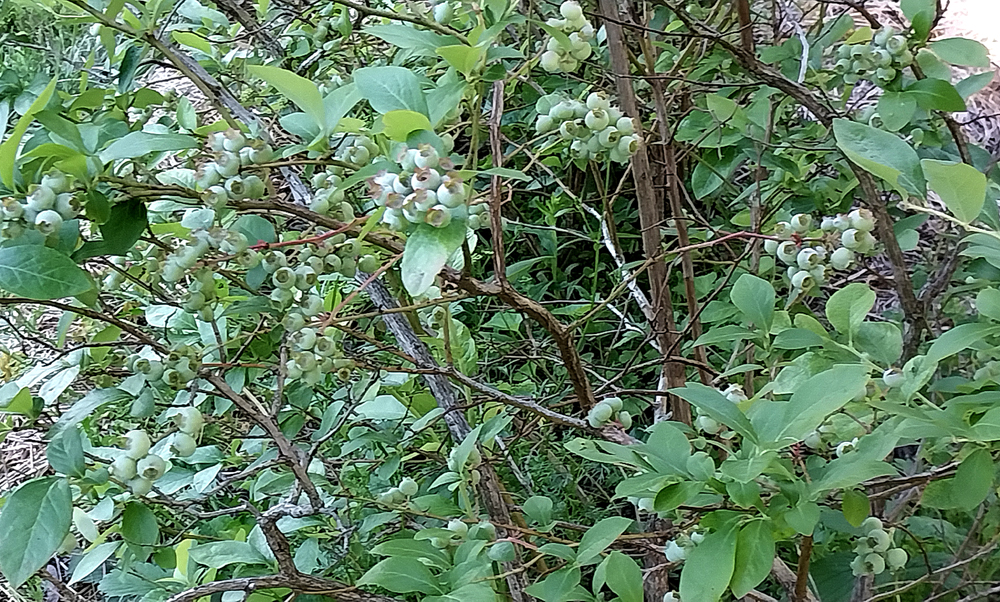
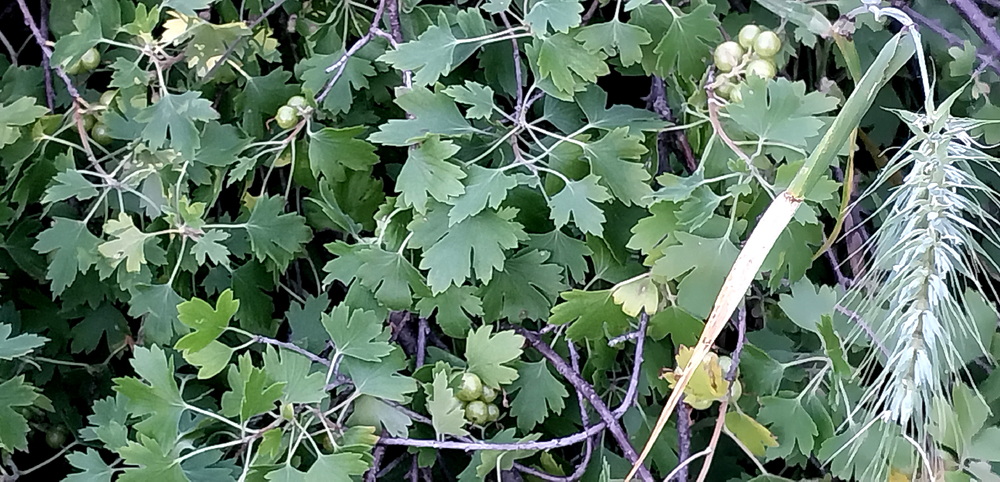
The blueberries, raspberries and black currants were producing masses of fruit so we picked berries each morning. And ate them. Mimi cooked a mess of currants and made a black currant fool. After cooking she passed the berries through a sieve/colander with a wooden pestle then combined them with sugar and whipped cream – an English recipe from Elizabeth David. So good.
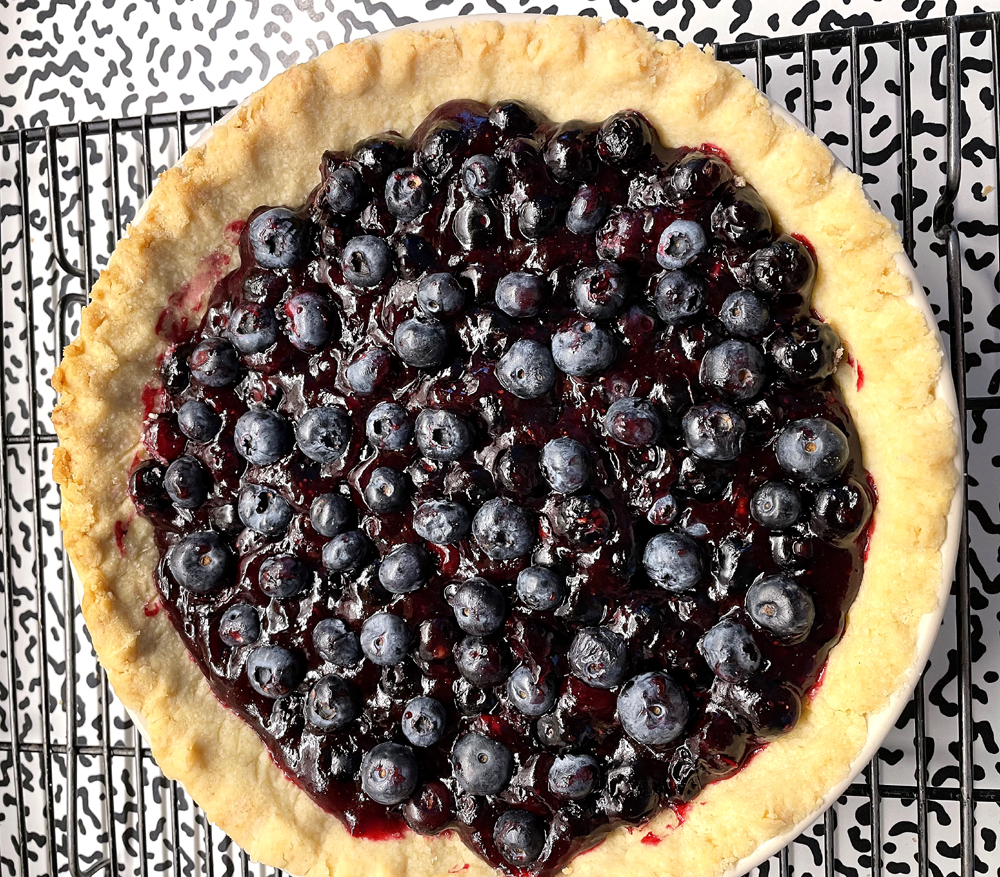
Mimi sent us home with two quarts of blueberries and a recipe from her friend Jesse who had it from a Benedictine monastery in Vermont. I adapted it a bit.
Blueberry Tart
Prepare a tart shell. I used my favorite based on one from Patricia Wells. Combine 1¼ cups unbleached flour, ¼ cup sugar, pinch of salt, 1/2 cup melted butter, cooled. Press dough into tart/pie pan and chill while the oven heats. Bake at 375° for 20 minutes until brown and cooked through.
For the filling:
5 cups fresh blueberries, 1 ½ tablespoons cornstarch, 2 teaspoons finely grated lemon zest, 3 tablespoons fresh lemon juice, ½ cup sugar, pinch of salt
Reserve 1 cup of the prettiest berries for the topping. In a medium saucepan, bring ¼ cup water and 1 cup berries to a boil over high heat. Reduce heat, simmer, stirring occasionally, until berries begin to break down (3 to 4 minutes). In a small bowl, mix cornstarch with 2 tablespoons water. Stir into berries in pan. Add lemon zest and juice, sugar and salt. Bring to a boil then reduce heat. Simmer, stirring, just until mixture begins to thicken (30 to 60 seconds). Remove from heat. Stir in remaining 3 cups fresh berries.
Immediately pour hot berry mixture into cooled tart shell and smooth with a spatula. Scatter reserved berries on top, pressing down lightly to help them adhere. Refrigerate until cool.
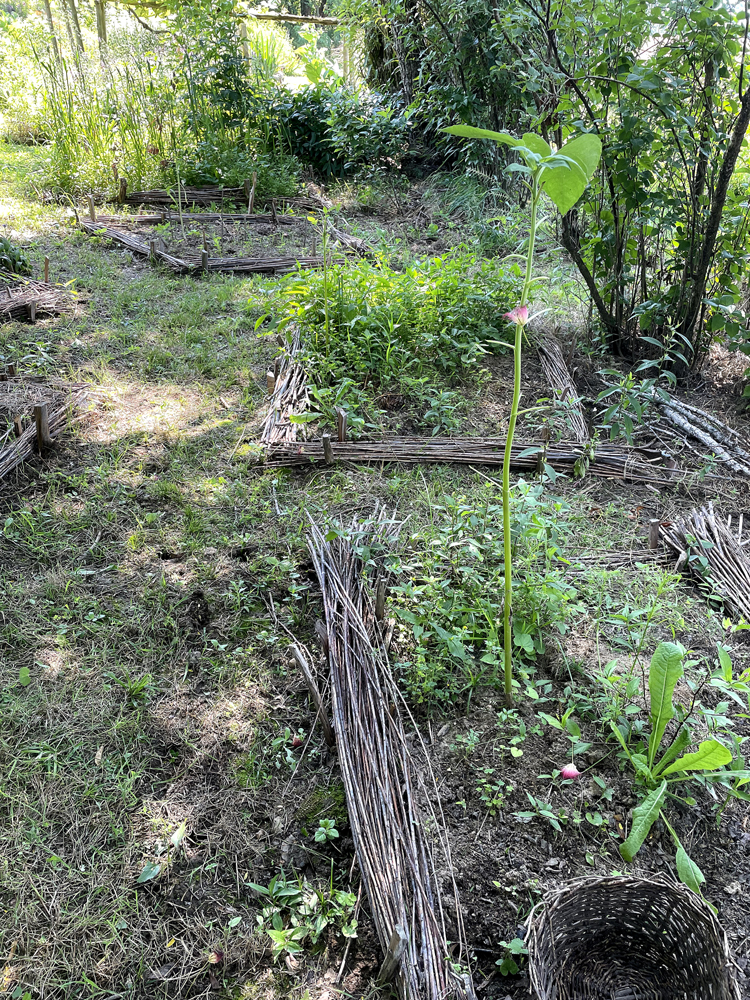
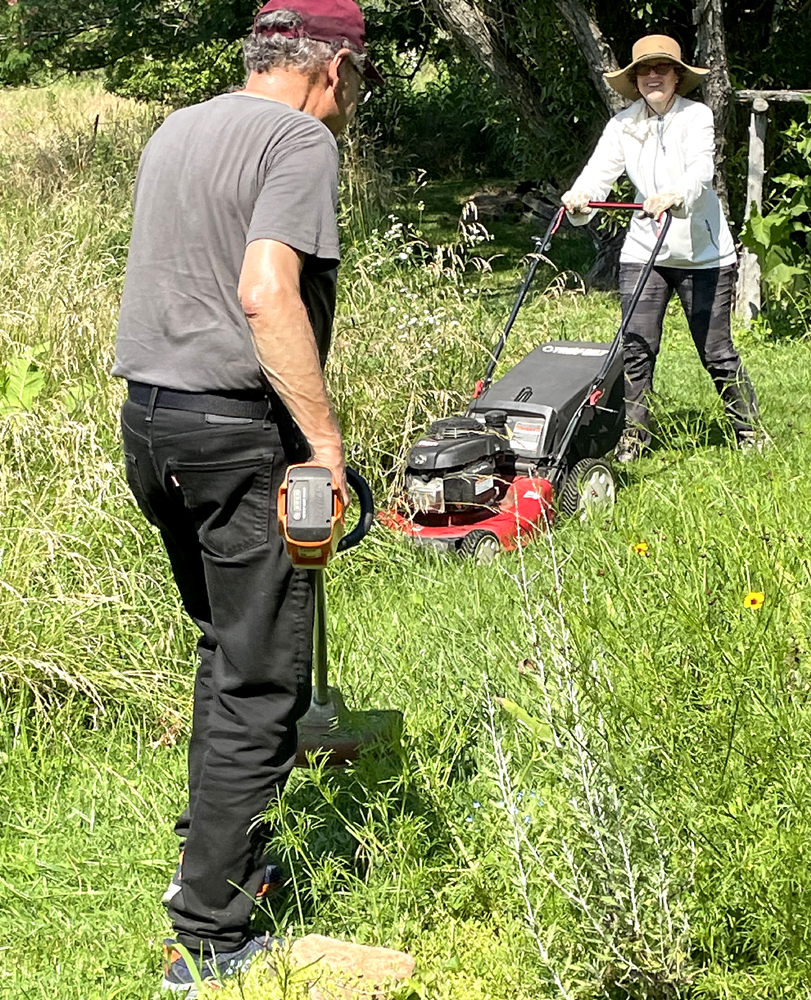
One morning we helped mow the paths in the park. Here are pictures of the beds Mimi lined with old letters, before and after, now filling with volunteers until she decides what to plant.
Newly prepared bedsBeds with volunteers
I took a break and tipped off the end of a bench into an ant pile. Ouch. I jumped into the shower to dislodge the tiny critters feeling very foolish.
Each day on the farm I noted my sister’s serene attitude to everything around her. She observes the pace of life on the farm, the weather that determines what grows when, and the unexpected – the seeds that suddenly sprout, the patch of native plants that become a thicket. Mimi takes such pleasure from all the things she sees. I learn a lot about expectations, patience and laughter from my sister. She lives a simple, rich life full of wonders. Thank you for a wonderful visit.
Would you laugh at me if I told you planting a garden in spring is like conducting a symphony? A symphony composed by Mother Nature. I follow her cues, sowing seed or planting plants when she deems it the proper time. I’ve never thought about the garden in quite this way before. Somehow all the staging that takes place when a large garden’s planted, how each piece feeds into the next, made me see this comparison.
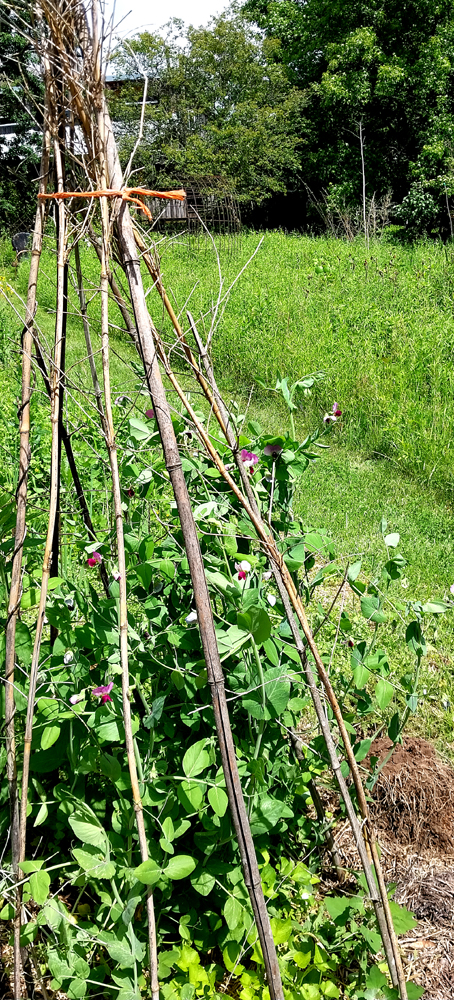
Dwarf grey sugar promise
My symphony doesn’t follow the usual order of sonata, adagio, scherzo or minuet, and then the rollicking finale. The opening of this symphony begins slowly with an adagio on Valentine’s Day and the sowing of lettuce seed when all seems calm and possible; the arrival of the hopes and promises newly imprinted on our winter weary minds. With the cool weather, planting seems leisurely. We walk around as if we own the world. Neither the head gardener nor I feel the pressures that will come. The Irish potatoes go in on St. Patrick’s Day, peas too with their bamboo teepees. Still dressed in winter clothes we exude confidence, smiles come easily. Greens and brassicas follow soon thereafter. Everything takes their turn. We rest. We weed. We think about summer. The conducting seems gentle.
Blueberries beginning to ripen.
After weeks of little activity, the temperature rises and Mother Nature insists the sonata begins. All hell breaks loose. The warm weather crops shout for immediate attention. Everything feels tired of sitting under the lights, their roots feel bound in pots. The tomatoes especially want to go into the deep earth. Peppers and eggplants want to see and feel the sun. The head gardener and I make frantic looks at each other. She complains I move too slowly. I scowl at her. We run into each other’s wheel barrow. And the conductor waves her baton in grand gestures.
Black currants luxurious.
I used to make gigantic pushes to get these crops planted in a few days. Everything from tomatoes, eggplants, peppers to melons and squash of all kinds, then beans of many colors to herbs and flowers.
Yes, I’d feel exhausted after this push, but my body recovered quickly, and I didn’t see the work as anything other than what I did. Now I see it as heroic. My eyes bug out when I watch young people do magic in moments and think, ”that used to be me”. I have a message in front of old journals, reprinted spring after spring. In bold, capital letters: DO NOT PANIC. IT’S SPRING. IT TAKES SIX WEEKS TO GET EVERYTHING UNDER CONTROL. Now, I would amend that pronouncement. I wouldn’t use bold or capital letters. I’d make no guarantees. Six weeks? What a laugh. I might say something like, “All in good time. Relax, enjoy your good fortune.” And my sonata now seems more like an adagio.
Southern arrowwood adorned.
In fact, my entire symphony may seem more like a prolonged slow, lyrical movement. I can’t follow protocol anymore. Or, like Ron, choose not to. When we went to Hilary’s graduation from the Naval Academy, Ron wore his Marine Corps dress blues for the ceremony. He felt proud that the uniform still fit. He had a pony tail and a mustache. Commanding officers came up to him to shake his hand after looking at his medals and ribbons, realizing he’d been in Korea. One of the officers motioned to his mustache. Ron looked at him and smiled, “Age has its privileges, sir.” And the officer laughed and smiled back.
This May, when I came to the part of the symphony when the beans moment arrived, I sat on the summer kitchen with our bean seed collection, a bowl, and the compost bucket. I felt nostalgic looking at the dozens and dozens of varieties we’ve grown over so many years. A few names: Molly Frazier Cutshort, Foot-long Green, Purple Yard-long, Christmas Lima, Dixie White Butter Pea, Greek Gigante, Goat’s Eye.
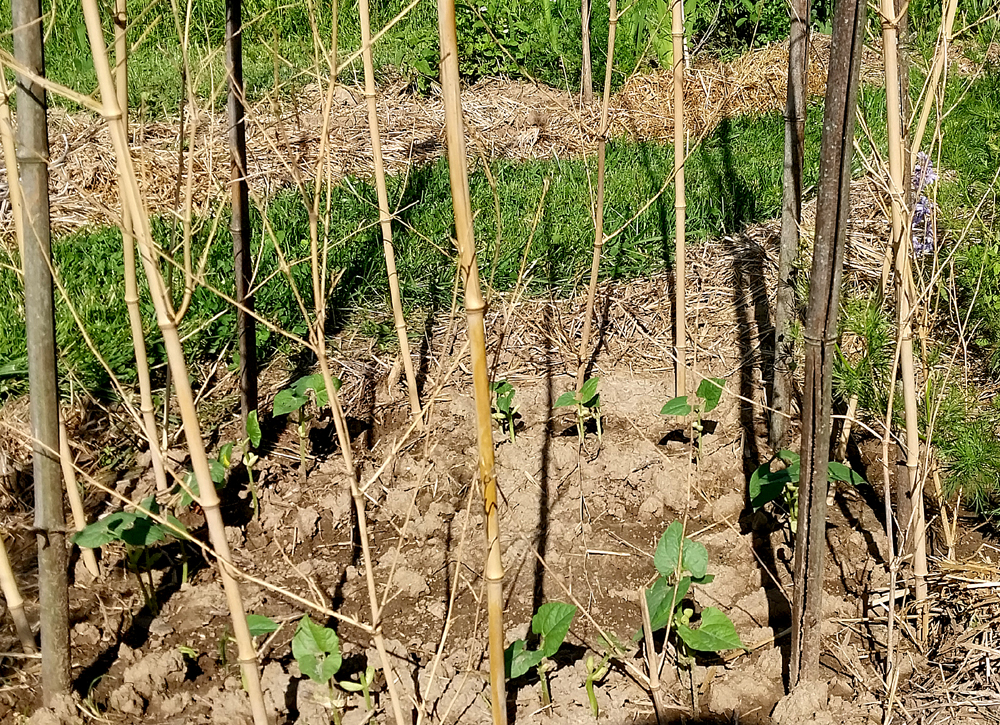
Anasazi beans sprouting.
Any seed not grown out for eight years went into the compost bucket. I knew they’d germinate for me, but for the average gardener who uses fast-acting yeast and wants immediate gratification, I knew it would be frustrating to wait and wait for the seed to germinate, so no sense taking them down to the seed bank at our local library. The compost has an insatiable appetite and as I dropped the seeds into the bucket, it felt like a gentle offering to the earth. I wasn’t throwing them away, I was giving them back to where they came from. The newer seed went into the bowl. These seeds would feed my body. A last hurrah for them. I had them with lamb’s quarters. Beans and greens, a favorite on Strawdog. There are still six or eight favorite varieties like Borlotti and Anasazi that we’ll keep going as long as the conductor still conducts.
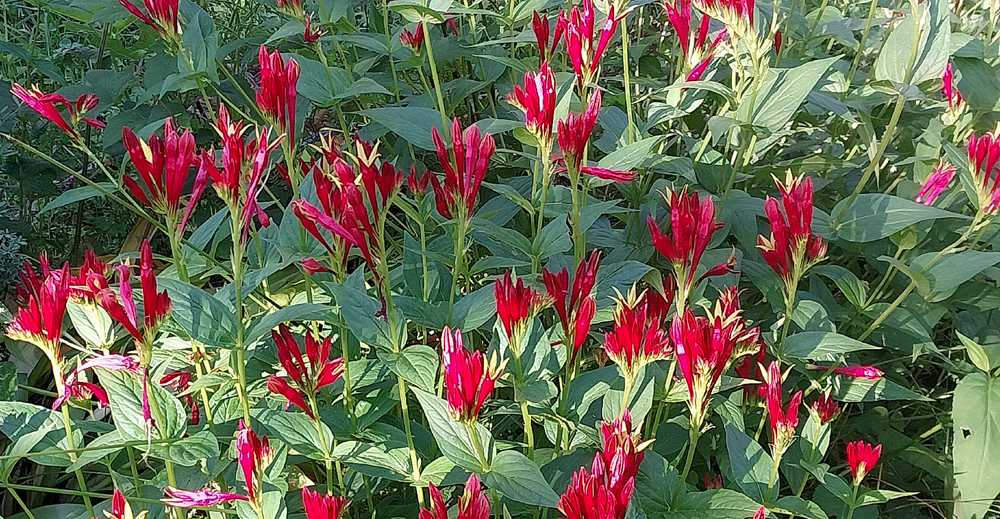
Indian pinks in morning light.
Each day the music continues, a slow minuet rather than a scherzo. Finally the day arrives when the finishing touches, the herb and flower seeding begins, tying all the crops together with their beauty, fragrance, so that I and the head gardener feel stimulated. The enticing nectar and pollen activate the pollinators and their work for successful fruiting. The seed packets, bags of seed that have waited on trays have now found their way into the warm earth. The symphony’s rollicking finale.
Pale purple coneflowers open.
With a sigh of appreciation and relief we rest over Memorial Day weekend and at least one of us bows her head in memory of all that came before. The other one is plotting and scheming what will come next. It feels wonderful to collaborate with Mother Nature and to watch each seed pop out of the earth, bear fruit over the summer and then seed in the autumn. The symphony continues. No conductor needed.






































 How I Learned to Cook, an Artist's Life ─ Barbara Shark